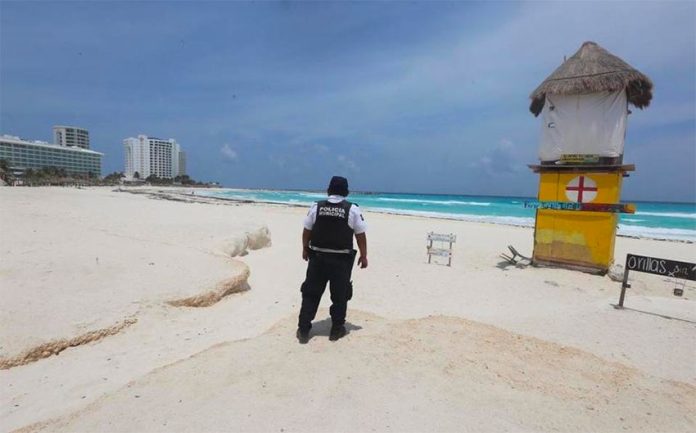
A police officer patrols an empty beach in Cancún. The state hopes they won't remain empty for long.
Tourists could start returning to Quintana Roo as early as June 8 if the state’s governor gets his way.
Governor Carlos Joaquín González says tourism is an essential business in his state, and he will fight for the federal government to classify it that way.
He is hoping for hotels to get back to work internally on June 1 and prepare their facilities and employees for reopening between June 8 and 10 if he receives permission from national authorities.
The governor had previously announced that the state’s hotels, including resorts in popular Cozumel, Cancún and Tulum, would reopen to the public on June 1 but rescinded that date as the state still has significant levels of coronavirus contagion.
In a virtual meeting with the National Conference of Governors and the National Tourist Business Council yesterday, Joaquín said that Quintana Roo has lost around 80,000 jobs due to the coronavirus pandemic and that reopening to tourists will allow the state to begin its economic recovery.
Joaquín said that more than 1,600 companies have signed up for training to acquire a health certificate issued by the state government which is thought will encourage travelers to return.
The governor urged residents to keep up social distancing and other coronavirus measures so the state can reopen as planned.
“The main objective is for businesses to be prepared to return to activities on a still unspecified date in June,” said Tourism Minister Marisol Vanegas Pérez earlier this week.
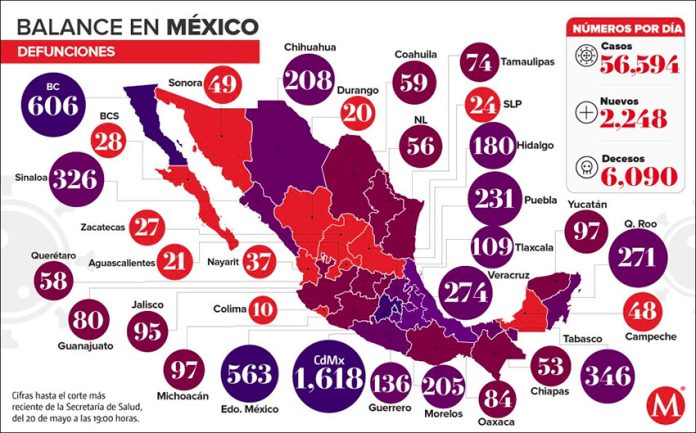
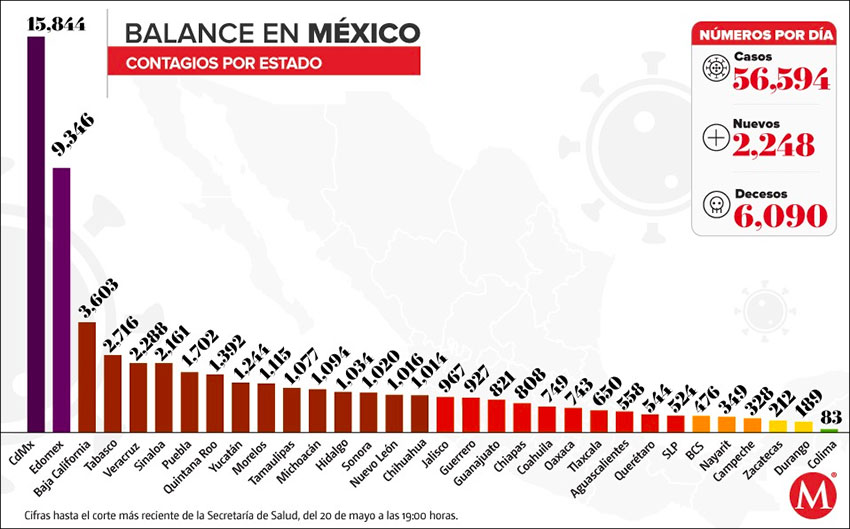
The announcement comes as the state has registered 1,392 confirmed cases of the coronavirus and 271 deaths as of Wednesday.
Coronavirus deaths by state as of Wednesday evening.milenio
The federal Health Ministry reported a new daily high of 424 Covid-19 fatalities on Wednesday, pushing Mexico’s coronavirus death toll past 6,000.
Director of Epidemiology José Luis Alomía said that there have now been 6,090 confirmed Covid-19 deaths since the start of the pandemic. Yesterday’s daily death toll is 20% higher than the previous record of 353 reported on Tuesday last week.
Alomía said that an additional 726 fatalities are suspected of having been caused by Covid-19 but have not yet been confirmed.
He also reported 2,248 new confirmed cases of the disease, lifting Mexico’s cumulative case tally to 56,594. The Health Ministry has reported more than 2,000 new cases on each of the past seven days.
Of the total number of confirmed cases, 12,085 are considered active, Alomía said. There are also 31,866 suspected cases across the country, while 193,589 people have now been tested.
Accumulated cases of Covid-19 as of Wednesday.milenio
National data presented at Wednesday night’s coronavirus press briefing showed that 39% of general care hospital beds set aside for patients with serious respiratory symptoms are occupied while 32% of those with ventilators are in use.
Occupancy levels are much higher in Mexico City, where 72% of general care beds and 60% of beds with ventilators are in use.
The capital, Mexico’s coronavirus epicenter, has now recorded almost 16,000 confirmed coronavirus cases and 1,618 deaths. However, a recent analysis of death certificates issued in Mexico City between March 18 and May 12 found that more than 4,500 deaths were likely caused by Covid-19.
One month has now passed since the government declared the commencement of phase three of the pandemic, a period in which the Health Ministry reported 47,822 new cases, 84% of the total number, and 5,378 deaths, 88% of all confirmed coronavirus-related fatalities.
Despite the worsening pandemic, the national social distancing initiative will conclude on May 30, paving the way for a gradual return to a “new normal” from June 1 on.
Deputy Health Minister Hugo López-Gatell stressed last night that the initiative is not yet over and urged people to continue to stay at home.
Compliance with the social distancing recommendations will allow Mexico to reach the “new normal” more quickly, he said.
López-Gatell highlighted that Cancún, Culiacán and Tijuana are among the cities where new Covid-19 cases are declining but noted that the epidemic curve is still on the rise in Acapulco.
In contrast to Cancún, where the tourism sector is expected to be given the green light to recommence activities between June 8 and 10, there is no reopening in sight for hotels and other tourism-oriented businesses in Acapulco, he said.
“The critical time [of the epidemic] is still a long way off” in the Pacific coast resort city, López-Gatell said.
Guerrero has recorded 927 Covid-19 cases since the start of the pandemic, 519 of which were detected in Acapulco, according to official data.
To limit the risk of Covid-19 infection, the State Workers Social Security Institute (ISSSTE) has adopted a new system to communicate with the family members of coronavirus patients receiving treatment at 112 of its hospitals and clinics.
ISSSTE general director Luis Antonio Ramírez Pineda said that due to the coronavirus crisis, family members will be provided updates about the condition of their hospitalized loved ones exclusively by telephone in order to avoid crowds at healthcare facilities.
As soon as a person is admitted to hospital, family members will be asked to provide a mobile telephone number at which they will receive calls and messages from medical staff at agreed times, he said.
If a patient lapses into a serious condition or dies, family members will be notified immediately, Ramírez added.
While family members are currently not permitted to visit their loved ones in all but exceptional circumstances, Covid-19 patients, if well enough, will be permitted to use cell phones, laptops and tablet computers to communicate with them, the ISSSTE chief said.
The announcement comes three weeks after the México state government distributed tablet computers to family members of coronavirus patients receiving treatment at a hospital in the municipality of Ecatepec. The government took the decision to allow video calls between patients and family members after an angry mob stormed the hospital seeking information about their sick loved ones.
The lineup for a sandwich in the Juárez neighborhood on Tuesday.
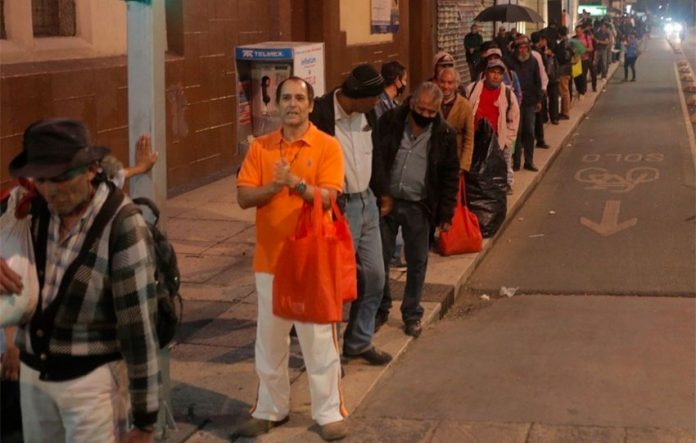
The economic impact of the coronavirus pandemic was on stark display in central Mexico City on Tuesday night: almost 500 people lined up for food prepared by a lay association of the Catholic church.
Approximately 380 men and 110 women lined up on Génova street and Reforma avenue in the capital’s Juárez neighborhood at dusk on Tuesday to receive a chicken or ham sandwich, a piece of fruit and a bottle of water from members of the Community of Sant’Egidio, a Catholic association dedicated to social service.
The association has long provided meals to Mexico City’s homeless but among those waiting patiently for something to eat last night were many people who recently lost their jobs due to the coronavirus pandemic and no longer have any money to put food on the table.
“A lot of people were left without jobs,” said one woman who lost her job as an office cleaner.
As she lined up with her teenage daughter, Linda Sánchez told the newspaper Milenio that she was informed that her services were no longer required as offices emptied due to the pandemic. She has tried to find a new job but has had no luck so far.
Also lining up was Brigida Ricardo Matilde, an indigenous Otomí woman who usually sells handmade dolls on the streets of the capital. However, with few customers about, her sales plummeted and she too decided to stay at home.
“One doesn’t eat like before anymore,” she said. “My kids want a liter of milk and to eat something different every day but they can’t now. We had a little bit of money saved but because we’re not going out [to sell] anymore, it’s gone.”
Among the hungry citizens in a separate line for men was Juan Carlos Martínez, who was laid off from his job at a 7-Eleven convenience store, and Raymundo Hernández, a homeless shoe shiner who is having more trouble than ever finding customers.
Hernández told Milenio that restaurants used to give him food for free but that ended with the arrival of Covid-19.
Another man was overcome with shame and asked not be filmed as a Milenio reporter and camera operator approached him.
“I don’t want my family to see me here lining up to ask for food,” he said.
César Cárdenas, one of the Sant’Egidio volunteers, said that the number of people lining up for food has increased from about 200 people per day to 500. People who have lost their jobs in the formal economy and vendors who work in the informal sector are among those now availing themselves of the free food service, he said.
Analysts and financial institutions are forecasting a deep recession for the Mexican economy this year but government officials have expressed optimism that it will recover quickly once coronavirus mitigation restrictions are lifted.
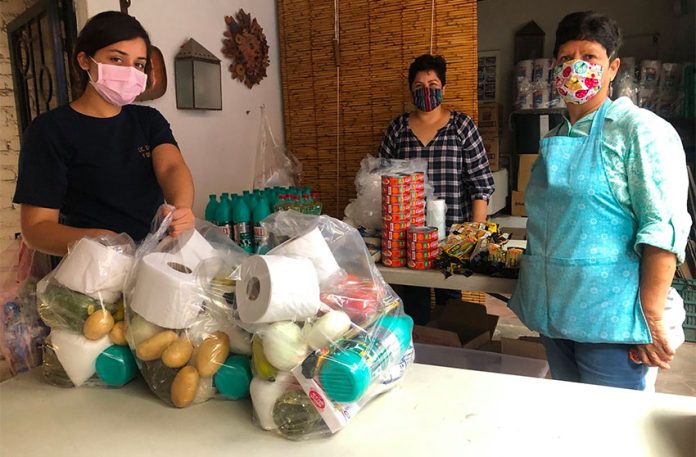
Volunteers prepare despensas in Marfil, Guanajuato.
For expats who call Mexico their permanent home, self-quarantine — quédate en casa — may be uncomfortable or boring, but most have sufficient means to cover the basics.
But as the weeks and months have gone by they’ve watched their neighbors and friends struggle to make ends meet, their communities shuttered and quiet. Behind closed doors, they knew people were afraid, wondering what the future would hold, where the next meal would come from and how they would survive.
Children’s advocate and beloved TV host Mister Rogers has pertinent advice for times like these.
“When I was a boy and I would see scary things in the news, my mother would say to me, “Look for the helpers. You will always find people who are helping.”
One of those people is Guanajuato resident Betsy McNair. Compelled to help those less fortunate — including her working-class neighbors in the community of Marfil where she lives – she thought for a week and then went into action. A background in catering and running restaurant kitchens directed her decision to start a food bank. Phone calls to friends yielded US $300 overnight which grew to $2,000 in two days. Posting on Facebook brought more money and more help.
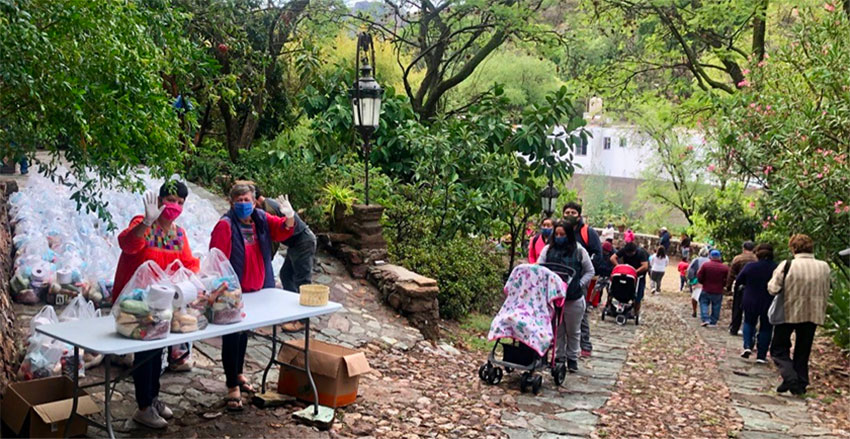
Distribution day: people line up for food and other supplies in Marfil, Guanajuato.
“I see people going through the dumpster every day hoping to find food or something they can sell. They don’t have food, they’re losing their jobs,” said Betsy. “I thought, ‘We need to do this right now.’”
“The first week we hoped to get the priest to announce at church that we’d be doing this on Easter Sunday,” Betsy recalled. “But we were never able to contact him, so we just put up a poster on Saturday that we would be giving out despensas [bags of food basics] on Sunday. We packed 50 and crossed our fingers that enough people would show up that we wouldn’t have too many extras.”
“We needn’t have worried: the 50 were gone in half an hour and there were 100 more people in line!” she said. “It broke my heart.”
Concha Marín, who normally works with Betsy in her Mexico tour business and is now project manager for the food bank, came up with the idea to give tickets to the rest of the people in line so as to guarantee them a despensa the following week. They gave out more than 100 tickets. But even that wasn’t enough: people continued to knock on Betsy’s door all afternoon until she’d given out about 150 tickets total.
That week they packed 200 despensas, and because of the ticket system, had one for everyone that was promised one, plus another 50 or so. They then gave out 175 tickets to the rest of the people waiting, guaranteeing them a despensa the following week.
“It won’t be enough, but it’s four times what we did last week,” said Betsy. “As Concha and I tell each other at least once a day, Algo es mejor que nada.” (Something is better than nothing.)
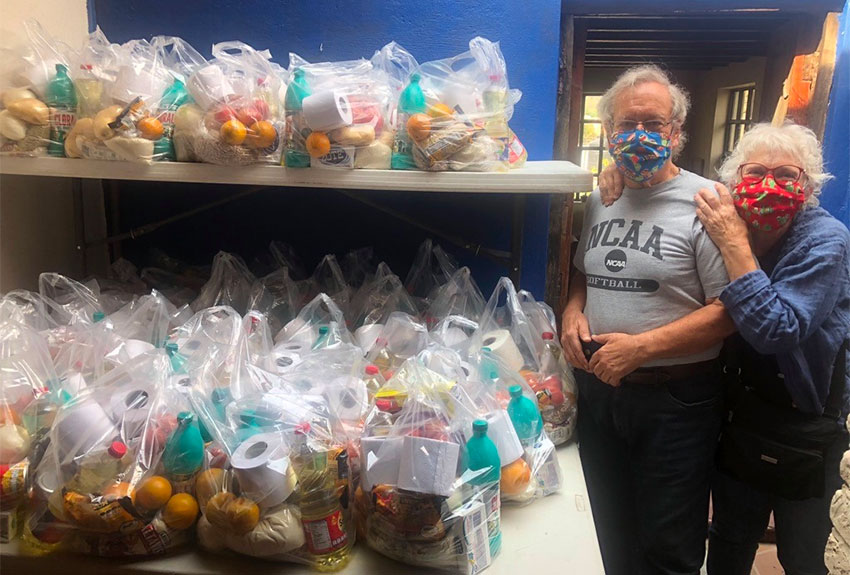
Food bank supporters Scott and Diane Harris.
As word has gotten out, the food bank is serving even more people. They’ve been able to start doing home deliveries to housebound people in need who can’t get to them. Last week, neighbor Estela Cordero, director of Guanajuato’s Gene Byron Museum, offered the use of the museum space, staff and resources, getting it out of Betsy’s living room and into a more easily accessible and bigger public location.
Local police, Civil Protection and transit have stepped in to help with crowd control, checking ID to be sure people are from the Marfil colonia, and handing out masks and hand sanitizer while keeping order and offering encouragement to the 400+ people in line each week. And the Guanajuato state secretary has offered his support and texts Betsy several times a week to see how they’re doing.
The ticket system enables them to plan their purchases, which Betsy and Concha make at small tiendas and mom-and-pop stores to help those businesses too. The despensas are filled with beans, rice, potatoes, onions, lentils, sugar, cooking oil, oranges, eggs, tomatoes, pasta, zucchini, bleach, soap and toilet paper. They make a point to include fresh fruit and vegetables, and pet food and feminine products are also available. Thanks to the police, distribution goes smoothly and they’ve been able to distribute 200 bags in about 45 minutes.
“So far we’ve been funded about 90% by friends in the U.S. and Mexico who jumped on board to support us,” said Betsy, who sees this as an ongoing project, at least until the crisis is over. “It’s running us about 201 pesos per despensa ($8.32) times 225 bags which is 45,225 pesos or $1,872 per week. All that money is being spent in small stores in the neighborhood.”
A Facebook page has updates, info and photos, and a Paypal site handles donations. As of May 15, donations totalled $14,293. This week’s distribution will be the sixth, for a grand total of 1,150 despensas given out. A total of 142 people have donated, with 27 donating numerous times. (“I call them our Repeat Offenders,” laughed Betsy.)
“Since we started this, we’ve always had enough money on hand for the next two weeks,” said Betsy. “I can’t begin to tell you how good it feels to be able to plan into the future. We’re so very, very grateful.Hopefully the generosity will continue and we’ll be able to keep this going as long as the need is there.”
Betsy said two other groups of people have reached out to tell her they’re starting up their own programs in their own neighborhoods and asked for her advice.
“The truth is that the need is everywhere,” said Betsy.“Every day when Concha leaves, we both cry.”
Janet Blaser is a frequent contributor to Mexico News Daily. She lives in Mazatlán.
Sheinbaum: automakers, construction companies, miners and brewers can reopen June 1.
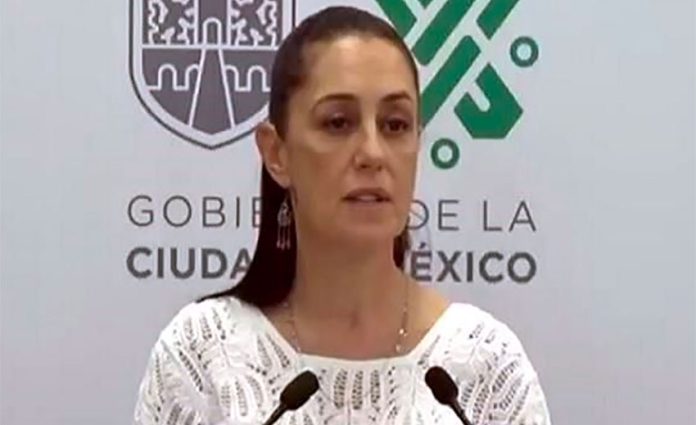
Most coronavirus mitigation restrictions are expected to remain in place in Mexico City until June 15, Mayor Claudia Sheinbaum said on Wednesday, but some industries will be permitted to resume operations from the start of next month.
Presenting a plan setting out a gradual reopening of the economy, Sheinbaum said that “red light” restrictions stipulated by the federal government’s color-coded stoplight system are unlikely to be lifted in the capital before the middle of next month.
Mexico City is the epicenter of Mexico’s Covid-19 pandemic, with more than 15,000 confirmed cases and 1,452 deaths, according to official statistics.
Sheinbaum said that Mexico City will continue to be classified as a “red light” state while hospitals in the capital are at or above 65% of their capacity to treat Covid-19 patients. Data presented by the federal Health Ministry on Tuesday showed that 74% of general care beds set aside for coronavirus patients and 66% of those with ventilators are currently occupied.
Although most restrictions are predicted to remain in place throughout the first half of next month, Mexico City-based automakers, construction companies, miners and brewers will be able to resume operations starting June 1 provided they follow measures to prevent the spread of Covid-19.
Sheinbuam said that parks in the capital will also open that day but only for exercise purposes and only at 30% capacity.
Once hospital occupancy levels drop below 65%, Mexico City will transition to the “orange light” stage and once levels are below 50%, the “yellow light” phase will begin, the mayor said.
The hoy no circula, or no-drive day, restrictions currently in place for all residents regardless of the age of their vehicle will be lifted once the capital has been given the “orange light.”
More businesses and industries will be allowed to resume operations and some small events will be permitted during the period.
Once the epidemiological stoplight switches to yellow, more people will be allowed into parks and other public places and citizens considered vulnerable to Covid-19 due to their age or existing health problems will no longer be advised to stay at home all the time.
Marking a complete return to the so-called “new normal,” the green light” stage won’t start until the number of hospitalized coronavirus patients has been on the wane for at least a month.
Sheinbaum predicted that won’t occur until August, meaning that students will not return to school and other educational institutes until the start of the new academic year in that month.
However, restaurants, hotels, cinemas and theaters will likely be able to open at 30-50% capacity in July, she said.
The use of masks on public transit will remain obligatory even when the capital reaches the “green light” stage and residents will also be required to wear them in places that attract large crowds.
Just over 3,000 coronavirus cases are currently considered active in Mexico City, an increase of almost 900 compared to a week ago.
Deputy Health Minister Hugo López-Gatell said Sunday that the spread of Covid-19 had stabilized in the Valley of México but predicted that the number of coronavirus patients in intensive care in metropolitan area would peak on Tuesday of next week.
Allen, Weinstein and AMLO: on violence against women, their credibility is lacking.
I was a big fan of Woody Allen for a long time. Nearly two decades, actually, which is saying a lot since I’m not yet 40.
His specific kind of self-deprecating banter that’s somehow both nihilistic and disarmingly charming is something I’ve long incorporated into my own sense of comedy, and anyone with an even remotely similar style will always get attention from me.
I side-eyed him when I realized that he’d married his former step-daughter (and I quote: “The heart wants what the heart wants.” Oh dear.)
Much to my current embarrassment, I also gave him the benefit of the doubt when his daughter accused him of sexual abuse, thinking that surely someone else would have noticed. I mean, isn’t a celebrity family constantly surrounded by others?
But when the Harvey Weinstein sexual abuse story broke it all fell apart and I knew, definitively, that he was not a good guy.
I read an op-ed piece that Woody Allen wrote defending Weinstein, and fell out of love in a matter of seconds: not only did he classify his “persecution” (excuse me?) as a “witch hunt,” he had the nerve to say that he himself had been told about all kinds of abuse from women throughout the years, but none of them were ever told “seriously.”
I’m sorry, what? How does Woody Allen think he knows that women were always joking when they told him about being harassed and abused? In that moment, he lost all credibility for me.
He even preemptively accused the media of “twisting his words,” surely realizing he’d stuck his foot in his mouth once again.
The reason he thinks he knows this? Well, he just does. He’s always treated women with respect, after all. And the Mexican family is so “united,” so how could that possibly co-exist with abuse?
His vision of a typical household is basically Norman Rockwell a la mexicana, and he doesn’t seem willing to let go of it for anything:
“In the homes of Mexicans, the children are there, the daughters-in-law, the grandchildren, and there has always been harmonious cohabitation. In other places, where this tradition, this culture, doesn’t exist it might be that isolation [to limit the spread of coronavirus] causes aggravation, confrontation and violence.”
I know that Mexicans are “used to living together.” Big deal. All humans are used to living together, it’s what we do. And that doesn’t mean that abuse doesn’t happen. In fact, data from all over the world, not just Mexico, has proved that being locked up in close quarters has contributed to a significant increase in domestic abuse, especially toward women and children.
“There has always been harmonious cohabitation.” Are you sure about that? Cohabitation, yes. Harmonious? I’d suggest asking the women in these families how that’s going.
Look, AMLO: there are the things you know, the things that you know that you don’t know, and then there are the things that you don’t know you don’t know. Though you seem to think there are very few items in that third category, there are actually quite a lot.
Also: it’s OK to make mistakes and backtrack if you need to. Humility’s a good look, not a weak one. Few sentences make me feel more human and deserving of grace than “I was wrong.” Give it a try, you’ll see.
It’s OK to have people smarter than you around. It’s OK to say, “Gee, really? Let me double-check those numbers because I’ve been told something else in briefings. Or even “You know, that’s something that I’m evolving on, and trying to get better at as a man in a macho culture. I’ve always treated women with respect and am against gender violence, but I know that’s not enough, and I’m actively working with my administration to address the issue in concrete ways.” Those are the sentences I want to hear.
Meanwhile, women are stuck at home with people who hurt them. An average of 155 calls per hour are made by women so desperate and worried that they feel they need outside help to protect their safety. Are any of them lying or joking?
I suppose it’s possible, even statistically likely. But 90%? Just stop, AMLO. Es más, backtrack. No shame in misspeaking and admitting a mistake.
I’m still rooting for you, AMLO, because you’re in charge of Mexico, and I’m always rooting for Mexico. I truly believe that this is one of the best countries in the world (as all immigrants tend to believe about their new homes, I suppose).
I even still basically agree with your overall ideology and vision for Mexico. But hearing you continually dismiss violence against women makes me despair that it will ever end.
Sarah DeVries writes from her home in Xalapa, Veracruz.
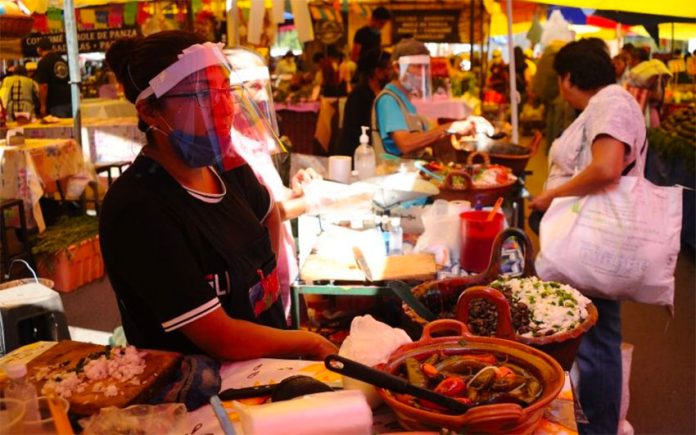
Mexico City will offer 25,000-peso loans (approximately US $1,072) to some 100,000 itinerant market vendors in the city who have had to close their stalls due to the coronavirus.
Mayor Claudia Sheinbaum announced yesterday at a virtual press conference that the federal loans would be made available this month and payable over the course of three years, with a four-month grace period and 0% interest for those who work in street markets and bazaars.
Government workers in Mexico City’s 16 boroughs will conduct a telephone survey of open-air market vendors, the government will evaluate the information provided and guard against duplicates, and then the funds will be released through banks.
The process will be carried out regardless of the political affiliation of vendors, and the loans will be distributed directly to individuals, Sheinbaum said.
The loans are an attempt to keep Mexico City’s 1,500 street markets shuttered and thus prevent the spread of the coronavirus, effectively paying vendors to stay home.
In Iztapalapa, Mayor Clara Brugada said that not a single mobile street market out of the 354 in her borough has opened for the past 16 days. The situation is similar in Iztacalco where 36 informal market organizations have suspended their activities, as requested by Mexico City officials.
Homicide numbers decreased slightly in April compared to March but remain at alarmingly high levels despite the coronavirus pandemic.
Speaking at the president’s press conference on Wednesday morning, Security Minister Alfonso Durazo told reporters that statistics from the National Public Security System show that there were 2,950 homicides last month, a 1.66% decrease compared to the 3,000 murders in March, the most violent month since the federal government took office in December 2018.
Although the homicide numbers barely budged between March and April, Durazo said that “the important thing” is that the upward trend didn’t continue.
“We managed once again to reverse the trend of growth … even though the numbers are [still] high,” he said.
However, there is little to celebrate considering that the slight reduction in homicides in April occurred in the first full month of the national social distancing initiative, during which the authorities are urging people to stay at home as much as possible.
Guanajuato remains the most violent state in the country, having recorded 1,534 homicides in the first four months of the year, followed by México state (982); Chihuahua (906); Michoacán (886); Baja California (880); and Jalisco (700).
Baja California Sur, plagued by high levels of violent crime as recently as 2017, is now the most peaceful state in the country based on homicide numbers between January and April. Just 15 homicides were reported in the state in the first four months of the year, one fewer than Yucatán.
Campeche, Aguascalientes and Tlaxacala were the next most peaceful states, with 26, 28 and 45 homicides, respectively.
Durazo also reported that femicides – women and girls who were killed on account of their gender – decreased to 70 in April from 78 in March, a 10.25% reduction. Compared to December 2018 – the month President López Obrador took office – femicides decreased 30% in April, he said.
The security minister said that federal crimes, including drug trafficking, fuel theft and firearms offenses, declined by about a third last month compared to March. He also said that vehicle theft fell 20%, muggings declined 24%, robberies on public transit decreased by 44%, burglaries dropped by 18% and business robberies were down 20%.
For his part, army chief Luis Cresencio Sandoval said that just over 150,000 members of the military and the National Guard are deployed around the country to carry out public security tasks.
Los Cabos hotels will remain quiet until further notice.
Days after the Los Cabos Hotel Association announced it was preparing for a partial opening of hotels in the popular southern Baja resort on June 1, the organization changed its mind and pushed back the date indefinitely.
The state still has high levels of coronavirus infection, and last week the association’s president, Lilcí Orcí, said it was working instead on a cautious reopening plan which would be put into place once state health officials determine it is safe to do so.
“In line with the federal authorities, a slight rethinking of the reopening phases was made,” Sandra de la Garza, public relations coordinator for the Los Cabos Tourism Board told Mexico News Daily. “Any decision that is made depends on the day-to-day development of the pandemic in the country and is therefore subject to change.”
Protecting the health of workers as well as visitors takes precedence over economic concerns, Orcí said, and all tourism providers will work together on health and hygiene guidelines for tourists.
Los Cabos will not offer a two-for-one plan on hotel nights to encourage visitors to return, as Cancun has discussed, but will rely instead on strict sanitary measures as a marketing concept through the Punto Limpio, or Clean Spot certification, a program that already exists but will be modified to reflect particular concerns associated with the coronavirus.
The Ministry of Tourism, Economy and Sustainability says Clean Spot training is set to begin today.
The certification process is divided into four phases and takes two months to obtain. Around 400 businesses will participate in the first stage of training, the government said.
“The idea is that we all have the same objective, that is why we are all under this same comprehensive plan and with this certification we will be working under unified criteria in hygiene and health that will give tourists the safety they are looking for right now,” said Orcí.
Tourism numbers for 2020 are expected to drop to just 25% of the visitors the resort destination normally receives in a year. Los Cabos will be lucky to see 1 million visitors.