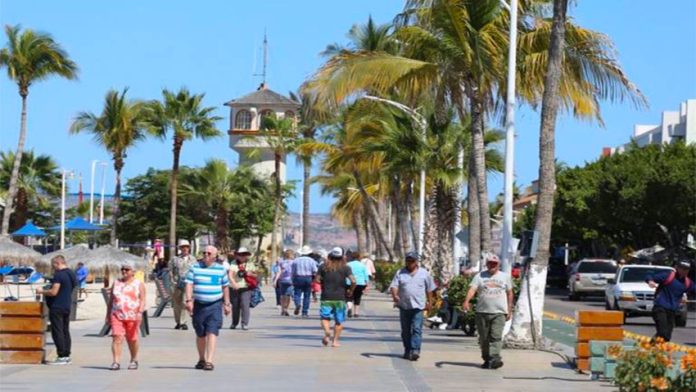
Baja California Sur saw an 8.5% increase in tourism in 2019 over the previous year, welcoming over four million visitors thanks to new air connections, more cruise ships and changing trends in travel, state officials said.
One significant factor was a new air route between Los Cabos and London, England, which opened up a new route of connectivity with Europe.
State Tourism Secretary Luis Araiza said he plans to continue attracting more European visitors, but will not neglect the state’s primary markets, the United States and Canada, to which it is connected via 38 air routes.
Ocean-going visitor numbers were also strong: nearly 600,000 visitors to Baja California Sur arrived on cruise ships, around 100,000 more than in 2018.
The trend is expected to continue and expand throughout the state as a new Sea of Cortés cruise that launched this year will bring passengers not only to established tourist destinations like Los Cabos and La Paz, but also to towns like Santa Rosalía, which hasn’t welcomed a cruise ship in eight years.
Increased connectivity led to the construction of 1,393 new hotel rooms in the state last year, and another 2,308 are planned for 2020. Tourism represents 70% of the state’s GDP, with 40% of that concentrated in Los Cabos.
But that concentration is starting to change, said Araiza, who cited millennials as driving tourism to other parts of the state, such as the mining-turned-ghost town of El Triunfo, the Pacific coast Magical Town of Todos Santos and San Ignacio with its cave paintings and lagoon.
To promote tourism in these and other communities in the north of the state, he announced the creation of a new tourist route called Ruta Uno (Route One) with an investment of 10 million pesos (US $534,000).
Araiza also cited conference and sports tourism as other important contributors, because it brings in more revenue than traditional tourism.
He also announced the return of the Mexican stage of the Tour de France to La Paz and a new mountain bike tournament.
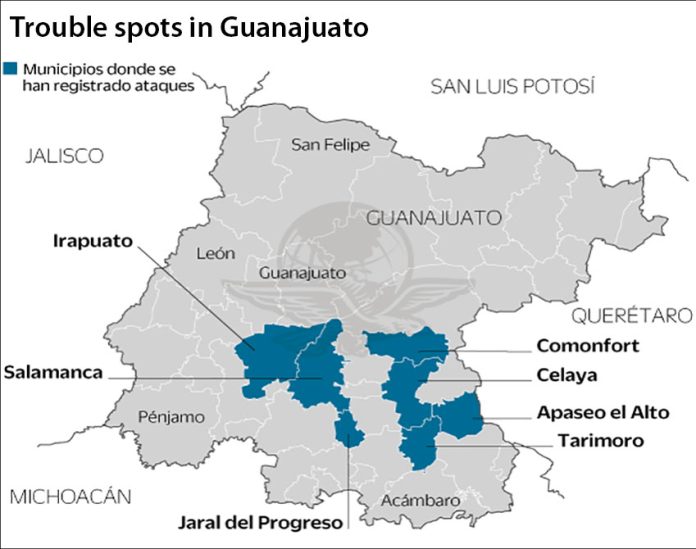
Municipalities where homicides have occurred are indicated in blue. el universal
Guanajuato’s wave of violence in 2019 has continued into the new year with 213 murders recorded in just 15 days.
Statistics from the National Public Security System (SESNSP) reveal that Guanajuato led the country in murders in 2019 up to November with over 3,000. The state saw 265 homicides in that month alone.
The Guanajuato Attorney General’s Office said that January’s murders have occurred primarily in the cities of Salamanca, Irapuato, Celaya, León, Apaseo el Alto, Tarimoro and Jaral del Progreso.
Armed men killed seven people in an auto repair shop and scrapyard in Tarimoro on Wednesday afternoon and two men were murdered in a guesthouse in Celaya in an attack that occurred at the same time.
Security forces reported that armed attacks late Tuesday night left 11 people dead and two houses burned in Comonfort, Apaseo el Alto, Celaya, Salamanca, Jaral del Progreso and Irapuato.
The houses in Jaral del Progreso and Salamanca were both reportedly empty when they were attacked and burned. The one in Jaral del Progreso was said to belong to a police officer.
In the face of the widespread violence, Guanajuato Governor Diego Sinhue Rodríguez Vallejo said Wednesday that the National Guard must be on the streets patrolling rather than in their barracks if something is to be done about insecurity.
“It doesn’t do any good to have bases of operation with the soldiers inside them. We need them to go out and keep watch, to do operations, we need them to be out on 24-hour surveillance, not inside their barracks,” he said.
Sinhue said on Monday that he doubted National Guard Commander Luis Rodríguez Bucio’s claim that there are 4,150 National Guardsmen in the state and asked him to specify how many are actually on patrol.
The alleged fraud was conducted by a Monex employee in San Miguel de Allende.
A Mexican financial services company has attempted to resolve a multi-million-dollar fraud involving expatriates and others in San Miguel de Allende with an offer to reimburse them with 60 cents on the dollar.
But two brothers from the United States have chosen legal action instead.
Jim and Ken Karger are among investors from several countries who charge that their savings were stolen from their Grupo Financiero Monex accounts in Mexico. More than 50 retirees in San Miguel discovered early last year that their accounts had been emptied.
An investigation by Mexico News Daily published last June found that an estimated US $40 million from more than 150 Monex accounts belonging to United States, Canadian, British, European and Australian expatriates was stolen via an alleged decade-long Ponzi scheme.
The banker who allegedly defrauded the Karger brothers and other victims, was Marcela Zavala Taylor, an English-speaking woman who provided personal banking services to Monex clients. However, after the millions went missing, she stopped all correspondence with her customers.
Alleged fraudster Zavala.
Monex has denied any responsibility for the fraud, filing a criminal complaint against Zavala and declaring that she acted alone.
Some defrauded customers who settled with the bank, often for amounts much less than their losses, were asked to sign an agreement that blamed Zavala alone for missing funds.
Meanwhile, Monex has continued to argue with other defrauded customers about how much money they should get back, Bloomberg said in a report published on Thursday.
Several victims said they didn’t consider legal action because they believed that any settlement they won would likely be eaten up by lawyers’ fees.
The Kargers, on the other hand, “won’t back down,” Bloomberg reported.
The news agency reported that the brothers, who have a private lending business in San Miguel de Allende, turned down an offer for about 60% of their principal in US dollars, choosing instead to launch legal action.
Jim Karger told Bloomberg that they had cash in a Monex bank account and shares in Apple Inc. and Tesla Inc. in a brokerage account, which was allegedly drained. When the brothers began speaking to Monex about their missing money a year ago, they were told that their account had been in pesos although Zavala had told them that it was in dollars.
As the peso has lost value in recent years, the amount they would get back from the bank if they opted for settlement would be much lower than their initial investment. Instead, Jim and Ken Karger are suing for their principal investment in US dollars, Bloomberg said.
“Most people settled for less than principal because they can’t afford to do what we’re doing,” Ken Karger said. “It may be a long shot, but what we’re doing will punish the bank, which will force them to the table.”
The brothers have also set up a website – bancomonexfraud.com – that is designed to draw attention to their case and help other people who have lost their savings. It features news stories and other information about the fraud allegations against Monex as well as an open letter to chief financial officers responsible for funds in Mexico.
According to Bloomberg, Jim and Ken Karger want their cash but also want to make a point that the Mexican banking system should take responsibility for the actions of employees.
To date, the brothers have spent US $150,000 trying to get back about $1.5 million that they say they lost.
Fraud victims Mauri and Ken Karger.
“This is a cause, and it’s bigger than Jim and me,” said Ken Karger, a retired dentist who lives in Fort Worth, Texas.
Legal actions filed by him and Jim Karger, who had a labor law firm in Dallas before moving to San Miguel 18 years ago, are aimed at having federal financial crimes prosecutors take up their case. The brothers want them to investigate Monex, its employees and Zavala, their one-time personal banker.
They hope that a two-year-old law that says that financial companies can be held accountable for the actions of their employees and agents will help their cause.
“Monex is trying to let everyone believe that Marcela was the only one involved,” Antonio Holguin, an attorney representing the Kargers, told Bloomberg.
“We think she was not the only one responsible. She was using tools of the bank, so the bank as an entity should face criminal charges.”
However, proving that Monex is responsible could take a very long time, according to Kevin Carr, founder of financial technology company Finiden in Washington, D.C. and a former primary representative of the United States Treasury Department Mexico.
He told Bloomberg that cases can take years and that courts often attempt to push opposing parties towards settlement. That makes legal action risky, Carr said.
Monex spokesman Fernando García told Bloomberg via email that the bank has been cooperating with investors and has settled with all but three clients who claimed to have been defrauded.
“It is up to the judicial system to determine those responsible,” García wrote. “Monex Financial Group reiterates that it is an institution that acts with strict adherence to national and international standards.”
Bloomberg said that its attempts to contact Zavala and her lawyer were unsuccessful.
The electrical wiring at 30 of Mexico City’s largest markets is in poor condition and poses a fire risk.
The city government inspected the electrical installations at the markets between January 2 and 14 after fires at the San Cosme, Merced and Abelardo Rodríguez markets in December.
According to a Secretariat of Economic Development (Sedeco) document seen by the newspaper El Universal, authorities detected wiring that was overloaded, in a state of disrepair and subject to overheating, all of which can trigger fires.
Of the 30 markets where wiring was not up to standard, 14 are in the central borough of Cuauhtémoc, 11 are in Venustiano Carranza and five are in Miguel Hidalgo. The government plans to inspect the electrical installations in all of Mexico City’s 329 markets but has given initial priority to 50 large ones.
Economic Development Secretary Fadlala Akabani said that when authorities detect a situation that poses a risk, they make arrangements for the problem to be fixed either through repair or replacement.
“That doesn’t mean that the faults are being corrected at the moment. When we finish [inspecting] the 50 markets, we’ll meet with the [borough] mayors” to develop a plan to modernize electrical installations in each market where problems were identified, he said.
Akabani said the first stage of inspections will finish by the end of this month after which the wiring in the city’s other 279 markets will be checked.
He also said that authorities have removed illegal wiring used by some stallholders to steal electricity, adding that there will be “permanent surveillance” to ensure that they don’t do it again.
Mexico City authorities indicated last month that they would also inspect gas and hydro-sanitary installations at public markets.
Last month’s market fires destroyed almost 1,000 stands at the San Cosme and La Merced markets. Two people died in the blaze at the latter, located in Mexico City’s historic center, while three vendors’ stands were destroyed in the fire the Abelardo Rodríguez market in Cuauhtémoc. Faulty electrical infrastructure was identified as the cause of all three fires.
Ecology experts and conservationists have urged authorities to make a coordinated effort to save the country’s jaguar population, which is under threat from poaching, habitat loss and illnesses transmitted by domestic animals.
Despite moderate increases in its population over the last decade — from 4,000 in 2010 to 4,800 now — the jaguar is still considered a threatened species, according to Rodrigo Medellín, a researcher at the Institute of Ecology at the National Autonomous University (UNAM).
Medellín and ANCJ president Gerardo Ceballos said the only way to stop illegal trafficking of jaguars is through coordinated efforts by authorities, local populations and the international community, for which an alliance of 14 Latin American countries was created in order to articulate a conservation and protection strategy on the continent.
They said that specific goals and clear environmental public policy are necessary in order to maintain jaguar populations and biological diversity in the long term in Mexico.
One such goal would be achieving a rate of zero deforestation by the end of President López Obrador’s term, as 100,000 hectares of forest and jungle are lost each year in Mexico, contributing to the numerous threats to the jaguar’s existence.
They said it was also necessary to evaluate infrastructure projects for communications and transportation, as many affect the jaguar’s natural habitat and fragment populations, making them smaller and more vulnerable.
Their strategy also calls for an increase to the National Forest Commission’s (Conafor) budget in order to support communal landowners, members of cooperatives and owners of small wildlife refuges for jaguars.
Jañez and Salazar said trade agreement alone won't boost growth in the absence of certainty.
The leaders of two influential business groups took aim at the federal government on Wednesday, declaring that hostile discourse and policy changes that are friendlier to the state than private enterprise are scaring away foreign investment.
At an event in Mexico City, the president of the Executive Council of Global Companies (CEEG) told a press conference that the business community is “deeply concerned” about increasing uncertainty and government “hostility” towards private investment.
“It’s making it very hard for us to convince our parent companies to invest in Mexico,” said Claudia Jañez, who is also Latin America president for the chemicals company DuPont de Nemours.
Attracting new investment became even harder in the second half of last year, said the head of the CEEG, whose 51 member companies, including Exxon Mobil Corp. and AT&T, have contributed to 45% of foreign direct investment (FDI) in Mexico over the past 15 years.
However, Jañez said that investment last year, and that which will flow into Mexico in 2020, are the result of plans made between five and 10 years ago.
A major factor in the flat growth seen in 2019 was the “systemic change of rules to doing business and the constant political messages against the markets and companies,” Jañez said.
She cited changes to contracts awarded during the previous federal government and modifications to rules in the energy sector as examples.
No new auctions of gas and oil blocks have been held since President López Obrador took office in December 2018 and the government has stopped Pemex from entering into new joint ventures with private firms.
In addition, the Energy Secretariat last year decided to grant clean energy credits designed to encourage the development of new wind and solar farms to old, state-run renewable energy projects. Six foreign and Mexican companies filed injunction requests against the new rule and one of them was upheld in November.
The López Obrador administration also entered into a months-long dispute with several pipeline companies after it decided that it wanted to change the terms of contracts signed with the previous government.
Seated next to Jañez, Business Coordinating Council (CCE) president Carlos Salazar Lomelín said that companies make long-term investment decisions and “changing rules doesn’t help growth.”
He said the CCE has sent a clear message to the government that rules shouldn’t be changed because doing so creates economic uncertainty and hurts investment.
Salazar, who has rarely been critical of the federal government since he became CCE president early last year, said he remained optimistic that Mexico can achieve its economic growth goals in the future – López Obrador has said that he is targeting average annual growth of 4% during his six-year term – citing the US $43-billion National Infrastructure Plan announced in November as one reason for confidence.
However, both he and Jañez said that ratification of the new North American free trade agreement and macro-economic stability won’t be sufficient on their own to stimulate growth if there is no certainty for investors.
The latter added that the United States-Mexico-Canada Agreement and the other free trade pacts to which Mexico is party won’t be successful unless the security situation improves (homicide numbers almost certainly hit an all-time high in 2019).
Safety is the primary concern for many companies in Mexico, Jañez said, adding that some have increased spending on security by 30% to 40%. “Insecurity should not be the new normal,” she added.
Also on Wednesday, the Nuevo León industry association Caintra added its voice to the call for the government to generate greater certainty in the Mexican economy.
The association noted in an economic outlook report that inflation is under control and that investment in infrastructure is in the pipeline but added that government policies that are not favorable to investment and the operation of businesses must be scrapped.
Workers protest outside a Home Depot in Mexico City.
Employees of home improvement retailer The Home Depot have threatened to strike in 13 states if the United States-based company doesn’t improve their salaries and benefits.
The workers are seeking a 20% pay rise as well as 20 days of paid vacation, assistance to cover transportation expenses, school supplies for their children, food vouchers and contributions to savings funds.
A spokesman for the Revolutionary Confederation of Laborers and Farmworkers (CROC), which represents the disgruntled Home Depot employees, told the newspaper Milenio that a strike would affect stores in Yucatán, Puebla, México state, Guerrero, Tabasco, Querétaro, Quintana Roo, Colima, Michoacán, Aguascalientes, Baja California Sur, Mexico City and Guanajuato.
Eduardo Miranda said the company is not only refusing to review the collective contracts it has with workers but is also opposed to the CROC representing them.
However, International Labor Organization conventions and the USMCA, as the new North American free trade agreement is known, stipulate that workers have the right to freely choose their union representation and participate in the collective bargaining process, he said.
The CROC said it would initiate proceedings with state-based conciliation and arbitration boards to pressure Home Depot to review the collective contracts it has with about 6,200 workers.
In addition, the confederation is urging the company to put an end to alleged discrimination, sexual harassment and unjustified dismissals at its stores, all of which it says it has knowledge.
Miranda said Home Depot workers are in a similar situation to that in which Walmart employees found themselves early last year.
In response to the claims from Home Depot workers, public relations manager Roberto Riva Palacio said the company is committed to doing the right thing by its employees and complying with the law, “as we’ve done since our arrival in Mexico in 2001.”
He also said The Home Depot is proud of the employment opportunities it has created for thousands of workers in Mexico. The company has 123 stores across the country.
Hockey player Luisa Wilson made history on Wednesday when she became the first Mexican athlete to win a gold medal at a Winter Olympics tournament.
Wilson won the medal in the three-on-three women’s ice hockey event at the 2020 Winter Youth Olympic Games in Lausanne, Switzerland on Wednesday.
Each team was comprised of players from several countries. Wilson shares the gold with athletes from Belgium, Spain, France, Italy, New Zealand, the Netherlands, the Czech Republic, South Korea, Germany, Norway, Switzerland and Austria.
Her Yellow Team won out in the final over the Black Team 6-1 in a three-game match.
“Having a gold medal around my neck is an incredible sensation and great for Mexico, but it’s a victory for a team from many nations and I love that,” said Wilson after the win.
Although the team lost two of its preliminary games, Wilson and her teammates had the drive to make it to the finals.
“We had lost two games before, but we made it to the semifinals because we had a lot of points and in the semis we tried our best and made it to the finals,” she said.
Wilson, who lives in Canada, says she chose the sport because her father also played it and she learned to love and play ice hockey from a young age, as well.
The head of the Mexican delegation, Carlos Pruneda, said the Mexican Olympic Committee is very happy with the country’s first-ever Winter Olympics gold medal.
“We’re very happy that Luisa Wilson won the gold medal with the Yellow Team, while Ximena González, with the Brown Team, ended up in fourth place,” he said.
Pruneda said that although the youth competition has a different format from the official Winter Games and the Olympic anthem — rather than that of Mexico — was played at the awards ceremony, it was still an historic achievement for the country.
Mexican athletes have competed in all three Youth Winter Olympics, which began in Innsbruck, Austria, in 2012.
Sánchez gets five years, Cacho still waits for justice.
After more than 14 years, a former police official has been sentenced to jail time for the torture of journalist Lydia Cacho in December 2005.
Authorities announced Wednesday that Juan Sánchez Moreno, formerly of the Puebla Attorney General’s Office, was sentenced to five years and three months in prison and fined 12,113 pesos (US $645).
Sánchez was arrested in April of last year but three others allegedly involved in Cacho’s kidnapping and torture — former Puebla governor Mario Marín, businessman Kamel Nacif and another senior police official, Hugo Adolfo Karam Beltrán — are still fugitives.
Cacho spoke out in January to express her disappointment at the lack of progress despite years of investigations and substantial evidence.
“Almost 14 years have passed and we still haven’t achieved [justice]. The strength of the criminals was able to do more than the honesty of the press, the bravery of the victimized boys and girls and my efforts accompanied by invaluable social solidarity,” she said.
Cacho is the author of The Demons of Eden (2005), an exposé that implicated businessmen Jean Succar Kuri and Kamel Nacif in an international pedophilia ring, for which Nacif and others allegedly retaliated by orchestrating her kidnapping and torture in 2005.
The press freedom organization Article 19 stated its determination to ensure the execution of the arrest warrants of those who are still at large in order to guarantee justice. It also charged that Sánchez’s punishment did not fit the crime of which he was found guilty.
“. . . [the] punishment does not meet the gravity of the acts of torture or the command post occupied by Sánchez Moreno,” the organization said in a tweet.
Acapulco will kick off the 10th national danzón demonstration on Thursday with over 2,000 dancers from 18 states.
The four-day event has two sites, the Paseo del Pescador in the older part of the city and the Juan Ruiz de Alarcón at the Centro Internacional Acapulco, where dancers from 36 groups are expected, according to promotor and organizer Marcela Ávila Durán.
Danzón enthusiast Felicitas López Flores says danzón keeps people health. “As a physical activity, danzón stimulates the mind, as one must learn the steps. It exercises the body and contributes to people staying healthy.”
The dance is particularly popular among older couples due to its slow, fluid movements. Said Fabián Robles, another danzón fan, “. . . I came to danzón late, about five years ago. I have always liked to dance, since I was a boy, but I never took classes. When I retired, I asked my wife what do we do now and we decided to take classes . . .”
Danzón is popular in many places in Mexico, and couples can often be seen dancing in town parks and squares. But it did not originate in Mexico. It is a musical and dance genre that was introduced initially into Veracruz and Yucatán from Cuba, where it is the national dance.
It most likely has roots in English and French country dances, but as it spread to the New World it took on local rhythms and movements. This process has continued in Mexico, as the dance spread. Although considered by many today to be the dance of older people, it was considered scandalous when it was introduced in the 19th century, as the slow movements allowed couples to dance scandalously close.
One of the Acapulco demonstration’s purposes is to overcome danzón’s association with retirees and attract young people to the genre.