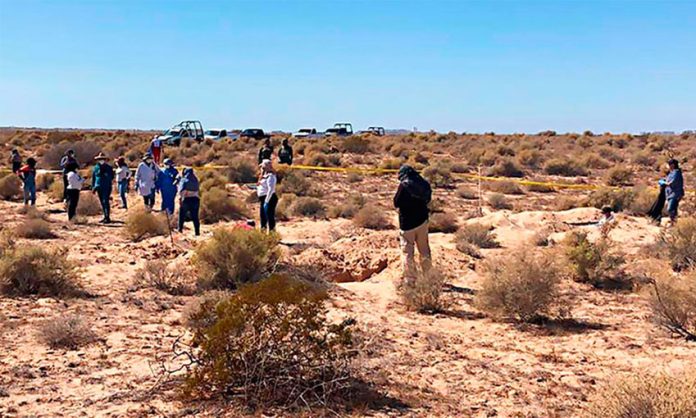
Searchers at the site where the bodies were found.
A citizens’ search brigade says it found 42 bodies in the desert outside Puerto Peñasco, Sonora, on Thursday and Friday.
The Searching Mothers of Sonora, a group that has taken up the search for the disappeared victims of drug cartels in the absence of official efforts, located the bodies near the Puerto Peñasco-Caborca highway.
However, state officials have confirmed the discovery of only 13 or 14 bodies. The brigade tweeted later that the state Attorney General’s Office (FGJE) only helped recover 14 of the bodies, “leaving the rest to the animals.”
That accusation came despite a pledge by the FGJE that the brigade would no longer be alone in its efforts to find missing people in the area.
It promised protection during their search efforts, technical assistance from forensic experts, psychological attention and the support of the forensic sciences laboratory in order to perform DNA tests on the remains they find.
Strained relations between authorities and citizens’ search organizations, of which there are several across Mexico, are not uncommon due to inattention to the issue of missing persons by government. There are more than 40,000 people on the National Registry of Missing and Disappeared Persons, of whom many if not most were probably victims of organized crime.
The FGJE repeated a call for families with disappeared loved ones to submit DNA samples to its database in order to identify remains.
Although Puerto Peñasco has not seen as much violence as other parts of Mexico, the Sinaloa Cartel is known to operate in the tourist destination on the Gulf of California.
Last week’s search was the second carried out by the Searching Mothers of Sonora this year. In May, another search by the group turned up 18 bodies.
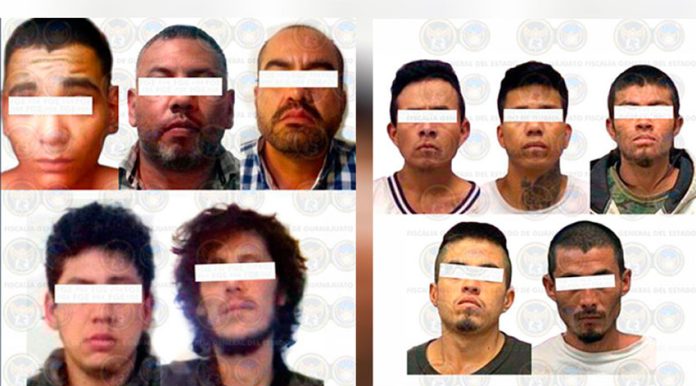
The criminal suspects arrested in San Miguel de Allende.
Seven of 10 suspected members of the Santa Rosa de Lima Cartel arrested in San Miguel de Allende last week were high-priority targets, according to state attorney general Carlos Zamarripa Aguirre.
“They are priority targets in the dismantling of a dangerous criminal group that maintained operations primarily in San Miguel de Allende [and neighboring communities],” he said.
They are also accused of at least two other murders in San Miguel in late September and early October, and are believed to have been behind a July 7 shooting at a taco stand that killed a couple and a young girl.
The arrests bring the total of high-priority detentions to 90 as a result of a coordinated operation against the cartel that began in March, Zamarripa said.
“We’ve been getting results, maybe not the ones we wanted, but in numbers, we have. We have arrested over 90 people from this group who were priority targets.”
Zamarripa announced in a press release the formation of a special task force to deal with armed attacks, extortion and high-impact homicides in the region.
In a meeting with local businesses in the tourism industry, he attempted to allay fears about insecurity in the city, one of Mexico’s most popular tourist destinations. He assured businesspeople that all levels of government will coordinate to maintain security in and around San Miguel.
According to state security official Sophia Huett López, authorities are closing in on Antonio “El Marro” Yépez Ortiz, leader of the Santa Maria de Lima Cartel.
Federal Security Secretary Alfonso Durazo was optimistic back in March, when he said the cartel boss would be captured “soon.”
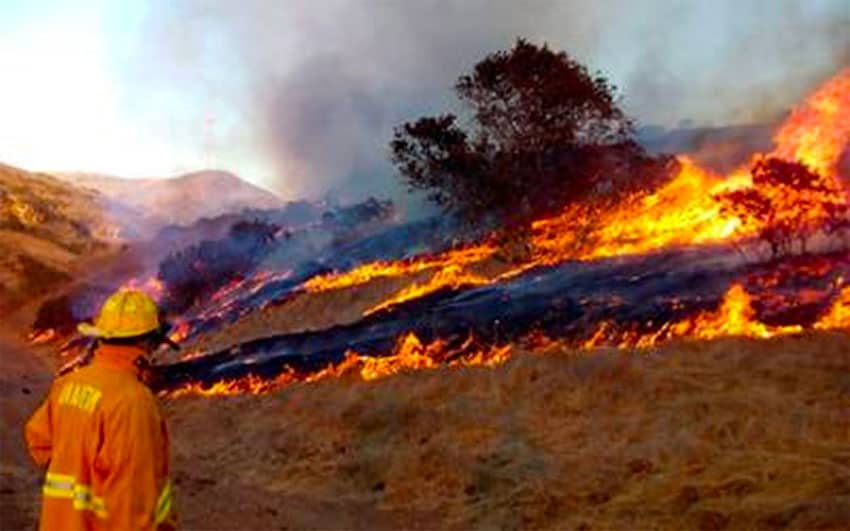
Trees burn on the side of a road in Baja California.
Raging wildfires in Baja California have left four people dead, destroyed some 200 houses and burned over 7,000 hectares of meadow land.
The state government declared a state of emergency in Tecate, Playas de Rosarito and Ensenada and put Tijuana on pre-alert as a result of the deadly fires.
The Defense Secretariat (Sedena) has implemented the DNIII-E natural disaster emergency response plan and evacuated 1,645 people.
The fires began on Thursday and grew out of control as a result of the Santa Ana winds, which have been reaching speeds as high as 95 kilometers per hour. They have completely burned at least 70 houses in Tecate, 50 in Tijuana and over 30 in Rosarito.
“The most serious fire is the one . . . in Tecate, in which preliminary reports state that 70 houses have been destroyed,” said state Civil Protection director Antonio Rosquillas on Friday. “Unfortunately, two people there have died, two were wounded, and around 60 families affected.”
About 50 fires have been reported in four municipalities.
In Playas de Rosarito, where around 30 houses were completely burned, firefighters found a man and his dog burned to death in the bathroom of a house that was consumed by the flames.
Classes at public schools and universities in the affected cities were canceled on Friday, and police closed highways in the area that were covered in a thick layer of smoke.
Tijuana Mayor Arturo González Cruz believes the fires to have been started by a trash fire at an illegal dump site that grew out of control with the winds.
The federal Secretariat of Security and Citizens Protection (SSPC) reported Friday night that the National Forestry Commission (Conafor) had contained only 35% of the estimated 50 fires. It is not known how much of the region’s natural protected areas have been burned.
Eugenio Romero of award-winning brewery Wendlandt.
Baja California brewery Cervecería Wendlandt was named the best in Mexico at the latest edition of an annual beer competition that was held in Mexico City on Thursday.
The Ensenada-based brewery won the award for best large brewery at the Copa Cerveza competition held at the World Trade Center.
There was actually a tie in the category between Wendlandt and Mexicali brewery Cerveza Fauna but the former was awarded the prize because it won more gold medals for its beers.
It is the second time that Wendlandt has been named best large brewery in Mexico after winning the category in 2015, and it’s the sixth consecutive year that a Baja California brewery took the prize.
Three Wendlandt beers were awarded gold medals at this year’s Copa Cerveza: the American wheat ale Veraniega, the India pale ale (IPA) Perro del Mar and the imperial red ale Super Harry Polanco. The brewery also won a silver medal for its stout Foca Parlante.
Cerveza Fauna of Mexicali was a close second in the best brewery competition.
Wendlandt was established by Eugenio Romero in 2012 and grew quickly to become one of the biggest craft breweries not only in Baja California but all of Mexico. It continues to grow by sending its beer to more and more Mexican states and new markets abroad.
The brewery has two tap rooms in Ensenada and its brews are also available in bottles and on tap at craft beer bars in Mexico City and other large cities across the country.
Wendlandt is one of more than 200 craft breweries in Baja California, which is now the second largest producer of artisanal beer in the country behind only Jalisco.
In 2018, craft breweries in the state made 18.5 million hectoliters of beer, 15.5% of the total quantity of artisanal beer produced in Mexico. Over the past nine years, the industry has become an increasingly important part of the Baja California economy.
Rubén Roa Dueñas, director of the Metropolitan Center for Economic and Business Information, told the newspaper El Imparcial that 95% of the state’s craft breweries are in three municipalities: Tijuana, Mexicali and Ensenada. The other 5% are in Rosarito and Tecate.
Local beer producers say that two main factors have contributed to the rapid proliferation of craft breweries in Baja.
The first is that their product pairs well with the region’s gastronomic offerings, which have won national and international acclaim.
“People are searching for new flavors, new culinary experiences and that’s only achieved through a good combination of food and beverages,” said Raúl Aispiro, president of the Baja Brewers Association.
The second factor is proximity to the beer industry in California, particularly San Diego, which is known as the craft brewing capital of the United States. San Diego craft breweries such as Stone and Coronado have collaborated with Baja brewers to produce special edition beers.
Another magnet for beer lovers is the annual expo Cerveza México. The three-day event started at the Pepsi Center at Mexico City’s World Trade Center today and runs through Sunday.
Scores of craft brewers will have stalls and more than 900 different beers will be available for tasting at the event, which also features conferences at which attendees can learn about craft beer and the Mexican industry.
Clocks in most parts of Mexico will move back an hour this weekend when daylight saving time ends at 2:00am on Sunday.
The change applies to the whole country except for the states of Sonora and Quintana Roo and 33 municipalities along the northern border, which follow the United States’ daylight saving time schedule and will change on the first Sunday in November.
The municipalities are:
Tijuana, Mexicali, Ensenada, Playa Rosarito and Tecate in Baja California.
Juárez, Ojinaga, Ascención, Coyame del Sotol, Guadalupe, Janos, Manuel Benavides and Práxedis G. Guerrero in Chihuahua.
Acuña, Piedras Negras, Guerrero, Hidalgo, Jiménez, Zaragoza, Nava and Ocampo in Coahuila.
Anáhuac and Los Aldama in Nuevo León.
Nuevo Laredo, Reynosa, Matamoros, Camargo, Guerrero, Gustavo Díaz Ordaz, Mier, Miguel Alemán, Río Bravo and Valle Hermoso in Tamaulipas.
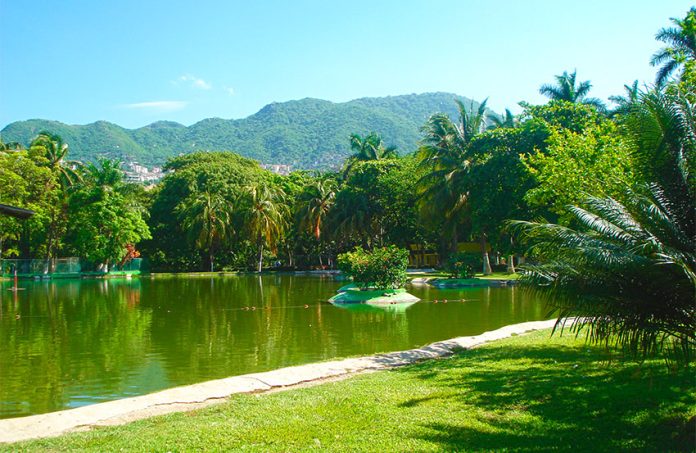
Parque Papagayo in Acapulco will receive a 300-million-peso (US $15.7-million) upgrade over the next year.
Known by locals as Acapulco’s green lung, the 22-hectare park is to be revamped into a vibrant, modern space that will be a popular attraction for both locals and visitors.
Agrarian Planning and Urban Development (Sedatu) Secretary Román Meyer Falcón announced that the project will begin in November and will be completed next year.
“We’ll begin the process with certain actions next month, but we are going to concentrate on next year,” Meyer said. “Next year is when we will put in all our efforts to recuperate Parque Papagayo in order to assure that it won’t just be a local reference point, but also an important attraction for Mexican citizens and foreigners.”
Meyer said half of the investment would come from the federal government, and the other half from the state.
Inaugurated in 1981, Papagayo is Acapulco’s largest green space, incorporating an ecological reserve and recreational and tourist areas.
During a ceremony announcing the rehabilitation of the park, Guerrero Governor Héctor Astudillo Flores presented 415 families from Acapulco’s suburban areas with written pledges that their neighborhoods will receive federal funding, as well.
Through its Urban Improvement Program, Sedatu will invest 600 million pesos (US $31.5 million) in a number of infrastructure and other public works projects in neighborhoods that lack basic services and have restricted access.
“We’re going to install complete roads, water, drainage and housing, and improve schools, markets and parks,” said Meyer. “And . . . we’re going to repeat the program next year.”
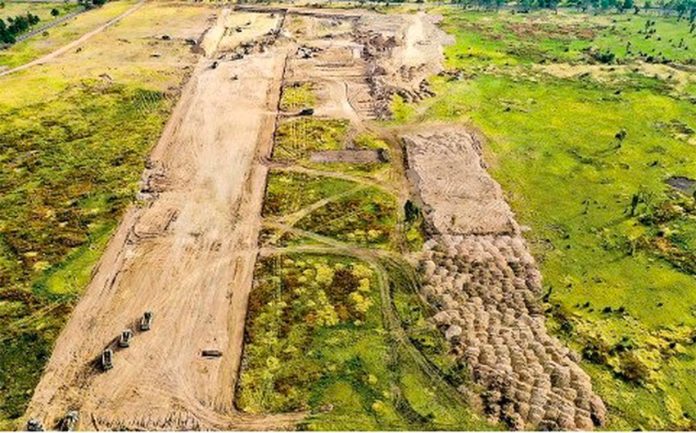
A week after President López Obrador officially inaugurated construction of the Santa Lucía airport, progress is being made at the México state air force base site.
The newspaper Milenio, whose reporters visited the site located about 45 kilometers north of central Mexico City, reported on Friday that military engineers have made progress on the preparation of land for the construction of one of two new runways.
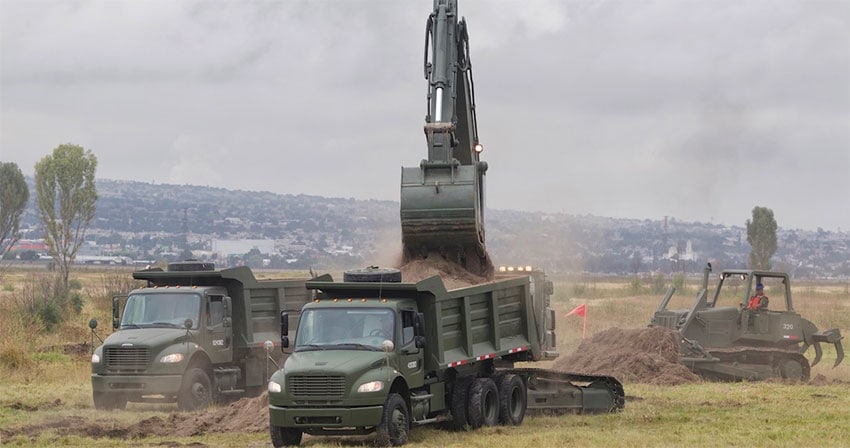
Machinery to lay the foundations of the runway is already on site as is a large team from the Secretariat of National Defense (Sedena), which is in charge of building the airport.
The two runways, to be built alongside an existing military runway, will enable domestic and international flights to take off and land simultaneously, Milenio said. The airport, which is expected to open in March 2022, will have a capacity of 20 million passengers annually in its initial stage of operations but capacity will eventually increase to 85 million passengers per year.
In contrast to what happened during the construction of the abandoned airport at Texcoco, where building materials such as the volcanic rocks tezontle and basalt were trucked in from nearby quarries – many of which operated illegally – clay, sand and gravel to build runways, taxiways and other infrastructure at Santa Lucía will come from the site itself.
Colonel Mario Alberto Pérez, who is in charge of a team of 455 military engineers, told Milenio that the onsite building materials are of “very good quality.”
He explained that personnel from the National Institute of Anthropology and History are currently working at the site to check for the presence of archaeological remains.
Pérez said that 17 separate projects will be executed simultaneously during the construction. Among them: the runways, a terminal building, a parking lot for 5,500 cars and maintenance hangars.
Existing military facilities will have to be relocated to make way for the airport and land adjacent to the site will be developed as an “airport city” with space for hotels, airline offices, banks, a shopping mall and a convention center.
Pérez said the airport “will be equipped with satellite technology” so that planes can land safely when fog hinders visibility.
The nearby Cerro de Paula, a 2,625-meter-high hill, will not affect the operation of the airport, he said.
Military equipment at work on new airport site.
The airport’s master plan was modified earlier this year due to the close proximity of the hill. The position of the two commercial runways was changed, meaning that several military facilities require relocation. The modifications to the plan caused the first overrun for the airport, increasing its cost by 11%.
Pérez said that building the airport is “a project of great magnitude” and explained that Sedena won’t be able to complete it on its own.
“. . . Although most of the engineers are here . . . we will need a complementary workforce,” he said. The government will launch a recruitment drive to attract the workers required.
To build a new road link to the airport, the government still needs to purchase several parcels of land surrounding the site. Pérez said 60% of 1,400 hectares that are required have already been acquired.
Construction was held up for several months due to legal action taken by a group that hoped to revive the abandoned project at Texcoco.
Local residents have raised environmental concerns about the project and are particularly worried about the impact that the airport will have on already depleted water resources in their México state communities.
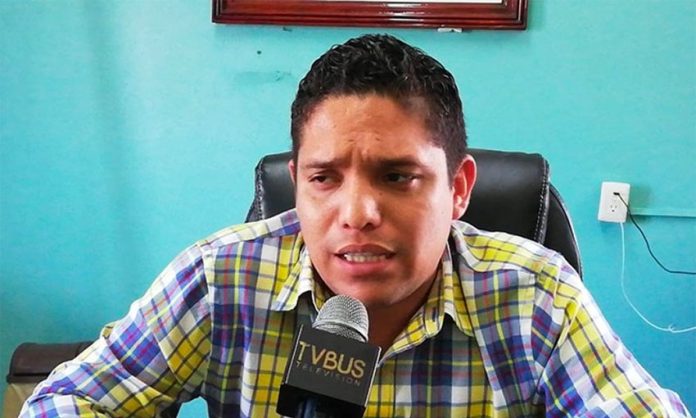
The mayor of San Felipe Jalapa de Díaz, Oaxaca, was arrested in a joint operation by state and federal forces on Thursday as a result of an investigation into more than a dozen cases of forced disappearance.
Oaxaca Attorney General Rubén Vasconcelos Méndez said Arturo García Velázquez was found in possession of six illegal weapons and more than 1,000 rounds of ammunition when his house was raided as part of the investigation. The mayor faces charges for weapons violations.
Police arrested nine people suspected of participating in forced disappearances, including two police officers from Jalapa de Díaz.
The attorney general said 100 state police and 120 National Guard troops participated in the operation.
García is the second Oaxaca mayor to be arrested in the past two weeks. San Marcial Ozolotepec Mayor Ramiro López was arrested in connection with a triple murder.
The lower house of Congress has approved steep hikes to two taxes that foreigners pay to enter Mexico, triggering criticism from business groups that are urging the Senate to vote against them.
Deputies approved a whopping 388% increase to the DSM immigration services tax and a 58% hike to the DNR non-resident tax.
The reform passed by the Chamber of Deputies increases the former to 380 pesos from 77 pesos and the latter to 885 pesos from 558 pesos.
To enter the country, tourists would be required to pay a total of 1,265 pesos (US $66), 98% more than they currently pay. (The DSM is only paid by visitors arriving by air.)
Four private sector groups – the Business Coordinating Council, the Confederation of Industrial Chambers, the National Chamber of Air Transport and the Mexican Transport Council – called on senators to stop the tax hikes, warning they would have an adverse effect on tourism and business.
“. . . Mexico would lose competitiveness as a tourism and business destination to countries with lower tax burdens,” the groups said in a statement.
“. . . The increases . . . represent a severe blow to the travel budget” of foreigners who travel to Mexico, they added.
Taxes and other fees included in the price of an airline ticket to Mexico are the highest in the world, the newspaper Reforma reported, making up about 45% of the total cost of flying in to the country.
Revenue from the DNR tax, approximately 6 billion pesos (US $314.6 million) annually, was previously allocated to tourism promotion.
But the current federal government disbanded the Tourism Promotion Council and has said that the DNR revenue will help finance construction of the Maya Train project on the Yucatán peninsula.
DSM tax revenue is supposed to be used to improve the country’s immigration services, including the implementation of new technology. However, the business groups claimed that it hasn’t been used for that purpose in recent years.
They said that if the revenue is used as it should be, “optimal” immigration services can be achieved at the nation’s airports without raising the DSM tax.
A vaquita porpoise swims alongside a boat fishing illegally.
Scientists have photographed an endangered vaquita porpoise swimming alongside a fishboat in an area of the upper Gulf of California where fishing is not allowed.
It was the same area in which a dead vaquita was photographed in a gillnet in March.
“Unfortunately, these boats are exactly where we saw the remaining vaquitas on our last trip,” said Octavio Carranza, captain of the Sea Shepherd Conservation Society vessel Farley Mowat.
The scientists reported that on October 17 they saw over 70 fishboats in the 150-square-kilometer zero-tolerance zone, where the use of gillnets for shrimp, milkfish and corvina is prohibited. The federal government has been frequently criticized in recent years for failing to enforce the fishing restriction, intended to prevent the vaquita from becoming bycatch of other species.
A measure intended to encourage fishermen not to fish was the payment of a government subsidy, but no monies have been paid in the last 11 months.
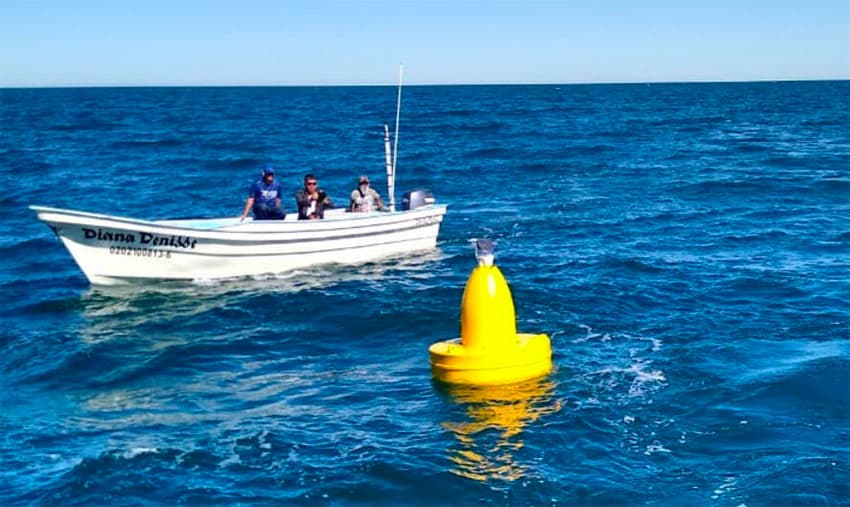
Buoys were placed this week to mark the area where fishing is prohibited.
Ramón Castro, president of a San Felipe-based fishermen’s organization, said fishermen were in the protected area as a result of the lack of attention and dialogue from the federal government.
The sentiment was echoed by Carlos Tirado, leader of a regional federation of fishermen’s cooperatives.
“We’re stuck between a rock and a hard place: between organized crime . . . and the pressure put on the commercial fishing sector by the government,” Castro said. “Those most affected are the organizations that follow the rules. Those who benefit most are the illegal fishermen.”
Tirado demanded that the federal government attend to the matter immediately.
Fishermen in the region also go after totoaba, another endangered species whose swim bladder fetches high prices in Asia, so high that organized crime is believed to be trafficking in the product. Again, the vaquita is often unintended bycatch, picked up in the totoaba nets.
Although the fishboat photographed with the vaquita put it in danger, the fact that one was photographed is a positive sign, according to the director of marine mammal investigations for the National Protected Areas Commission (Conanp), Lorenzo Rojas-Bracho.
“There are still vaquitas as of now, [and] I hope that we can keep these few alive and protect them exactly where they are,” he said. “These types of expeditions are key for photographic identification efforts, which provide the best options for orienting our means of protection.”
Earlier this week, the Sea Shepherd Conservation Society and the La Paz Whale Museum, along with federal officials and local fishermen, installed buoys in the area to mark the boundaries of the prohibited zone.
The buoys will facilitate the inspection and surveillance efforts by environmental authorities and other organizations, and help fishermen avoid the area.
Following recommendations from the International Committee for the Recuperation of the Vaquita (CIRVA), the demarcated zone covers 288 square kilometers, including the restricted area.
Scientists estimated earlier this year that only 10 vaquita porpoises remain. The species is found only in the upper Gulf of California.