Home Blog Page 1894

Mexico City has 18,000 police officers; it needs 10,000 more

0
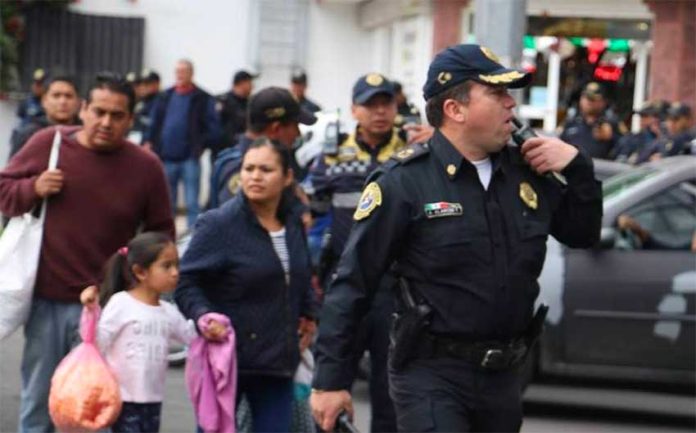
Mexico City's police are too few in number.
Mexico City's police are too few in number, the mayor says.

Mexico City is 10,000 police officers short of being able to effectively guarantee its citizens’ safety, the mayor said today.

Claudia Sheinbaum said the city’s previous administration claimed to have 26,000 police officers in its service, but the new government found only 18,000.

To compensate for the shortage, the mayor said, 3,500 members of the auxiliary police force are currently in training to be incorporated into the main force. That measure, along with an expected graduating class of 1,500 from the police academy this year, would bring the number up to 23,000 officers by the end of 2019.

In addition, the National Guard, now a reality after it was declared constitutional last month, will also provide support in policing the capital, especially in parts of the city that border or spill over into México state. But those officers will not likely be available till the end of the year.

Sheinbaum said the current force falls far short of being able to guarantee residents’ safety, and that she was prepared to make dramatic budget choices to augment the number of officers.

Improving salaries is seen as a priority.

The mayor cited low police salaries as one of the principal reasons for insecurity in the capital. On average, police make between 9,000 and 9,500 pesos a month (US $470-$500).

“We are facing a grave security situation in the city, and one of the first things that we have to guarantee is police presence. We are coming up with different strategies that will allow us to address the problem.”

Source: Milenio (sp)

Latin American’s biggest artisans’ fair now on in Michoacán

0
The artisans' competition at the fair now on in Uruapan, Michoacán.

An artisans’ fair that has been dubbed the biggest in Latin America is now under way in Michoacán’s second largest city.

The Uruapan Tianguis Artesanal is hosting nearly 2,000 artisans from the state’s four ethnic groups — the Otomí, Nahua, Mazahua and Purhépecha — whose pottery, weaving, copper, carved wood and musical handicrafts will be displayed and sold until April 28.

More than one million pieces are on display.

Festivities began Friday with a 3 1/2-hour parade in which 63 organizations and 40 bands from 48 communities participated.

More than 50 cultural and artistic events are organized around the fair, including a contest among the artisans.

A total of 1,710 from 58 communities participated with 3,118 unique pieces, 207 of which were awarded a prize. Over one million pesos (US $54,600) was given away to the winners.

There is also a traditional Purhépecha food festival, where 15 women from 15 towns in Uruapan draw from their traditions and prepare meals using the same ingredients and artisanal tools their forebears used.

Source: Mi Morelia (sp)

At 5,000 pesos in 15 minutes, occupying toll plazas can be profitable

0
toll plaza
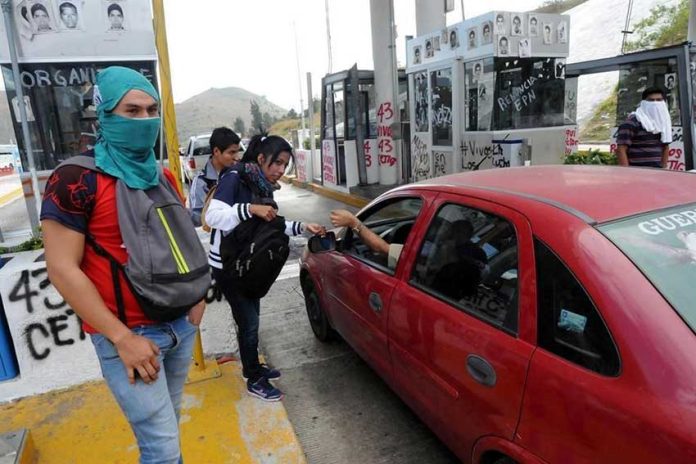
Your donation, please.

Protesters charging motorists a “voluntary fee” at highway toll plazas is a common sight in Mexico and for good reason – the practice can be very profitable.

In less than 15 minutes late last month, early childhood teachers protesting against the elimination of government subsidies for daycare centers collected at least 5,000 pesos (US $263) at the Palo Blanco toll booth on the highway between Chilpancingo and Acapulco in Guerrero, the newspaper Reforma reported.

Their colleagues carried out simultaneous hours-long collections at two other toll plazas on the Autopista del Sol, charging each car 50 pesos (US $2.63) – a small amount that can add up very quickly.

“It’s a [monetary] cooperation that will be used to continue our movement because we often have to travel to Mexico City to participate in protests,” one protester told Reforma.

However, some people doubt that the money collected is used by protesters to further their cause, and there was evidence at last month’s collection in Guerrero to support that view.

Compañeras [colleagues], we’re all going to get our bit,” a teacher called out as she took another 50-peso contribution from a passing motorist.

A Federal Police officer said he and his colleagues have been unable to do anything to stop the toll plaza takeovers because state authorities advocate dialogue with protesters rather than removal by force.

“The truth is that a lot of organizations have taken over the toll booths to make some money but there are also organizations that don’t ask for a cooperation and allow free passage. They hand out information about their struggle,” he said, adding that whatever amount protesters collect in tolls represents a loss for the federal government.

More evidence that protesters personally profit from their toll collections was presented in the form of a verbal confrontation that almost came to blows at the Palo Blanco toll plaza.

The day before the early childhood teachers’ takeover, students from a physical education college occupied the plaza for three hours and at the end of their “shift,” a heated argument broke out about who would take home the money, Reforma said.

However, a regional leader of CETEG, a Guerrero-based teachers’ union, denied that money collected by protesting teachers goes into their own pockets, stressing that it is used to keep on fighting against injustices.

Taurino Rojas González said that taking over the highway is “very expensive and dangerous” but added that organizations are forced to do it because “the authorities never resolve [their] demands.”

He also said that police have at times used force to remove protesters, recalling that students from the Ayotzinapa Rural Teachers’ College – the same school attended by the 43 students who disappeared in Iguala in 2014 –  were shot at on the Autopista del Sol in 2011 and two young men were killed.

Despite the dangers, the occupation of toll plazas continues to be a popular – and lucrative – way to protest.

Protesters including farmers and teachers took over highway toll booths at 13 locations in eight states last Friday to ask for contributions that in some cases, motorists had no choice but to pay.

Source: Reforma (sp) 

Woman sought for kidnapping baby from outside hospital

0
An amber alert was issued for eight-month-old Nancy.

Police in Mexico City are looking for a young woman who kidnapped a baby on Sunday from outside a hospital in the Doctores neighborhood of Cuauhtémoc.

María Magdalena Sánchez went to visit her sister in the hospital, accompanied by eight-month-old Nancy and her niece and nephew. Upon arrival, she was told by hospital staff that the children could not enter with her.

So Sánchez made a space for the children next to the main hospital entrance using blankets and bits of cardboard, entrusting her baby with Emiliano, 15, and Jenni, 6.

According to the police report, Emiliano said that at about 4:00pm his sister said she needed to go to the bathroom. A woman approached and offered to look after the baby while the two went to the washroom. When Emilio and Jenni returned, the woman and little Nancy were gone.

The Mexico City Attorney General’s Office has issued an amber alert and police have released a sketch of Nancy’s kidnapper based on Emilio’s description of a 25 to 30-year-old woman with white skin, oval face, thin, straight hair and about 1.6 meters tall.

The suspect in the kidnapping.

A photo and description of the baby, who has a scar on her left wrist, was also released.

Police ask Mexico City residents with any information relevant to the investigation to call 5200 9000 or 01800 745 2369.

Source: Milenio (sp)

Caravan of 5,000 migrants begins northward march from Tapachula, Chiapas

0
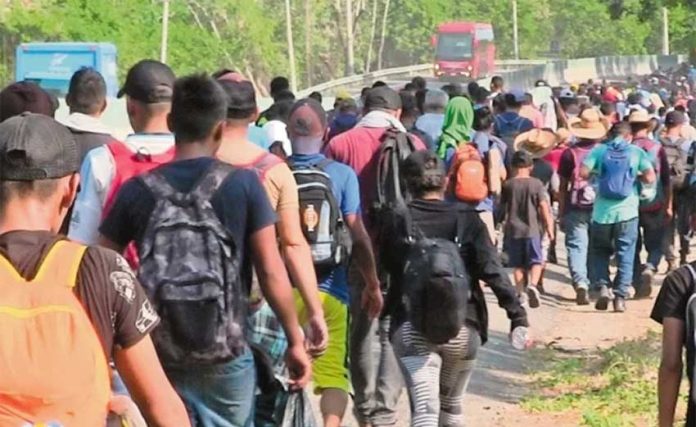
The latest caravan marches north.

More than 5,000 migrants left Tapachula, Chiapas, yesterday morning to begin the long journey through Mexico to the United States.

The migrant caravan includes an estimated 3,000 people who crossed the Suchiate river at the Rodolfo Robles international bridge between Tecún Umán, Guatemala, and Ciudad Hidalgo, Chiapas, last Friday.

Many other migrants who have been stranded in southern Chiapas in recent months while waiting to file visa requests with the National Immigration Institute decided to leave Tapachula at the same time, the newspaper El Universal reported.

There are around 7,200 migrants currently in Chiapas, according to the National Human Rights Commission, and another 1,600 are waiting to enter Mexico on the Rodolfo Robles bridge.

More than 3,000 are in Mapastepec, a town about 100 kilometers north of Tapachula, where some have been employed in a temporary government work program.

Among those who left Tapachula at 3:00am yesterday were a large number of minors as well as pregnant women, seniors and members of the LGBT community.

After walking for hours in temperatures as high as 38 C, some caravan members reached the outskirts of Huixtla in the afternoon where police tried to stop them from entering the town.

But a group of about 500 migrants ignored the police and walked into the center of Huixtla to camp in the town’s central square.

Municipal authorities told businesses to close and warned local residents not to leave their houses to avoid any possible confrontations.

In February, Huixtla police prevented another group of migrants from entering the town due to security concerns after two police officers were killed farther south in the state, presumably at the hands of the Mara Salvatrucha gang.

Other migrants stayed at shelters outside Huixtla last night while yet more camped out in Huehuetán, a town around 20 kilometers to the south.

Federal Police stationed at a migration checkpoint in the latter town made no attempt to stop or detain the migrants.

A trans woman identified only as Nancy told the newspaper El Universal that she fled her Central American homeland because of discrimination, a lack of employment and abuse at the hands of gangs.

“I’ve been mistreated a lot because of my gender, I can’t get a job. I want to live in a free country where at least I’m treated better,” she said.

Earlier this year, the federal government issued more than 10,000 humanitarian visas that allow migrants to work in Mexico and access services for up to a year but the initiative has largely been discontinued, forcing new arrivals to run the risk of being deported as they travel towards the northern border.

The Immigration Institute said that 204 Hondurans were flown back to San Pedro Sula Sunday from Minatitlán, Veracruz, because their stay in Mexico was “irregular.”

Most of the deported migrants were families traveling with children, the agency said.

The Human Rights Commission called on federal and Chiapas authorities to guarantee dignified treatment and conditions for migrants and to speed up the processing of visas for people stranded in shelters.

Fleeing poverty and violence in their countries of origin, tens of thousands of migrants have entered Mexico in recent months, many of whom arrived as part of several large caravans that originated in Central America.

Migration continues to be a point of contention between the Mexican and United States governments, and U.S. President Donald Trump has repeatedly threatened to close the border if Mexico doesn’t do more to stem migration and drug flows.

However, Trump said on April 4 that he was giving Mexico a “one-year warning” before he would move to impose tariffs on Mexican auto imports and close the border.

Source: El Universal (sp), Reforma (sp), La Razón (sp) 

Search continues for woman, 68, missing in Baja desert

0
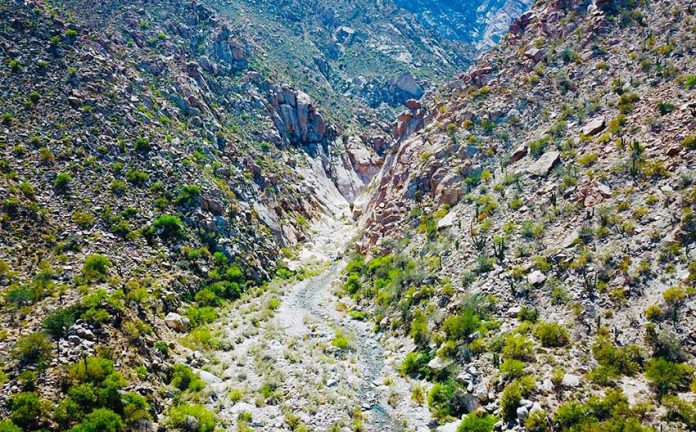
The San Pedro Mártir Sierra where a 68-year-old San Felipe woman is missing.
The San Pedro Mártir Sierra where Kat Hammontre is missing.

The search continues for a United States citizen missing since last Thursday in the desert near San Felipe, Baja California.

Kat Hammontre, 68, was hiking at the entrance of the Diablo Canyon in the San Pedro Mártir Sierra with friends and her dog Tootsie, but grew tired and stopped to rest near a creek.

She told her friends to continue and that she would catch up later, but that was the last time anyone has seen her or her dog.

It wasn’t until later in the day when Hammontre’s friends returned from their hike and spoke with her husband, Warren Sundquist, that they realized she was missing.

Volunteers and Mexicali Civil Protection personnel, the fire department, the army, the Red Cross and five search and rescue dogs mounted a search that revealed two marijuana plantations but no sign of the missing woman.

Kat Hammontre.
Kat Hammontre.

It is believed that Hammontre cannot have strayed far from her last known whereabouts — where daytime temperatures have been reaching 32 C — due to poor health.

Yesterday evening, state Civil Protection chief Antonio Rosquillas announced the search was being called off and that the case had been turned over the state Attorney General’s Office (PGJE), which will continue to investigate and attempt to locate the missing woman.

“We suspended the search. We combed the area surrounding the spot where she was last seen . . . a five-kilometer perimeter, and we did not find her,” said Rosquillas yesterday evening.

Sundquist posted on Facebook early this morning that he met yesterday with PGJE officials and that he was to travel with them to the Diablo Canyon area today.

He also said he understood that Civil Protection personnel would continue to search after all.

Source: 4 vientos (sp)

Mexico City vendors threaten to form self-defence force

0
Street vendors under threat in historic center.

Street vendors in the historic center of Mexico City have threatened to form a self-defense force if authorities don’t act to stop extortion, threats, kidnappings and murders allegedly committed by a notorious criminal organization.

An association of stall-holders and informal vendors based on two streets just north of the capital’s central square wrote to Mexico City Attorney General Ernestina Godoy to denounce the criminal acts they say are perpetrated by members of La Unión de Tepito, a gang based in the infamous neighborhood of the same name.

The vendors also criticized the Attorney General’s Office (PGJ) for not acting on the criminal complaints they have previously filed.

“. . . You must understand that everything has a limit and due to what is expressed above, don’t be surprised by the emergence of self-defense groups . . . in the face of the tardiness and inaction of the authorities responsible for security and law enforcement,” the letter said.

Association leader Raymundo Pérez López said that La Unión de Tepito charges cobro de piso, or extortion fees, that are so high that many vendors have been forced to abandon their businesses and lose their only source of income.

“Those of us who haven’t abandoned our activities continue to survive with a scant profit margin and with an economic situation that is increasingly miserable,” he said.

“The worst of all is that despite the existence of complaints and investigation files in several agencies of [the PGJ], no progress is achieved. We perceive this as a lack of capacity, interest or commitment from the authorities,” Pérez added.

The newspaper El Universal reported that Mexico City has evidence dating back to 2017 that shows that La Unión de Tepito has been extorting and attacking street vendors and shop owners in the capital’s downtown.

The gang is also believed to have taken possession of abandoned buildings in the historic center.

Data from the business organization Canacope shows that criminals collect at least 483 million pesos (US $25.6 million) annually in cobro de piso payments in Mexico City, and that three of every 10 businesses in the capital are targeted by extortionists for regular payments that allow them to continue operating.

In November, then-mayor José Ramón Amieva called on all small businesses that have been targeted not to be intimidated into silence but to file complaints with the PGJ.

The same month, Pérez filed a complaint about extortion and threats but nothing has come of it.

“Like my complaint there are surely thousands more that only form part of the statistics. I have . . . hundreds of signatures from citizens who work in the same activity as me and who suffer from threats, who are desperate, but up until today, these criminal groups continue to operate without the responsible authorities doing anything to stop the ambush . . .” he said.

La Unión de Tepito is also believed to be responsible for a number of kidnappings and homicides in and around Mexico City’s historic center, including a gun attack last September that killed four people and wounded six more in Plaza Garibaldi, a square known as the capital’s home of mariachi music.

Source: El Universal (sp) 

269,000 new jobs created in first quarter, making it the best in 10 years

0
'We're going to win,' says AMLO of his economic growth forecast.

The number of jobs created in the first quarter of this year was the highest in 10 years, President López Obrador said today.

“According to IMSS [the Mexican Social Security Institute], the number of insured workers grew in the January-March quarter – 269,143 jobs were created. The figure represents an increase not seen for 10 years in a similar period,” the president told reporters at his morning press conference.

López Obrador said the job numbers are indicative of a growing economy, adding that the government remains confident that economic growth will exceed the figures forecast by analysts for 2019.

“The bet is on with the experts, the banks, the financiers, who have forecast that we’re going to have lower growth than what we’re estimating,” he said.

“We accept the challenge and we’ll be here watching [the economic data] . . . We’re going to win.”

The International Monetary Fund (IMF) last week lowered its growth forecast for this year to 1.6% from the 2.1% predicted in January, while the Bank of México also cut its mean outlook to 1.6% in February.

The Secretariat of Finance and Public Credit (SHCP) said earlier this month that it expected the economy will grow between 1.1% and 2.1% this year but López Obrador quickly rejected his own government’s figures, stating that they were too low.

The federal government says that it is targeting average 4% growth during its six-year term, a figure considered fanciful by most analysts.

Source: El Financiero (sp) 

Salaries of civil servants and teachers have been published online

0
Sandoval presents government's new salaries portal.

The salaries of around 3.4 million civil servants are now publicly accessible on a government website, the secretary of public administration announced today.

Irma Sandoval Ballesteros said that the earnings of 1.4 million employees of 290 federal departments as well as those of almost two million teachers can be consulted on the Portal Nómina Transparente (Transparent Payroll Portal).

The secretary explained that information on the site will be updated after each bimonthly pay cycle to ensure that the salaries of new appointments to government positions are available.

People curious to see how much a friend, family member, colleague or indeed anyone in the public service makes can simply enter their name into a search engine on the portal to find out.

Sandoval said that the site contains 10 or 11 times more information than that available on the portal of the National Institute for Transparency and Access to Information (Inai).

Although she is no longer employed by the government, the salary earned by Yalitza Aparicio – star of the Oscar-winning film Roma – when she was a teacher in Oaxaca was revealed on the government portal, the newspaper El Financiero reported, although it now appears to have been removed.

The indigenous actress earned a monthly salary of 10,481 pesos (US $555) as a preschool teacher in the town of Tlaxiaco, around one-tenth of President López Obrador’s net salary of 108,305 pesos (US $5,735).

Anyone interested in finding out how much the foreign secretary, the Pemex chief, or their child’s teacher earns can consult the payroll portal by clicking here.

Source: El Economista (sp), El Financiero (sp) 

Experts warn that repealing education reform would be a step back

0
The president in Campeche
The president in Campeche, where he threatened to repeal education reforms by decree.

Complete abrogation of the education reforms implemented by the previous federal government would be a backward step for Mexico, experts said after the president threatened Saturday to do just that.

President López Obrador said he will issue a decree to repeal the reforms if his own education plan is held up in Congress by opposition lawmakers and the CNTE teachers’ union, which argues that it doesn’t go far enough.

The president conceded that there are groups who don’t view his education laws favorably, adding “we’re going to be talking with everyone until there’s an agreement but if it takes too long, I will bring out a decree to abrogate the badly named education reform while the new proposal is approved.”

López Obrador said that his government won’t persecute teachers “as the past administration tried to do” but made it clear that he intends to put an end to the practice of selling positions.

He also said that teachers’ salaries will be paid directly by the federal government to avoid “diversions of funds” to state governments and union leaders, adding that teachers won’t be subjected to compulsory evaluations as was the case under the Enrique Peña Nieto administration.

If a teacher has completed studies in education, he or she has sufficient training to teach, López Obrador charged.

Roberto Rodríguez Gómez, an education researcher at the Institute of Social Sciences at the National Autonomous University (UNAM), was among several experts who warned that if the president follows through with his repeal-by-decree plan, the consequences will be dire as Mexico would effectively return to the legal framework for education that existed before 2013.

“With this decision, the education sector would return to the hands of the union. [They would control] everything that has to do with the allocation of positions, the promotion of teachers . . . and transfers. It would also eliminate the possibility of having the best teachers, which is assured through evaluations,” he said.

Rodríguez also said the president doesn’t have the power to unilaterally cancel the past government’s education laws.

“To repeal the reform, the constitution needs to be modified but that cannot be carried out at the president’s will but rather it has to go through the legislative bodies – the Chamber of Deputies, the Senate and the state legislatures,” he said.

Marco Fernández, a researcher at public policy think tank México Evalúa, said that repealing the reform would amount to “a contradiction with what the president has said in disagreement with the practices of the inheritance and sale of [teaching] positions.”

He added that it was the “very legal framework” that existed before 2013 that “allowed these bad practices” to happen.

Carlos Arnelas, another UNAM researcher, said “the most negative part of the president’s proposal is that once again the union would colonize basic [pre-school to middle school] education,” explaining that “in other words it would have a very strong capacity for negotiation at a state level and no governor would have the power to confront them.”

Alma Maldonado, an education researcher at the National Polytechnic Institute (IPN) Center for Investigation and Advanced Study (Cinvestav), said the most worrying aspect of the repeal plan is the elimination of the National Education Evaluation Institute (INEE), “because it generates vital information about the education sector.”

Teacher evaluation as set out in the former government’s education reform was vehemently opposed by the CNTE union, which protested frequently throughout Peña Nieto’s presidency.

Source. El Universal (sp), Milenio (sp)