The chair that Mexican culture officials believe uses indigenous designs from Mexico.
Mexico’s Culture Secretariat is jealously guarding traditional Mexican designs from being used by international fashion brands.
Culture Secretary Alejandra Frausto sent a letter Friday to the French brand Louis Vuitton over the latter’s use of indigenous Mexican patterns for a very expensive chair.
The letter notes that in Vuitton’s collection Dolls by Raw Edges, one particular chair uses embroidery patterns that are intellectual property of the indigenous Otomí community of Tenango de Doria, Hidalgo.
Frausto asked if Louis Vuitton tried to contact the community and if it has their permission to use the designs.
“Each piece is unique and unrepeatable,” the letter reads. “And at the same time, it is the result of the continuity of the work of many generations who transmit knowledge, skill and creativity.”
The chair, whose price is US $18,200, uses embroidered images of multicolored animals which are typical to Tenango de Doria. By Tuesday, the chair had been taken down from Louis Vuitton’s website and social media pages.
Frausto invited the French company to work with the indigenous communities to agree on “direct and concrete benefits for all parties” and “give the communities the recognition they deserve.”
In June, Frausto sent a similar letter to the brand Carolina Herrera over its collection Resort 2020, which the culture secretary said constituted cultural appropriation of indigenous designs. According to the company, Resort 2020 was inspired by Mexican handicrafts and seeks to evoke a sunrise in Tulum, Quintana Roo, and a trip through Mexico City.
Frausto’s letter to Carolina Herrera asked for “an explanation of the use of indigenous designs and embroidery,” the origin of which, she said, “is clearly documented.”
In response, Carolina Herrera creative director Wes Gordon said the collection sought to respectfully pay homage to the “brilliant and diverse handicraft work” of Mexico and celebrate the brand’s Latin American origins.
Police had been protesting in Mexico City since last Wednesday.
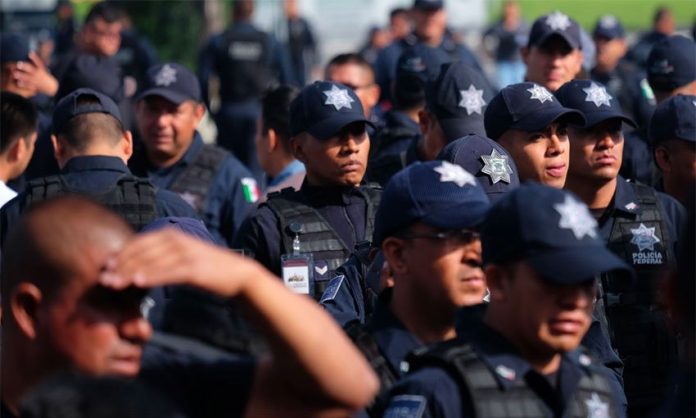
President López Obrador said this morning that an agreement had been reached with dissenting Federal Police who have been protesting their incorporation into the National Guard. But not all the police officers are on side.
The president said the dissident officers and the federal government had signed a 13-point agreement that included an end to protests, a guarantee of salaries and benefits, 10 options for relocation for those not reassigned to the National Guard and a promise of non-dismissal.
“The matter has been resolved: we will continue the selection process for those who wish to form part of the National Guard as long as they meet the requirements, and those who are unable to join will be given other options, like what we discussed with security duties in government offices and other work, but we are not going to dismiss anyone.”
The president added that of the Federal Police officers tested for positions in the National Guard, only about 60% passed, compared to nearly 90% of hopefuls from the army and navy, who must also pass the exam.
“In the case of the Federal Police, in general close to 60% qualify. What does this mean? It means that the agency has been going downhill for a long time, or in other words, discipline, professionalism and everything that must be present at all times [in law enforcement].”
The leader of an estimated 500 dissident officers said this morning he was unaware of the agreement reached yesterday. Mario Alberto Lover said his group was not represented at the negotiating table and therefore the accord is invalid.
“. . . they misled us once and now they’re trying to do so again, because the accords were made in secret; they didn’t take us into account so we don’t recognize them.”
However, the force will continue to carry out highway patrol duties and provide security at airports and international border crossings.
“. . . that is not the duty of the National Guard. The service will continue and the [Federal Police] will continue to carry out it out. What we must achieve is the betterment of the service: they must protect the citizenry rather than extort them. There cannot be corruption.”
Starting last Wednesday, hundreds of Federal Police officers protested and blocked roads in Mexico City to reject their incorporation into the National Guard, citing cuts to salaries and benefits. Disgruntled officers also took issue with being deployed to dangerous states without the bonus that used to accompany such postings and being evaluated by military personnel.
Four indigenous residents of communities located in the Isthmus of Tehuantepec have filed an injunction request against the government’s trans-isthmus trade corridor project, and more legal action is in the works.
Three Mixe people and one Zapotec man claim in their injunction application that the project – which includes the modernization of a railway between Salina Cruz, Oaxaca, and Coatzacoalcos, Veracruz – violates provisions of the constitution and human rights conventions.
The four complainants say that the body charged with executing the Isthmus of Tehuantepec interoceanic corridor was created without prior consultation of the indigenous communities that will be affected.
The failure to consult, they argue, violates Article 7 of the International Labor Organization’s Indigenous and Tribal People’s Convention.
“In a completely unilateral way, the Mexican government has designed a plan that is clearly invasive and which totally affects our land. Consequently, [the plan will] completely alter our way of life and organization,” says the injunction request, which was filed in a district court in Salina Cruz.
“Given the magnitude of the project that the government intends to execute, and considering that carrying it out poses a serious risk to our existence as indigenous peoples, there is no valid argument to deny our participation.”
According to Betina Cruz Velázquez, coordinator of the Assembly of Indigenous Peoples in Defense of the Land, residents of five other indigenous communities are planning to launch their own legal action against the trans-isthmus project this week.
Residents of the Zapotec towns of San Francisco del Mar, San Francisco Ixhuatán, Álvaro Obregón, Zanatepec and Santa María Xadani agreed to file separate injunction requests at town meetings, she said.
In late March, the government held public meetings in isthmus municipalities in Oaxaca and Veracruz to seek indigenous communities’ views on the trade corridor but they allegedly didn’t comply with International Labor Organization protocols.
The National Indigenous Congress and the Zapatista Army of National Liberation, among others, argued that the consultation was a simulation and that the rail project would go ahead regardless of the opinions voiced by local residents.
Cruz Velázquez said in June that the train is part of old “neoliberal policies” that have not gone away.
Other aspects of the trade corridor plan include upgrades to the ports of Salina Cruz and Coatzacoalcos, modernization of highways in the region and improvements to telecommunications connectivity.
It has long been argued that establishing a rapid link from the Gulf of Mexico to the Pacific Ocean across the narrowest stretch of land between the two coasts would enable Mexico to compete with the Panama Canal.
However, the Mexican Shipping Agents Association said earlier this year that any notion of that being possible was a “pipe dream.”
The United States announced yesterday it would impose tariffs on imports of fabricated structural steel from Mexico after an investigation determined that some exporters receive unfair subsidies.
The U.S. Department of Commerce (DOC) said in a statement that a countervailing duty investigation found that Mexican steel exporters received subsidies at rates ranging from 0.01% to 74.01%.
Separate investigations considered steel imports from Canada and China, and tariffs ranging from 30% to 177% will be imposed on product shipped to the United States by companies in the latter country. In Canada’s case, steel exporters were found to be receiving subsidies of less than 0.5% and no tariffs will be imposed.
“Based on these preliminary determinations, the Department of Commerce will instruct U.S. Customs and Border Protection to collect cash deposits from importers of fabricated structural steel from China and Mexico,” the DOC said.
The commerce department said the petitioner for the investigations was a Chicago subgroup of the American Institute of Steel Construction. It also noted that imports of fabricated structural steel from Mexico were valued at US $622.4 million last year.
Among the Mexican companies that will be subject to a 74.01% tariff are Swecomex, a subsidiary of Grupo Carso, which is owned by billionaire businessmen Carlos Slim, and Preacero Pellizzari Mexico.
The DOC said the final determinations of its countervailing duty investigations will be announced on or about November 19.
“The strict enforcement of U.S. trade law is a primary focus of the Trump administration . . . Antidumping and countervailing duty laws provide American businesses and workers with an internationally accepted mechanism to seek relief from the harmful effects of the unfair pricing of imports into the United States.”
Mexico’s Secretariat of the Economy (SE) said in a statement that the tariffs are not linked in any way to the Section 232, or national security, duties that were imposed by the United States on steel and aluminum products in June 2018 and lifted in May of this year.
“It should be noted that this type of investigation is carried out regularly when an industry feels affected by imports that it believes are being carried out through unfair practices (dumping and subsidies). The investigation in question is ongoing and will be definitively resolved in the next six months.”
The secretariat added that it will offer support to companies affected by the new tariffs “for the defense of their interests.”
Jesús Seade, foreign affairs undersecretary for North America, said the tariffs don’t represent a threat to ratification of the new North American trade agreement, which Mexico’s Senate approved last month.
In a series of Twitter posts, Seade also noted that only certain private companies will be affected by the duties.
President López Obrador said today that he wants to “fix” the situation and that his administration would take steps to that end. He stressed that the government’s relationship with the Trump administration is good.
“I’m confident that we’re going to be able to confront this new challenge of steel tariffs . . . because the relationship is good.”
Foreign trade specialists agreed with the government’s assessment that the tariffs don’t represent a threat to the wider trade relationship or the free trade deal.
“. . . There won’t be a great impact for the [steel] industry given that it [the tariff] is only on one specific product and only for some companies,” said Alejandro Gómez, an international trade expert at law firm Foley Gardere Arena.
He also said that ratification of the United States-Mexico-Canada Agreement (USMCA) isn’t at risk, stressing that the tariffs were the result of a specific investigation affecting only one industry.
Armando de Lille-Calatayud, an international trade lawyer at Baker McKenzie, said the tariffs are the result of a process that is more technical than political, adding that they didn’t come as a surprise.
Like Seade and Gómez, he dismissed any possibility that the new duties could affect ratification of the USMCA.
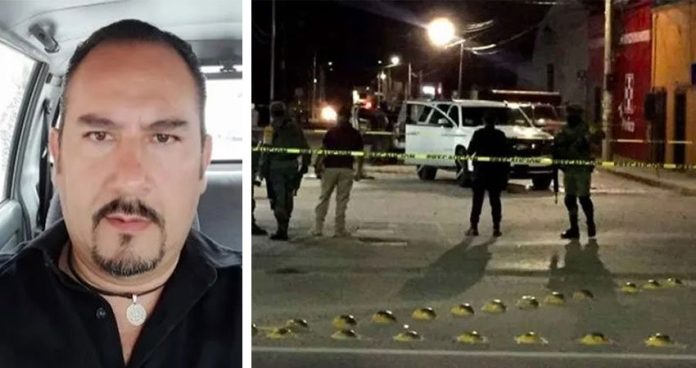
Campos, and a crime scene he would rather be kept under wraps.
A San Miguel de Allende politician has asked people to keep a lid on bad news after a deadly shooting Saturday night.
Municipal councilor Humberto Campos has asked residents not to share news stories about violence in order to promote a “good image” for the municipality.
“If you love San Miguel, don’t share violent news,” he said on Facebook. “Just share positive news, do it for a better San Miguel . . . even if things are not going right, do not spread bad news, our house is our house . . . I am not trying to cover up anything, I just want to avoid a damage to our economy.”
His statement drew criticism from other Facebook users, one of whom warned the councilor “you cannot cover the sun with you finger” (you can’t pretend the problem doesn’t exist).
“Of course it’s good to share positive things. But people should also be advised about what is happening around them.”
Campos replied, “OK, go on sharing the bad and not the good, only don’t complain when there’s no money or tourism.”
Late Saturday night and early Sunday, several people were shot on Conspiración boulevard near the La Placita Market. Witnesses told the newspaper El Sol del Bajío that they heard the first volley of about six shots around 11:25pm and minutes later, a second volley of about 15 shots.
“There were no shouts or motor sounds or anything,” one witness said. “It was very weird.”
Two people died at the scene, a 22-year-old man identified as Everardo and a 23-year-old woman identified as Elena Ugalde. At least three other women were also injured, including a 14-year-old girl named Ximena Morales Huerta who later died in hospital.
Anonymous sources told El Sol del Bajío that Morales was not an intended target of the attack, and that she was eating at a nearby taco stand when the shooting started.
The other women who were injured are Daniela Alejandra, 15, and Salud Magdalena, 48.
In a statement, the local government said at least four people were found wounded at the scene. The shooters fled in a red vehicle.
“We condemn these unfortunate events and reiterate our commitment to work with the authorities of all levels of government to investigate what happened,” the statement read. “We also reiterate our commitment to build the tranquility and social peace that all people from San Miguel aspire to.”
So far in 2019, there have been about 65 homicides in the Guanajuato municipality.
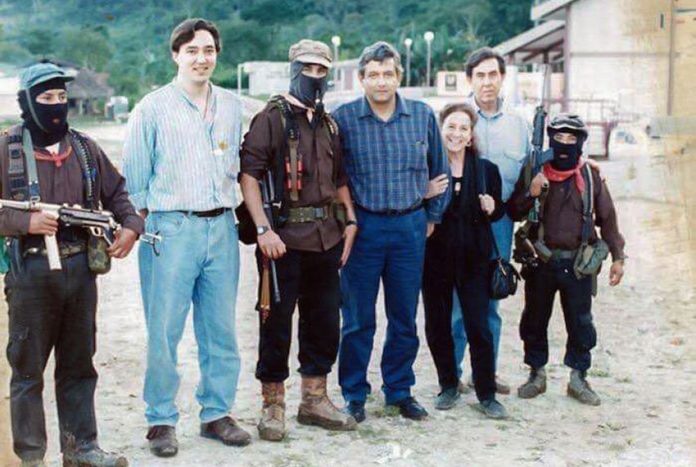
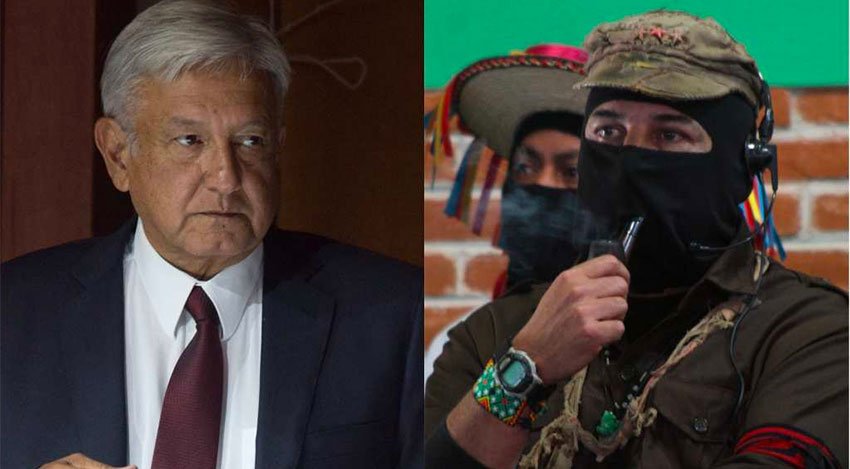
Former Zapatista leader Subcomandante Marcos, center, with López Obrador in 1994.
President López Obrador expressed his respect for the Zapatista Army of National Liberation (EZLN) during a visit to Chiapas over the weekend but the possibility of its indigenous Mayan members heeding his call for unity would appear unlikely judging by the two parties’ fractious past.
López Obrador said on Saturday that the government “very much respects the Zapatista movement,” adding that his “fraternal and respectful recommendation is for us not to fight.”
“Enough division already, all of us need to unite,” he said before reciting lyrics from the Chiapas state anthem that call for an end to “hateful vengeance” and for everyone to come together as brothers.
The president yesterday posted a 1994 photo to his social media accounts which shows him posing alongside former EZLN leader Subcomandante Marcos, other members of the rebel army and former presidential hopefuls Cuauhtémoc Cárdenas and Rosario Ibarra de Piedra.
“. . . On that occasion, the issue was to achieve peace. I only remember that a picture is worth a thousand words,” López Obrador wrote above the photo, which was published on his Facebook, Instagram and Twitter accounts.
On January 1, 1994 – the same day that the North American Free Trade Agreement, or NAFTA, took effect – the EZLN launched a military offensive in Chiapas after issuing a declaration stating that the Mexican government was illegitimate.
The rebel force seized several towns in the southern state but the Mexican army retaliated on January 2 and inflicted heavy casualties on the guerrillas, forcing them to retreat.
On January 1, army chief Subcomandante Moises said that the EZLN would oppose projects proposed by the López Obrador administration including the ambitious rail project and the National Guard.
“We are going to fight. We are going to confront [them]; we are not going to allow [López Obrador] to come through here with his destructive projects,” he said just before midnight on New Year’s Eve at a ceremony marking the 25th anniversary of the 1994 uprising.
That the EZLN opposes López Obrador should come as no surprise – it has been critical of the political veteran for more than a decade, although both are considered to be well to the left on the political spectrum.
AMLO and the pipe-smoking Marcos.
During the lead-up to the 2006 presidential election, the Zapatistas made it clear that they wouldn’t be supporting the Democratic Revolutionary Party (PRD) candidate, who ended up narrowly losing the vote to National Action Party contender Felipe Calderón.
Instead, they called for voters to abstain from voting, a move that some commentators said only helped López Obrador’s opponents.
In a 2005 manifesto entitled La (Imposible) ¿Geometría? del Poder en México (The (Impossible) Geometry? Of Power in Mexico), Subcomandante Marcos asserted that López Obrador’s plans for the country were not leftist but rather centrist, “and the center [of politics] is nothing more than the moderate right.”
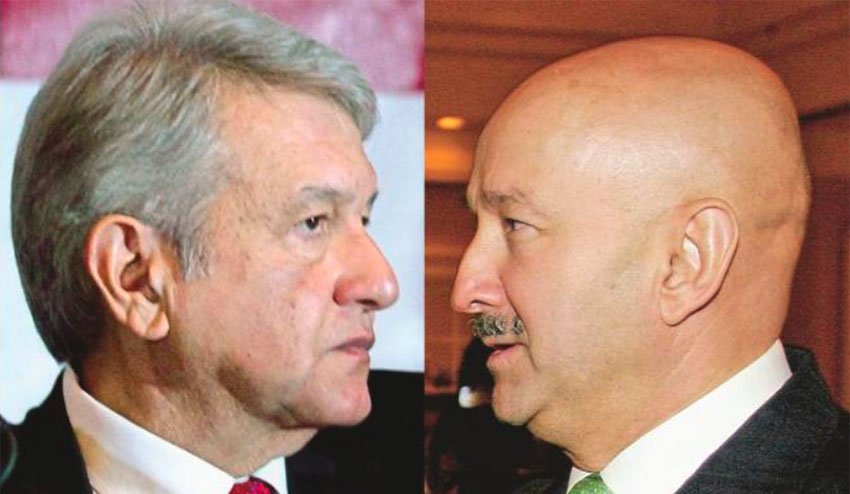
He also likened López Obrador to former Institutional Revolutionary Party (PRI) president Carlos Salinas de Gortari – widely considered one of Mexico’s most corrupt presidents – by writing that the image “constructed” by López Obrador of the latter “is, in reality, a mirror.”
It is worth noting that to this day, López Obrador continues to rail against Salinas, describing him as one of the most prominent leaders of the “mafia of power,” the president’s preferred term for describing corrupt politicians.
The president has long accused the ex- president of involvement in the alleged electoral fraud that he claims resulted in him losing the 2006 election to Calderón.
Days after the election, Subcomandante Marcos said that he agreed with López Obrador’s claim that fraud had cost him the election but denied that the lack of support from the EZLN had anything to do with the defeat.
In the lead-up to the 2012 election, in which López Obrador once again stood as a candidate for the PRD, the second-time presidential hopeful appealed to the EZLN to rethink its position.
“I ask you to freely reflect, to not make again the mistake of 2006, of discrediting [us], because without aiming to, by discrediting us and saying we were the same as the others, you helped the right,” he said.
The strategy didn’t work. Days later, Subcomandante Marcos surfaced and said that López Obrador hadn’t “matured or recognized his mistakes” from the past.
He also said that the ostensibly leftist leader’s ambitions were predicated on love, not for the people of Mexico, but rather “for the right” wing of politics.
Needless to say, the EZLN didn’t endorse López Obrador’s candidacy and PRI candidate Enrique Peña Nieto comfortably prevailed.
Marcos has likened the president, left, to a predecessor, Carlos Salinas de Gortari.
It was a case of third time lucky for the Tabasco native at last year’s election, which he won in a landslide representing a new party that he founded, the National Regeneration Movement, or Morena.
But once again the EZLN declined to back López Obrador even though his leftist rhetoric appeared to be, at least in part, congruent with the rebels’ ideology.
Instead, the EZLN declared its support for indigenous candidate María de Jesús Patricio Martínez, a Nahua woman affectionately known as Marichuy.
She ultimately failed to attract enough signatures to appear on the ballot but even so, the National Indigenous Council, an organization with close links to the EZLN, refused to endorse López Obrador.
Shortly after his victory, the Zapatistas said in a statement that the new government would only disappoint, asserting that the “foreman” might have changed but the “farmer will continue to be the same” – in other words, forgotten.
Now, a week after López Obrador celebrated the first anniversary of his election victory and just over seven months into his six-year term, there has been no indication that the EZLN is prepared to let bygones be bygones and support the maximum authority of the Mexican government, which for so long it has opposed.
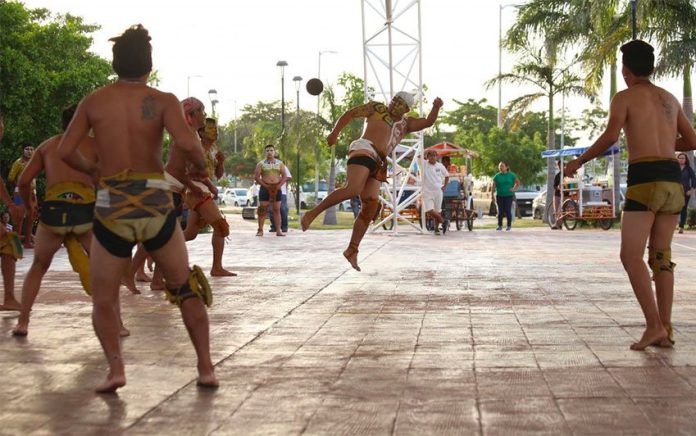
A player uses his hip to send the ball back to the other side in a game of pok ta pok.
A new school in Yucatán will teach pok ta pok, or Maya ball, a version of the Mesoamerican ballgame.
The municipality of Umán, located in the Mérida metropolitan area, has opened the school in an attempt to rescue the pre-Hispanic sport.
Municipal secretary José Manuel Ruiz Garrido told reporters that the school will be run by the Municipal Youth Institute with the goal of attracting young people from all over Umán.
“We want to rescue the Maya ballgame, which little by little has been disappearing in Yucatán,” he said. “That’s why we’re hoping that the new generations will play this sport, which was left by our ancestors as a legacy.”
José Manrique Esquivel, president of the Yucatán Association of Indigenous Games and Sports, said that more and more local and state governments are becoming interested in the game.
“It is a game, but it’s also a demanding discipline for those who play it,” he said. “In Yucatán, there are more and more groups who are getting involved.”
Last year, a team from Chapab de las Flores represented Mexico at a pok ta pok World Cup event and won. In this year’s World Cup, which took place in El Salvador, Mexican teams came in second and third place, while first place went to the host team.
It is hoped that the new school will lead to the creation of new teams across the state.
Pok ta pok is played with a ball that weighs three kilograms and is made out of rubber resin. Players use only their hips to send the ball to the other side of the court.
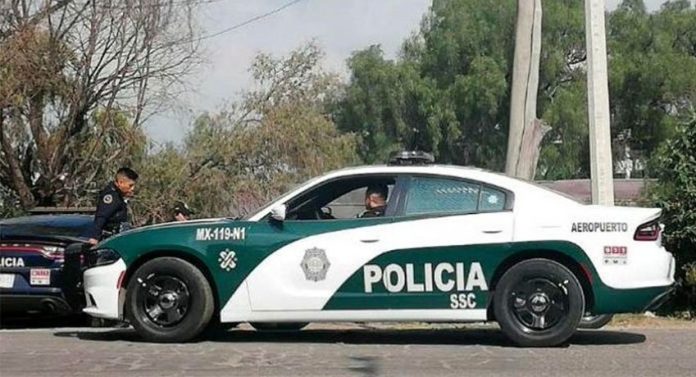
The Mexico City government has unveiled a new color scheme for its police vehicles, swapping the classic navy blue and white or yellow and white for a new green-and-white look.
In an interview with the newspaper El Universal, Mayor Claudia Sheinbaum said the new paint job will be officially announced on Tuesday. But green-and-white cars were already being seen on the streets Monday.
The new cars are the result of a July 1 contract between the city and the company Total Parts and Components to lease the 1,855 cars for three years. The cost of the lease is 3.3 billion pesos (US $174.5 million) and includes maintenance and insurance.
Leasing the cars instead of buying them saved the city about 300 million pesos, which was used to buy vehicles for the city Attorney General’s investigative unit.
The contract guarantees that 95% of the fleet will be in service at any given time. Currently, around 65% of the fleet is in the repair shop.
Jacob Thompson and the oarfish on a beach in Baja.
Two young tourists rescued a rare fish from a beach on the eastern coast of Baja California Sur a few weeks ago.
The encounter happened when Jacob Thompson, 17, and his brother Noah Thompson, 24, of Austin, Texas, were riding ATVs on a beach near Rancho Leonero Resort, getting ready to go out fly-fishing.
When the brothers saw a silver object that had washed up on the beach, Jacob Thompson “knew exactly what it was, and he was thrilled,” his brother told USA Today.
Jacob, who has been interested in fish since he was a child, had correctly identified it as an oarfish, a deep-sea fish that can grow up to 36 feet long and is rarely seen near the surface.
“When I was young I’d always seen pictures of these things and dreamed of being able to hold one,” Jacob said. “Obviously I couldn’t believe it at first. I was running up to this thing. I’d seen orange on him and I just lost it. I turned around and started screaming at my brother to come look at this thing.”
The fish found by the Thompson brothers was a juvenile, about eight feet long and weighing between 5 and 10 pounds.
To revive the weakened animal, Jacob took it into the water and began pulling it backwards to fill its gills with water. After the fish was able to hold itself upright, the brothers watched it swim away and disappear into the ocean.
John Ireland, owner of the Rancho Leonero Resort, told USA Today that in his 40 years in Baja California Sur he had never heard of an oarfish sighting.
In Japan, sightings of the rarely-seen fish are believed to be a sign of coming earthquakes, and several oarfish were reported to have washed up on Japanese beaches in the year before the 2011 quake in Fukushima.
Although most scientists have dismissed that belief, California was hit by two significant earthquakes just a few weeks after the Thompson brothers found the oarfish.
The youngster underwent surgery at the National Pediatric Institute.
In Iztapalapa, Mexico City, not even sleep provides a completely safe haven from the violence that can suddenly break out in the streets of the capital’s most crowded borough.
A stray bullet struck a 6-year old girl while she slept, striking her in the eye.
The bullet pierced the house’s sheetmetal roof and struck the sleeping girl at 2:00am on Saturday in the El Manto neighborhood. Family members rushed the girl to the Iztapalapa Pediatric Hospital but were turned away by hospital staff, who said there were no ophthalmologists on duty.
To draw attention to the girl’s plight, neighbors blocked Ermita Iztapalapa avenue and Javier Rojo Gómez avenue for over an hour. The government intervened, and the girl was transferred first to the Tláhuac General Hospital and finally to the National Pediatric Institute.
Mexico City Mayor Claudia Sheinbaum said the child’s condition was stable after surgery and that two government agencies were engaged in talks with the girl’s family.
On Sunday, Mexico City Attorney General Ernestina Godoy said an investigation into the incident had been opened.
“We are putting together an investigation, and we are looking into what was going on in the area around the El Manto neighborhood at that time. We want to know if there were parties, conflicts or anything like that to pinpoint where [the bullet] came from.”
She added that more measures were needed both at the federal and local level to prevent rampant arms trafficking in the area.
On July 4, 450 elements of the National Guard began operations in the Desarrollo Urbano Quetzalcóatl neighborhood in Iztapalapa, a zone widely considered to be one of Mexico City’s most dangerous.