Thursday, December 18, 2025
Home Blog Page 2010

Hitman guns down victim in church but spares the man’s child

0
Investigators at the crime scene in Ciudad Obregón.

“Don’t shoot my child,” were the last words of a 38-year-old man shot and killed yesterday evening in front of the altar at a church in Ciudad Obregón, Sonora.

Witnesses said the man pulled up in front of the church, located in the Casa Blanca residential area, followed by armed civilians in a pickup truck.

He ran into the church with the child in his arms but one of his assailants caught up with him inside and killed him with a burst of gunfire. The child survived the attack uninjured.

About 35 people were in El Buen Pastor church attending mass at the time.

The victim was identified only as Victor Alejandro by state authorities, who said he had a criminal record and was a pilot who worked for a crime gang known as El Chapo Trini.

Source: Entorno Informativo (sp)

Two gold medals for Mexico at World U20 Championships in Finland

0
González at the finish line today in the 10,000-meter race walk.

Two Mexican athletes won gold medals today at the IAAF World U20 Championships in Tampere, Finland.

Alegna González made history by winning the women’s 10,000-meter race walk, becoming the first athlete from the Americas to win gold in that category in the history of the World U20 Championships.

Two gold medals were awarded in the men’s high jump after Mexico’s Roberto Vilches and Antonio Merlos of Greece both cleared 2.23 meters on their first attempts.

The IAAF reported that a jump-off was an option but the two protagonists warmly embraced and agreed to split the prize.

González won her medal today with a time of 44:13 minutes, four seconds less than second-place winner Meryem Bekmez of Turkey.

It was Gonzalez’s second gold this year. She also won the U20 women’s 10-kilometer gold medal at the IAAF World Race Walking Championships in Taicang, China, in May.

Mexico News Daily

Smoothing the bumps: positive signs after high-level bilateral meetings

0
Today's meeting between López Obrador and US officials at the president-elect's campaign headquarters.

July 13, 2018 could go down in history as the day that marked the start of a new, more positive era in bilateral relations between Mexico and the United States.

A delegation of high-ranking U.S. officials led by Secretary of State Mike Pompeo traveled to Mexico City today to meet with President Enrique Peña Nieto and president-elect Andrés Manuel López Obrador.

Pompeo made it clear that the purpose of the trip was to begin to repair relations that have been strained by issues including migration, trade and U.S. President Donald Trump’s border wall proposal.

“We wanted to come down here to let you know that President Trump cares deeply for the success of the relationship between our two countries. Our presence here today signals that to you,” he said.

“We know there have been bumps in the road . . . but President Trump is determined to make the relationship between our peoples better and stronger.”

There are signs that today’s visit went some way to smoothing over the rough road down which bilateral relations have traveled since Trump took office in January 2017.

Mexico’s future foreign affairs secretary described the meeting between López Obrador and Pompeo as “frank, respectful and cordial.”

Marcelo Ebrard, who López Obrador announced as his prospective chief diplomat last week, told a press conference that the incoming administration has “reasonable optimism” that Mexico will be able to find common ground with its northern neighbor and have a good relationship in the coming years.

Ebrard said the president-elect submitted a proposal for the future of the bilateral relationship to the Pompeo-led delegation, which also included Treasury Secretary Steven Mnuchin, Homeland Security Secretary Kirstjen Nielsen and senior White House advisor Jared Kushner, who has played a central role in U.S. relations with Mexico since his father-in-law became president.

López Obrador’s proposal covered a range of issues including NAFTA, migration, security and development, Ebrard said.

He explained that further detail about the proposal would only be made public once a formal response has been received from the United States administration, although he revealed that an overarching aim of a new bilateral relationship is for no Mexican “to have to emigrate because of poverty or insecurity.”

The border wall proposal and the illegal trafficking and smuggling of weapons between the two countries were not discussed, he added.

At an earlier meeting, Peña Nieto urged the American delegation to quickly reunite migrant families that have been separated at the United States’ southern border and stressed the need to find a “permanent alternative that prioritizes the wellbeing and rights of minors.”

A statement released by the president’s office also said that Peña Nieto advised the U.S. delegation that the July 1 elections were “exemplary” and “a sign of the democratic maturity of our country.”

In addition, the president expressed concern about the recent attack on a 92-year-old Mexican man in Los Angeles, California, asserting that such incidents “encourage a climate of hate and racism that we must avoid.”

The statement concluded by saying that Peña Nieto had emphasized the government’s willingness to continue to negotiate an updated North American Free Trade Agreement (NAFTA) with the objective of completing a deal as soon as possible.

Representatives of both governments agreed to “move forward constructively” on the renegotiation process that has been characterized by the United States’ hardline stance aimed at achieving a more favorable incarnation of the 24-year-old agreement.

López Obrador has said that he will support Mexico’s negotiation team during the five-month transition period before he is sworn in on December 1.

Security was tight in the capital today for the diplomatic meetings but it didn’t stop a group of people protesting against Trump’s “zero tolerance” immigration policy near López Obrador’s transition headquarters in the neighborhood of Roma.

Protesters jeered as Pompeo’s motorcade approached the modest offices and held up signs with messages including “Where are our children?” and “Trump, no more migrant children separated from their families!”

Even though López Obrador and Trump are on opposite ends of the political spectrum, some analysts believe that the two leaders might defy the odds and develop a constructive, if not overly friendly, relationship.

López Obrador has emphasized the importance of that relationship and has declared that his government will be respectful of the Trump administration. But he has also said that Mexico in turn will also demand respect and that the country will not be the piñata of any foreign government.

One person who is confident that happier days are ahead is the U.S. Republican Party’s representative in Mexico.

“It’s a clear sign from the government of the United States, that just days after Andrés Manuel López Obrador won the election, a delegation of three secretaries and Jared Kushner are in Mexico,” Larry Rubin said in a message issued today.

“The bilateral relationship is entering a new and very positive era for both nations.”

Source: Milenio (sp) Reforma (sp)

Natural gas production even more critical than gasoline: regulator

0
Zepeda: urges focus on natural gas.

Mexico should produce more of its own natural gas to reduce dependence on imports from the United States, according to the National Hydrocarbons Commission (CNH).

Juan Carlos Zepeda, president of the federal agency, told the newspaper El Financiero that Mexico relies on U.S. imports for 85% of its gas needs, which he said creates not only a “geopolitical risk” but also an “operational risk” due to the possibility of a natural disaster interrupting supply.

“One of the first things we have to do . . . is produce more [of our own gas],” Zepeda said, sending a clear message to president-elect Andrés Manuel López Obrador.

This year, Mexico has imported an average of almost 120 million cubic meters of gas per day via pipelines that run into the north of the country.

Meanwhile, Mexican production of natural gas declined by 8.9% in May compared to a year earlier, according to data from the Mexican Energy Information System.

While López Obrador has said that he will seek to end massive gasoline imports — which also mainly come from the United States — and boost domestic production capacity by building one or two new refineries, Zepeda charges that ensuring Mexico’s gas security is an even more pressing need.

Speaking at a recent business forum, the CNH chief said that it is possible to bring gasoline into the country via ship in two days but because Mexico has insufficient regasification capacity, it cannot import gas by the same means.

Zepeda added that the need to produce more gas domestically represents an opportunity for the transformation of Pemex, explaining that the state oil company was awarded the rights to 90% of Mexico’s proven gas reserves but has been unable to exploit them due to a lack of capital.

He recommended that the government replicate the model in use in China, where petroleum companies owned and operated by the state are permitted to undertake joint ventures in order to raise capital.

Zepeda also said the federal government should provide tax incentives to encourage gas exploration and production and invest in increasing regasification capacity to mitigate the risk of supply cuts due to natural disasters such as hurricanes.

The latter measure would also allow gas purchases to be made from a greater range of suppliers located in countries that don’t share a land border with Mexico.

“We have a very limited regasification capacity in Mexico so our vulnerability [to supply cuts] is greater,” Zepeda said.

The CNH estimates that if Pemex increases its focus on the development of natural gas reserves, an additional 85 million cubic meters of gas could be produced daily, increasing Mexico’s daily output to 283 million cubic meters per day.

Source: El Financiero (sp), Milenio (sp)

Hundreds saved by advance warning of commercial center’s collapse

0
The commercial center where hundreds were evacuated in the nick of time.

Advance warning of the partial collapse of a commercial center in southern Mexico City yesterday saved the lives of hundreds of people, according to a report published today by the newspaper El Universal.

Half an hour before a section of the Artz Pedregal Commercial Plaza came crashing down just after 11:00am, private security personnel told employees and members of the public at the center that they had to evacuate immediately.

The account contrasts with the version of events provided by the Mexico City government, which said the center was evacuated three hours before the collapse occurred.

Structural faults are believed to have caused the incident. Mexico City Mayor José Ramón Amieva said the collapse was a “case of negligence” and that an investigation would determine the exact cause.

Víctor Cuéllar, a chef at a restaurant located on the third floor of the center next to the section that collapsed, told El Universal that the forewarning he and his 60 staff received came just in the nick of time.

While going downstairs on the building’s second floor, Cuéllar said, he and other restaurant workers heard “a very loud noise” that sounded like the dragging of boxes across the ground and then the building started to collapse.

After exiting a rear door of the plaza, Cuéllar and his team were engulfed by a cloud of dust that made it difficult for them to orient themselves and see exactly what had happened.

The evacuation raised suspicions that the collapse was a planned and controlled demolition but a spokesman for the plaza denied that was the case in a radio interview yesterday.

The center’s operator said in a statement that it notified city authorities as soon as it detected signs that the area would collapse.

It also said it regretted the impact the incident was having on traffic on the busy Periférico ring road, which is located adjacent to the commercial center. At least two outer lanes of the road were closed.

The order to evacuate was not the only warning sign that something ominous was about to happen at the new commercial center, which has only been open since March.

El Universal reported that before 10:00am people reported hearing a creaking sound emanating from the third floor.

Following the hurried evacuation, employees, shoppers and passersby gathered outside the plaza where they witnessed rows of windows splintering off just before the rest of the building section collapsed. Many of them filmed the incident on mobile telephones and uploaded the footage to social media.

Emergency services arrived at the scene soon after and 40 minutes after the collapse, Civil Protection Secretary Fausto Lugo said via Twitter there were no casualties.

Mexico City’s Attorney General’s office said last night that the weight of a rooftop garden might have caused the collapse. It said large planters could have added excessive weight to the building’s roof.

Source: El Universal (sp), Associated Press (en)

Cozumel police protest mismanagement of funds, threaten strike

0
Unhappy police in Cozumel.

Municipal police in Cozumel, Quintana Roo, have accused senior officers of mismanagement and threatened to go on strike, moves that have triggered the resignation of the chief of police.

The dissident police accuse the municipality’s public security and traffic department of mismanaging federal funds allocated to the security strengthening program called Fortaseg.

The protesters also demanded new uniforms, the standardization of salaries, the payment of bonuses owed for two years and the dismissal of police chief Raúl Sánchez Martínez and staff under his command who are involved in the alleged mismanagement of funds.

The dissenting officers also demanded to see Mayor Perla Tun Pech, who had pledged to meet similar demands made by the municipal police force in the fall of 2016.

But when Tun arrived at police headquarters and asked the protesters meet her in her office, they refused.

The protest then moved to the street outside the mayor’s office where several patrol cars were used to mount a blockade.

Tun later informed the protesters that she had accepted the resignation of Chief Sánchez and dismissed Fortaseg Cozumel liaison María Yajaira Jiménez Azueta. She added that the municipal police force had already received two sets of uniforms and that two more were coming.

The mayor offered the officers a cash payment of 9,000 pesos (US $475), a similar amount that would be deposited to their retirement funds and 3,000 pesos ($158) in food vouchers.B

But the protesters refused the offer, demanding instead that 18,000 pesos be paid in cash or they would go on an indefinite strike.

Mayor Tun said she has asked for federal intervention, declaring that she can’t meet the officers’ demands if she doesn’t have money to pay for them.

Municipal police in Benito Juárez and Solidaridad, where the resort destinations of Cancún and Playa del Carmen are located, have recently made similar claims of mismanagement of Fortaseg monies.

Source: Diario de Yucatán (sp), Noticaribe (sp)

Realtors welcome decentralization, anticipate boost for sector

0
There could be more construction as a result of decentralization.
Relocating government departments could also be good for construction.

The real estate industry has welcomed federal government plans to decentralize some of its departments.

Three federal secretariats will move their offices from Mexico City. two to the southeast and one to the north. Tourism Secretariat headquarters will be in Chetumal, Quintana Roo, the Secretariat of the Environment and Natural Resources will operate from Mérida, Yucatán, and the Economy Secretariat will be headquartered in Monterrey, Nuevo León.

The president of the Mexican Association of Real Estate Professionals (AMPI) said decentralization had been proposed several times in the past, but faced several bureaucratic obstacles.

“Finally, it looks like there’s a willful determination to make this happen,” said Alejandro Kuri Pheres, who expects the process will give a boost to the real estate sector and be good for the states’ economies.

Yucatán and Quintana Roo are good choices for the two departments, he said, because the Mexican Caribbean draws nearly 40% of all Mexico’s foreign tourism and Yucatán hosts a large part of the rainforests that still exist.

The vice-president of the Caribbean chapter of the Business Coordinating Council (CCE) agreed.

Ángel Lemus Mateos explained that decentralization will have a positive impact on real estate through the leasing of office space and the construction of new space.

It will also provide a stimulus to business tourism.

Lemus said moving the Tourism Secretariat to Chetumal will consolidate the city’s economy, where the workforce has depended for years on job opportunities within the state government.

AMPI president Kuri told a press conference earlier this week that moving a government department into a new location is like installing a large business, an industrial plant or even an airport.

He also observed that corruption is costly to the real estate industry because of the many permits, licenses, procedures, gifts and rewards that must be paid, and add 14-16% to the total cost, and welcomes the new government’s campaign promise to address it.

For another real estate professional the limitations on foreign ownership of land on the coast is an issue she would like to see addressed.

María Tayde Favila Soriano, head of the Cancún AMPI chapter, told the newspaper El Economista that her organization plans to discuss constitutional reform that would eliminate the constraints on foreigners buying land in the coastal zone. At present they can only do so with a bank trust or through a corporation.

Source: El Economista (sp)

Relatives remember Chihuahua victims as hard-working family

0
The suspect and one of his luxury vehicles.

Relatives of a Chihuahua family shot and killed by an alleged vendor of body organs remember the victims as members of a hard-working family.

Daniel Gregorio Romero Vega, 65, who suffered from diabetes and was in urgent need of a kidney transplant, had paid a man half a million pesos for a kidney, but the organ had not been delivered.

He and his family invited the man, who has been identified only as Jorge Alberto, to their home where they intended to demand he return the money.

But the meeting on the night of June 30 turned sour, according to officials at the state Attorney General’s office. They said surveillance camera footage shows Jorge Alberto draw a 9mm handgun and shoot and kill Romero and four members of his family. He stopped short of taking the life of a two-year-old boy, Romero’s grandson.

In addition to Romero, the victims were his wife, Rita Armendáriz Barraza, 62, two of their three daughters, Daniela and María Romero Armendáriz, 36 and 32, and son-in-law Ricardo Chávez Pérez, 32.

The massacre was discovered the following morning by another of Romero’s sons-in-law.

“Rita and Daniel did everything for their children. They both came from ranches in Parral and moved to Chihuahua to raise their three daughters.”

Romero held two jobs, one at the municipal water department and the other in a factory. They put their daughters through school, and all three had obtained bachelor’s degrees.

“He loved his neighbors, he helped everyone, family and friends. He was a volunteer at several charities and bought presents for orphaned children at Christmas,” family members said.

Jorge Alberto is now in custody, accused of murdering at least seven people while employed as an orderly at an IMSS hospital. He allegedly helped fellow employees get job promotions in exchange for a fee, and found organs for people requiring transplants.

But he didn’t always keep his side of the deal, and is suspected of killing his victims when they complained. Authorities say Jorge’s racket was so profitable he had bought 10 luxury vehicles.

Source: El Universal (sp)

Judge sentences Aguascalientes man to 87 years for sexual abuse of minors

0
García was a spiritual guide to his victims.

A man who acted as a “spiritual guide” to youngsters in the city of Aguascalientes has been sentenced to 87 years in jail for sexual abuse.

José Manuel Aguilar García was charged with sexual abuse and sexual assault against eight youngsters who attended his religious classes at a Catholic organization in the city.

The incidents took place in 2006 and 2007, the state Attorney General said. When accusations of abuse were made against him, he fled to the city of Querétaro, where he taught theology at a private university until his arrest in 2014.

Aguilar would take his students to solitary locations, various beach resorts and a corner grocery store he owned where he would engage in sexual acts with them.

In addition to the jail sentence, he was fined 67,000 pesos.

Source: El Universal (sp)

AMLÓpolis is new government’s blueprint for better living

0
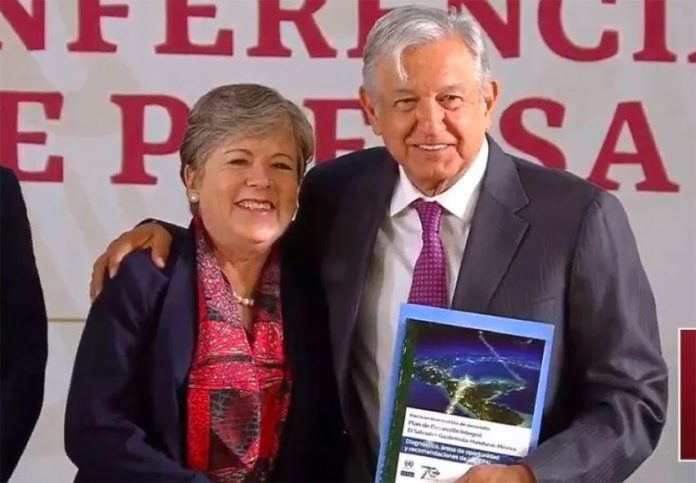
AMLÓpolis, the new government's development plan.

Stimulating regional development, ensuring that cities are well-managed, sustainable and safe, meeting housing needs and improving transportation services are all on the agenda for Mexico’s next federal government, according to a development plan known colloquially as AMLÓpolis.

The plan says the administration of president-elect Andrés Manuel López Obrador, also known as AMLO, will seek to “improve the environment in which millions of Mexicans live through the provision of quality infrastructure, public spaces, facilities [and] affordable and well-located housing.”

Román Meyer Falcón, an architect and academic who specializes in urban development, will be responsible for executing the plan as secretary of agrarian development and urban planning.

In keeping with López Obrador’s pledge to improve the standard of living for millions of poor Mexicans and to make economic growth and development more equitable across the country, the development plan says the administration will seek to “stimulate greater public and private investment in the country’s most disadvantaged regions.”

Directing public resources to the country’s poorest regions to carry out new infrastructure projects will be a priority.

In the nation’s metropolitan areas, the AMLÓpolis document says the government’s objective is to have “harmonious” urban development which contributes to making cities more connected, sustainable and inclusive.

Prudent water management, the provision of adequate sewage treatment services and the security of citizens are also priorities.

To halt or at least slow the uncontrolled march of urban sprawl, the AMLO-led administration will promote higher-density living closer to the center of Mexico’s large cities with both public and private investment slated to contribute to new housing developments.

The government will also develop “alternative models” to help people on low incomes purchase land, while a new housing policy that involves all three levels of government and the private sector will be designed to meet families’ needs.

“New homes will be well-located and have adequate urban facilities,” the document says, adding that financial assistance will be made available to people on low incomes and young people so they can access adequate housing.

With regard to public transportation, AMLÓpolis states that the next government will modernize existing transit systems to make them more integrated and to improve accessibility to essential services and facilities.

It also says the government will seek to make public spending more equitable across all modes of transportation by considering the needs of cyclists and pedestrians as well as users of public transit. Citizen participation in public transportation decisions will be encouraged.

In rural regions, the document states, the government will protect the rights of land-owning collectives and promote democratic participation in decisions related to agrarian and natural resources.

The priorities of the incoming López Obrador-led administration are becoming clearer through documents such as AMLÓpolis and a 12-point plan AMLO outlined this week that sets the next government’s legislative agenda.

López Obrador will be sworn in as president for a six-year term on December 1. He named the members of his prospective cabinet last December.

He won the July 1 presidential election in a landslide and has pledged to stamp out government corruption and transform Mexico.

His sweeping victory gives him a mandate to fulfill his campaign promises and with the three-party coalition he leads winning majorities in both houses of federal Congress, he will have the congressional backing to do so.

Source: Milenio (sp)