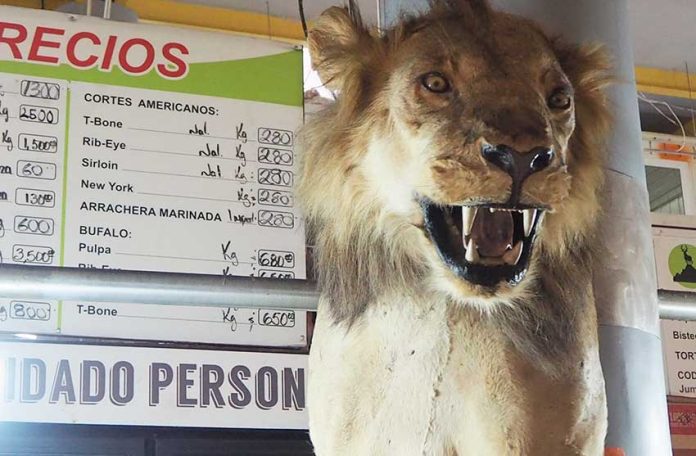
“Hello, friend. What do you want to eat? Crocodile, lion, armadillo, iguana, ostrich?” runs the vendor mantra at the Mercado de San Juan in Colonia Centro. The framing and countertops of each stall are decorated with the heads of their prey – capybaras, tigers, kangaroos and buffalo – their flesh long since consumed.
A ragtag brass band walks slowly, hat out for tips, through the rainbows of fruits and vegetables, European cheeses and cured meats, dried insects, skinned rabbits and goats, mountains of obscure sauces, and an entire ocean of fish, crustaceans and bivalves.
Built in 1955 on the former space of the Buen Tono cigarette warehouse and officially titled Mercado de San Juan Ernesto Pugibet after the land’s former owner, the building is one of the oldest municipal markets in Mexico City, and its common name comes from the nearby San Juan Plaza, where food vendors sold their wares beginning in the early 1900s.
The market is renowned worldwide for its rare array of gastronomic delicacies: items uniquely Mexican and strange to the rest of the world and others seldom seen in Mexico, imported from distant locales. And then, of course, there are tiger steaks and lion burgers – among some of the scarcest of meats, raised legally on farms in Puebla and Guerrero.
Food tourists ogle, sniff and poke; their taste buds stoked, cameras cocked and ready, as they vacillate at countertops, anxious for the sensual experience of the virgin tongue.
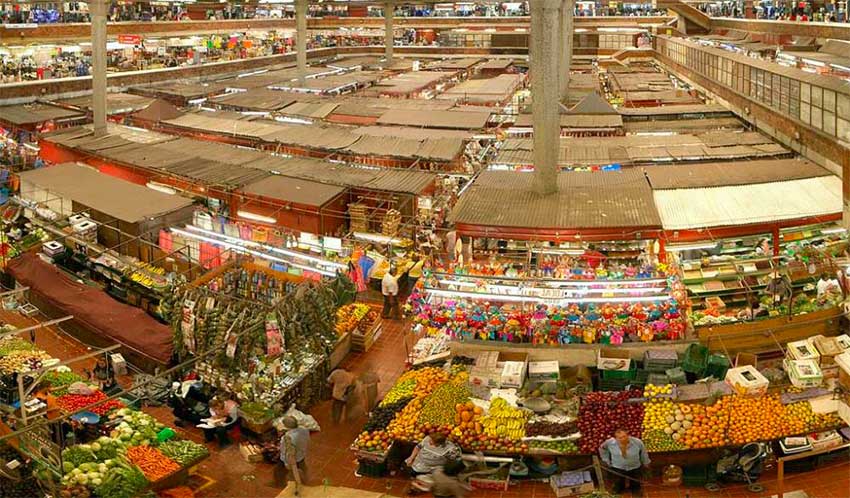
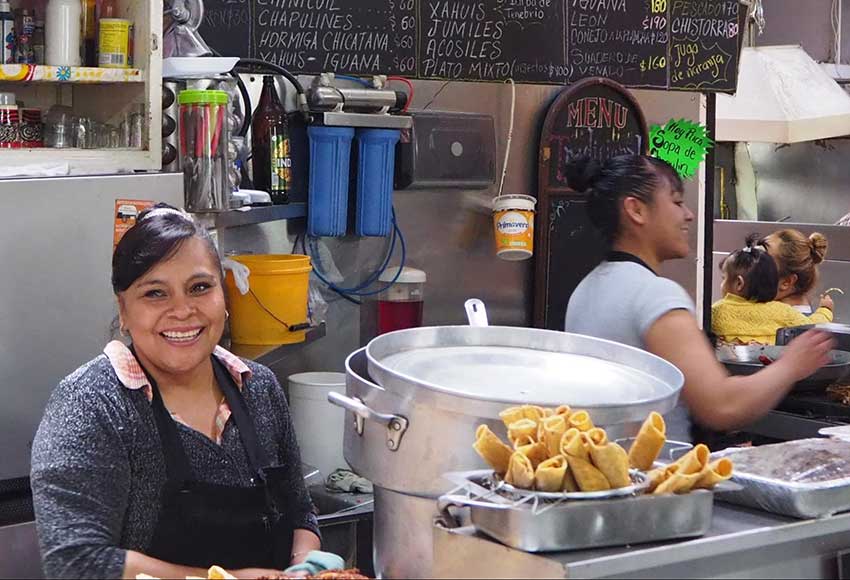
Martha Marín Marín, proprietor of La Sorpresa restaurant – staffed today with her daughter Jessica at the grill and son Aarón waiting tables – says it takes a special sort of interest to sample lions and tigers. They’re the strongest of the meats, and she doesn’t sell them much. They have to be cut into extremely thin slices and marinated in herbs and olive oil, then either grilled or pan seared in garlic olive oil to cut the overwhelming flavor.
Marín has owned La Sorpresa for 20 years but first started working at the market at the age of 12 when she would travel to the city on school breaks from Valle de Bravo to stay with her sister, who got her a job as a dishwasher.

“Tourists come from Sinaloa, Colombia, the U.S., China, Japan, Italy, all over,” Marín explains. “A lot come with guides who explain the food in their own language. The most popular we sell are crocodile, armadillo and wild boar. I try everything, but my favorites are venison, armadillo and wild boar.”
The latter doesn’t quite tick the exotic box. But an anteater in a shell, part rodent part rhinoceros, seems sufficiently weird. So I go with the armadillo, the “little weaponized one.”
A serving of armadillo, marinated and wrapped in plastic, comes out of the freezer and into a frying pan. Most of the exotic meats are frozen because they’re not selling dozens of armadillos a day. It’s served steaming hot, the meat stained red from the pepper marinade, with a distinct, smoky aroma that tingles the nose.
“Armadillo a los tres chiles” is marinated in guajillo, pasilla, and morita peppers and served with a side of rice and tortillas. It’s a small, round slab of the animal, cut from spine to belly with the carapace shell still intact.
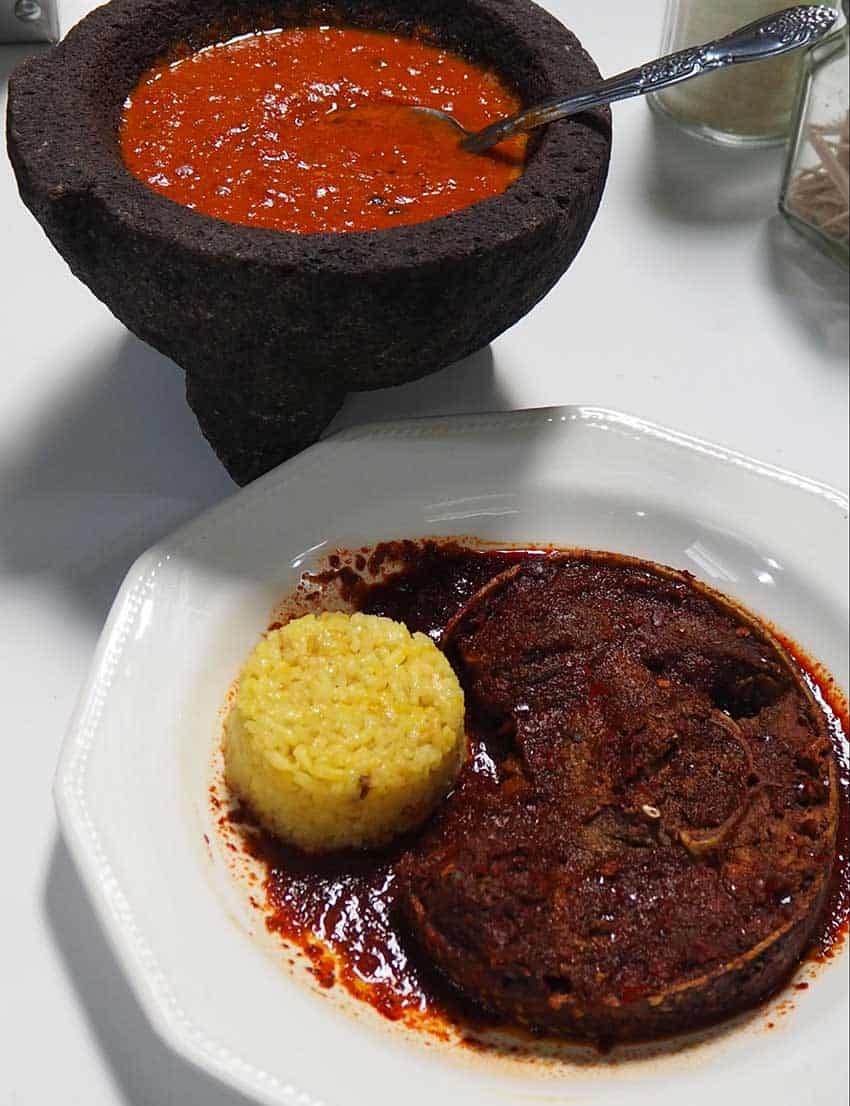
At first bite, I’m a little skittish to be peeling a mammal’s shell before slicing its flesh with my knife. Yet, after a single swallow holds, I can enjoy for taste alone. I realize the meat is more tender as I move toward the center, away from the carapace.
I see what appears to be a spine but no visible organs. It’s an interesting experience eating an animal cut all the way through from abdomen to back, as if sliced into pieces by a cartoon samurai. “I special order these cuts,” Marín explains. “They’re cut into medallions with a deli slicer. They have more meat and fat. When they’re cut into strips, there’s more bone.”
The flesh is lean and flavorful, with a slight, sweet liver taste but not too gamey, requiring a bit of knife work but not overly chewy – sort of like a porky rabbit. The peppers add a perfect saline and smoke flavor. “It can be made with more peppers,” Marín tells me, “but for me, this is the best combination.”
Marín talks like a woman that is used to this, like she’s been on TV. A documentary crew passes, panning the camera over stuffed animal heads. A man sits next to me and is served a simple consommé, while I request the provenance of my fried armadillo.
“I don’t know exactly where they come from,” Marín tells me. “I get them from different purveyors that work with farms throughout Mexico, but I don’t know what part of the country each animal is from.”
Jessica teases her brother out of boredom as he tries to get butts in seats for a bite of iguana. A tour of Americans passes learning about bugs. A well-behaved and manicured German family scans the vegetarian section with its mounds of mushrooms, blazing pink and yellow tropical fruits, unknown nuts and the mostly northern tree fruits and Asian vegetables that are often hard to find in Mexico.
The selection varies greatly depending on the season, with late fall among the most exciting for the wide variety of wild mushrooms coming in from the hinterlands. I tell a woman pushing persimmons that I’m a journalist and ask if I might be able to question her. She’s not at all interested, with a response that tells me she gets this request quite often.
Instead, she offers up her colleague, Claudia Barona of Rosse Gourmet, a gracious and eloquent host, well-versed in the historical significance of her offerings, many of which have been fundamental parts of the local diet for millenia.
She makes a clear point that, although they are a central ingredient to modern Mediterranean and European cuisines, tomatoes didn’t arrive in Spain and Italy until the 16th century.
I learn that tomatoes are thought to have first been cultivated by Mexican ancestors as early as 700 AD, originally as tomatillos, eventually growing into their sweeter, redder cousins that we we know as the modern tomato. In Mexican Spanish the word tomate is what we call “tomatillo” in English (coming from Nahuatl word tomātl, “swelling fruit” or “fat water”), while what Mexicans generally call jitomate is actually “tomato” in English (from Nahuatl xitomatl, loosely, “swelling fruit with a navel”). And Barona is delighted to point out that aguacate (avocado) is a Spanish bastardization of the Nahuatl word āhuacatl, meaning “testicle.”
For foreigners, she says, huitlacoche is one of her most frequent sales. Called the “Mexican truffle,” huitlacoche is a microfungus that grows within the cell walls of corn kernels to produce a blue-black powdery flesh, unlike mushrooms that are macrofungi and have their own multicellular fruiting structures.
Huitlacoche has a mild, semi-sweet, nutty, umami flavor – equal parts sweetcorn and mushroom – and is a common ingredient in quesadillas, tamales and scrambled eggs, turning to a dark black color when cooked.
“When mushrooms have a strong smell, it often means that they’re good and ready to eat,” Barona tells me. “But when huitlacoche starts to smell strong, it means it’s going bad and shouldn’t be eaten.”
Barona hands me a sample of a small tuber called papa de agua or oca that looks like a hard, bright red caterpillar and grows in shallow, slow-moving rivers and streams (hence, the name “water potato”). They’re common from Jalisco to Hidalgo and the mountains of Colombia and Peru, and are a traditional food source of the areas. They taste a bit like an apple, sweet and slightly acidic, usually eaten raw or roasted with poultry.
She points out the rábano arcoiris as a more popular delicacy among her Mexican clientele. Literally translated as “rainbow radish,” but more commonly known as “watermelon radish” in English due to its green skin with white flesh turning to dark red as it approaches the center. I recognize the watermelon radish as a common garnish among modern elite diners and their chic restaurants of choice.
As well as a popular destination for culinary tourists, San Juan Market is often mentioned as a favorite foraging spot for local chefs of international renown, so I assume Barona’s Rosse Gourmet would be frequented by the upper echelons of Mexico City culinarians. However, when I ask if “chefs” come to purchase from her she gives me a curt, “No” (a response that I understand to be a rejection of a word that, to her, denotes “white-jacketed, social-climbing snob”).
“Only tourists buy. They come with tours or by themselves to try new things,” she continues. (Or it could be that I am just one in a long line of foreign journalists obsessed with the circumstance and celebrity of 21st-century food culture and am simply cliché.)
At the far edge of the market hang pink muscled goats, lambs and deer, butchers working to free them of their internal organs. Gutted piglets lie together in rows, each one’s legs spooning its brother to the front, eyes closed, as if dozing the afternoon away.
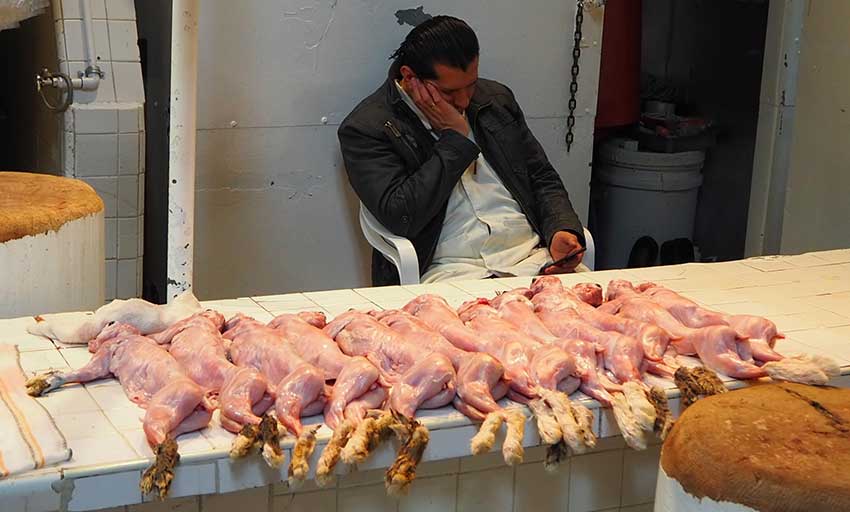
Fuzzy rabbit feet peek out from under towels, the rabbits appearing to be piled in a cuddle underneath, until the realization hits that, apart from the feet, they’re skinned bare.
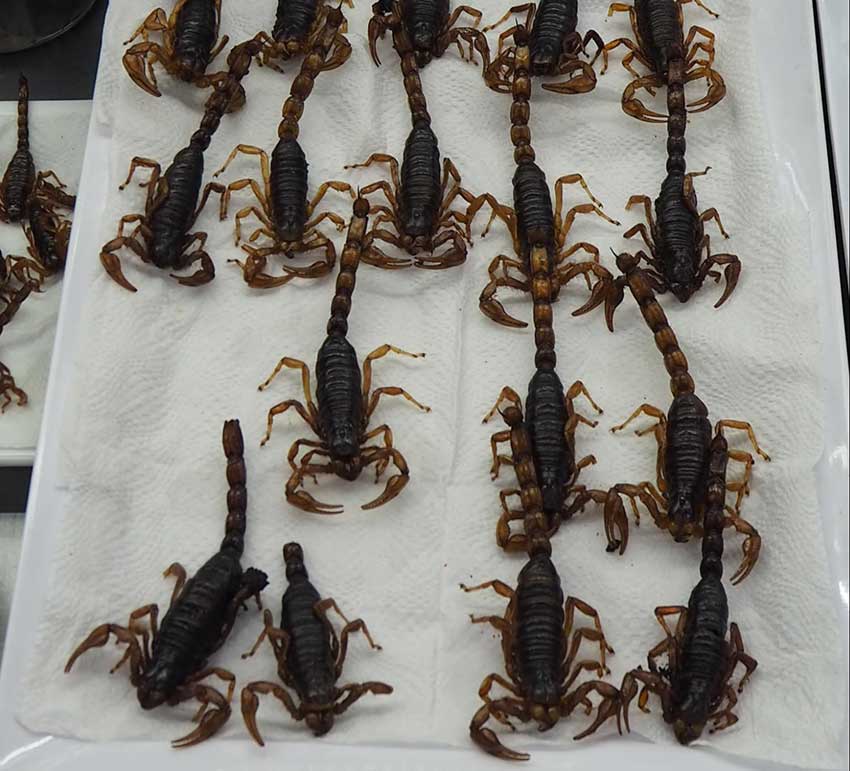
Next come rows of insects laid out on plates: chocolate covered chicatana ants, scorpions in lollipops, dried beetles and cockroaches and piles of seasoned maguey worms and grasshoppers, most of which have been regular protein sources for millenia. Tourists squeal and wince as they munch on crunchy bugs and fat, gooey worms, the vendors egging them on for personal delight.
At the restaurant México en el Paladar, I talk to José Carlos Camacho who tells me that the grasshoppers are the most common at 80 pesos for 60 grams, while the “tarantula tasting with a salad accompaniment” is the priciest at 500 pesos. You can get 10 scorpions for 250. A taco filled with dozens of whole, tiny crayfish, called acociles, costs 45. And a serving of one of Mexico’s most treasured delicacies, the buttery, melt-in-your-mouth escamol (chicatana ant eggs), will set you back 200 pesos.
For those with an affinity for the European diet there are countless tapas stalls, deli cases filled with cheeses and pâtés and hanging dried sausages and hams, begging to be plucked from their hooks. Among the most visited is Tapas de San Juan, where meat and cheese tapas, or a baguette sandwich, will run from around 150 to 400 pesos. It seems expensive until you realize that you won’t be charged for any wine until you’ve reached at least the fourth glass.
Shared seating on plastic stools and pallet benches around a table spread of flavored oils, herbs, marmalades and salsas makes for a good excuse to meet new friends. The sandwiches are large and the wine is flowing, so come with friends or be prepared to make new ones.
I decide on a domestic foie gras that is quite good, despite the overabundance of aspic, the thick, congealed meat jelly that often surrounds a pâté. I pick at the delicate pieces, not quite hungry: a fussy little foodie, teasing foie gras around his plate.
I chat with a British woman, new to the city, who is out designing a food tour for English-speaking visitors. We exchange notes on the market, speaking from a polite distance, despite the loud prog and psychedelic rock coming from the speakers. I make a note to visit the domestic specialty wine and beer shop in the back corner, though I never make it. Our glasses are filled dutifully, and I realize it’s nearly closing time.
As San Juan Market begins to close, there’s a comforting rowdiness in the air. The patrons have drunk abundantly at the wine, beer and mezcal, and vendors pop open Modelos and Tecates while they squeegee and wipe. Piles of skin bits, fish heads and animal feet wait to be bagged up and sold elsewhere.
I ask a woman wiping down the a fish counter if I may ask her a few questions. She points to a gray, crotchety, old man, gesticulating wildly at a friendly-looking couple dressed in light, wicking travel gear. “That’s the guy you need to talk to. He does all the promotion,” she says with a smirk. “But right now he’s talking politics.”
The documentary crew passes, scanning close-ups of an icy pile of enormous shrimp. The fishes still present are beautiful, hulking specimens; only fresh raw seafood, no prepared foods in sight.
When he has finished chatting, I meet Sergio Martínez, who’s owned El Puerto de Santander fish stall for seven years. His family has been in the fish business for over 100, when his grandfather’s brother had bodegas in the city. He began working under him as a kid and has been selling at San Juan Market for 59 years straight.
He tells me the róbalo (sea bass) is the most popular and his personal favorite because you can prepare it however you want, and it’s always delicious. In ceviche, grilled or fried it will be good. “In general, Veracruz has the best seafood,” he tells me. “But the pulpo [octopus] is best from Campeche, and the best langosta [lobster] comes from the Gulf.”
I bring up the global popularity of the market. “Who are your clients?” I ask. “Is it locals, food tourists?”
“Tourists don’t buy,” he tells me. “People that buy from me come from a certain sector of society. The ones that like high quality. The cost is pretty high to produce and source good quality, and some don’t want to pay. If you want good quality, you have to pay.”
I mention the tapas, that they seem expensive until you account for the copious wine pours. “How much does good wine cost?” he asks. “That’s not good wine they’re serving.” He doesn’t care for the prepared foods. “It loses what it is to be a market,” he says.
“I saw the old generation. They made everything themselves. It’s symbolic what these so-called restaurants pay the government for their stalls. When the market started, they weren’t selling any prepared foods. It’s not hygienic to cook in the market. These aren’t real restaurants.”
I get on my highfalutin horse again and ask about Mexico City chefs. “Chef,” he says with crystal-clear disdain, shot point-blank. “There are great cooks that come to buy from me. Some work in restaurants. But chefs? There are more gastronomy schools than medical schools here in Mexico these days. They are afraid of math and chemistry, so they go to cooking school!”
• Mercado de San Juan is located at Calle Ernesto Pugibet 21, Colonia Centro, Mexico City; open Monday through Friday, 9:00am to 5:00pm.
This the first in a series exploring the numerous, diverse markets and tianguis (markets on wheels) of Mexico City.