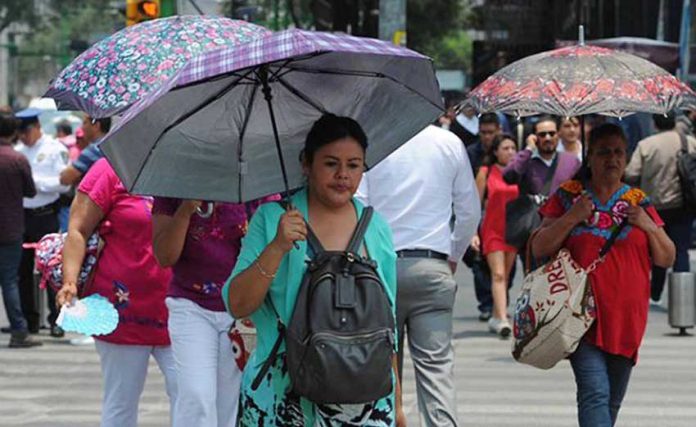
The National Meteorological Service (SMN) has forecast that the heat wave sweeping over 20 states is expected to continue at least until Wednesday afternoon.
High temperatures are expected to remain between 35 and 40 C in parts of Sinaloa, Colima, Nuevo León, Durango, Hidalgo, Querétaro, Puebla, Morelos, Veracruz, Campeche, Yucatán and Quintana Roo.
In parts of San Luis Potosí, Nayarit, Jalisco, Michoacán, Guerrero, Oaxaca and Chiapas, temperatures are expected to rise above 40 C.
The seventh winter storm of the season will bring snow and sleet in mountainous regions of Sonora, Chihuahua and Durango through Wednesday.
Temperatures will drop to between -5 and 0 C in the mountains of Baja California, Chihuahua, Durango, Sonora, Coahuila, Zacatecas, San Luis Potosí, Tlaxcala and México states.
Strong winds with gusts reaching 70 kilometers an hour are expected in Chihuahua, Coahuila, Durango and Zacatecas.
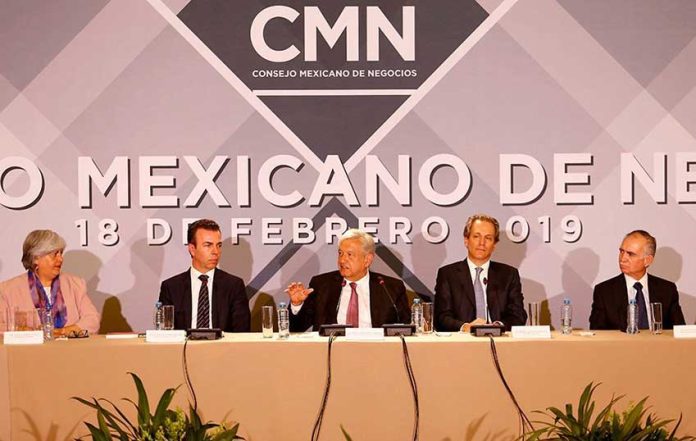
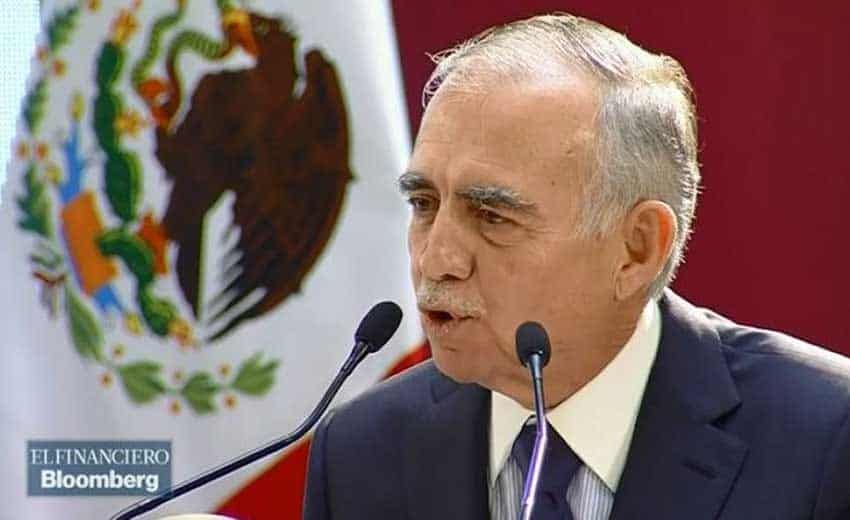
López Obrador, center, with members of the business council.
Despite suffering setbacks such as the cancellation of the new Mexico City airport project and the freezing of the 2014 energy reform, Mexico’s business leaders continue to give President López Obrador the benefit of the doubt.
The president met yesterday with members of the Mexican Business Council (CMN) – an elite group made up of 60 of the largest businesses in the country – who made it clear that they remain willing to collaborate with the new government to achieve greater economic growth and prosperity.
While business leaders didn’t reproach López Obrador for his decision to scrap the partially built US $13-billion airport at Texcoco, México state, or bring up the energy reform issue, the meeting wasn’t a total love fest: criticism was leveled at the president for his government’s handling of teachers’ recent rail blockades in Michoacán and strike action in Tamaulipas.
Both the blockades, which lasted for a month, and the strikes in the northern border city of Matamoros caused significant damage to the economy and, according to the CMN members, sent a negative message to investors.
Antonio del Valle Perochena, who was sworn in yesterday as the council’s new president, said the private sector is committed to investing in Mexico and supporting the government, but stressed that respect for the nation’s institutions and strengthening the rule of law are needed to ensure that the confidence of investors is maintained.
Del Valle Perochena, who is also chairman of petrochemical and banking conglomerate Grupo Kaluz, added that “as Mexicans, it’s our duty to contribute” to the achievement of the government’s goals of improving security, combatting corruption, stimulating economic growth and generating well-being.
The businessman said that member companies of the CMN could invest more than US $31 billion in Mexico this year but explained that they are waiting for the government to complete its National Development Plan (PND), which will set the economic course for the next six years, before they finalize their plans.
“We’re working together with the federal government to establish the [plan] . . . At the start of all six-year presidential terms . . . there are a lot of projects to do and the PND is going to define a lot of things . . . Our greatest interest is to invest in the country and to create jobs,” he said.
In his address to the business leaders, López Obrador said: “If there is growth, there are jobs. If there are jobs, there is well-being. If there is well-being, there is peace. That’s the route we must go down . . . You are fundamental to achieving growth and well-being but mainly growth because it’s very important that you invest and create jobs . . .”
However, outgoing CMN president Alejandro Ramírez pointed out that jobs are threatened by strikes in Matamoros and warned that more than 1,200 companies could be affected in Tamaulipas alone if the job action spreads.
The CEO of the cinema chain Cinépolis also questioned why “a small group of protesters” was permitted to maintain rail blockades in Michoacán that “caused losses of more than 24 billion pesos,” contending that a “bad precedent” had been set and that the government’s inaction sent “a negative message about the prevalence of the rule of law.”
López Obrador refused to use force to remove teachers from railway tracks and even sought an opinion from the National Human Rights Commission (CNDH) about what to do to end the blockades, only to have the commission say the government shouldn’t delegate its responsibilities to protect people’s rights.
Following the meeting, former CMN president and chairman of Kimberley Clark de México, Claudio X. González Laporte, told reporters that behind closed doors, he expressed his concern to López Obrador about the possibility that Mexico’s sovereign credit rating could be downgraded.
The rescue plan for the state oil company, announced by the president last week, was described as insufficient and disappointing by financial institutions, while Fitch Ratings warned that it doesn’t insulate the state oil company against future cuts to its credit rating, which it currently places just one notch above junk status.
González said López Obrador expressed his commitment to maintaining Mexico’s standing as a safe investment destination, adding that the private sector will do all it can to “retain investment grade [ratings] both for Pemex and the country.”
The governors of Guanajuato and Querétaro have expressed concern over the reduction in federal funding for municipal police forces, a move the former described as a “national strategy mistake.”
Last year, 21 municipalities in Guanajuato – the most violent state in 2018 in terms of sheer homicide numbers – received funding for their municipal police forces via the federal government’s Security Enhancement Program (Fortaseg).
But this year, the new administration has only allocated resources to 15 municipalities, all of which will receive less money for their police forces than they got in 2018.
León, which recorded the second highest number of homicides last year among Guanajuato’s 46 municipalities, will receive 38.3 million pesos this year compared to just over 67 million pesos in 2018, a 42% reduction.
All told, the 15 municipalities included in Fortaseg this year will receive 214 million pesos (US $11.1 million) but among those that won’t receive any federal security funding are municipalities located on the border with Jalisco and Michoacán, two states where criminal organizations have a strong presence.
Guanajuato Governor Diego Sinhue Rodríguez Vallejo said he has supported the government’s national security strategy, including the proposal to create a national guard and the crackdown on fuel theft, but was critical of the funding cuts for municipal police.
“If we don’t strengthen municipal police forces, [the security situation] won’t change. I think it’s a national strategy mistake,” he said.
“The role of federal and state forces is to look after territory; who should take care of the people are the municipal police because they have the training to attend to the citizens. The navy and the army are not trained to be preventative [forces] or to be close [to citizens],” Rodríguez added.
The governor said he will petition federal Public Security Secretary Alfonso Durazo to provide more funds to Guanajuato’s municipalities either through Fortaseg or other means.
Rodríguez added that the state government will provide 600 million pesos (US $31.3 million) for municipalities to strengthen their police forces, explaining that “security is the priority” for his administration.
Municipalities in Querétaro, which borders Guanajuato to the east, have also seen a reduction in their Fortaseg funding while Tequisquiapan, a pueblo mágico (magical town), has been excluded from the program altogether.
Querétaro, El Marqués, Corregidora and San Juan are the only four municipalities in the state that will receive Fortaseg money in 2019 but the 62.8 million pesos (US $3.3 million) they will share is 45% less than the 114.3 million pesos they got last year.
Querétaro Governor Francisco Domínguez told reporters that he will seek to meet either with Security Secretary Durazo or officials from the Secretariat of Finance to ask that the government reconsider the decision to exclude Tequisquiapan from the Security Enhancement Program.
Interest in renting and buying properties in the Mexico City district of Roma soared following the release of the Alfonso Cuarón film of the same name, statistics show.
The search for Roma rental properties also went up in the same period albeit by a more modest 35%.
Located around four kilometers southwest of Mexico City’s downtown, the Roma district is known for its bars, restaurants and bohemian atmosphere.
The district is actually made up of two distinct neighborhoods – Roma Norte and the slightly less trendy Roma Sur.
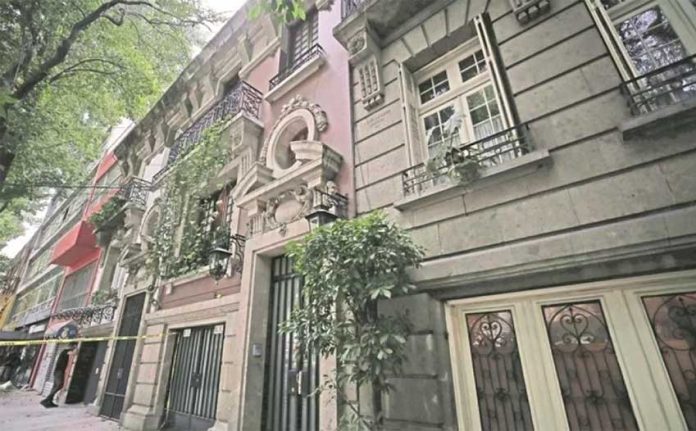
The house where Roma was filmed is located in the latter neighborhood on Tepeji Street opposite the home where Cuarón grew up.
The house, and other Roma locations featured in the black-and-white film as well as the restaurant La Casa del Pavo (The House of the Turkey) in the capital’s historic center, have become popular tourist attractions as a result of the success of Roma.
Interest in buying and renting real estate in Roma fell for a brief period after the powerful September 19,2017 earthquake, which caused significant damage in the district.
However, Roma’s location in an area of Mexico City that is more susceptible than most to seismic activity as well as high prices to buy or rent have done little to undermine the popularity of the neighborhood.
The average price to buy a house in Roma Norte is just under 6.7 million pesos (US $350,000) while the average cost of an apartment is 5.1 million pesos (US $265,000), according to real estate website propiedades.com.
Renting a house in the same neighborhood costs on average almost 39,000 pesos (US $2,000) a month while an apartment rents at just over half that amount, or just under 21,500 pesos (US $1,100).
But with Roma nominated for 10 Oscars at this Sunday’s Academy Awards and the strong likelihood that it will win at least some of them, the popularity of Roma as a place to live –and its real estate prices – will likely continue to go up.
Owners of communal land located near the Nevado de Toluca volcano in México state have discovered a monarch butterfly colony long searched for by park rangers and conservationists.
A small group of ejidatarios, or communal landowners, was carrying out a routine patrol of their forested land within the Nevado de Toluca National Park just before Christmas when they found the butterflies hanging in massive clumps from the branches of Oyamel fir trees on a steep mountainside.
Local forester José Luis Hernández Vázquez told the Associated Press that the landowners “didn’t make a big deal” about the find, explaining that he contacted the Natural Protected Areas Commission (Conanp) and other government authorities that confirmed the existence of the colony in mid-January.
However, officials say that the newly-discovered colony won’t be opened to the public as is the case with some other areas where the butterflies overwinter in México state and Michoacán.
Mario Castañeda Rojas, director of the Nevado de Toluca reserve, explained that the reason for maintaining the colony off limits was to “guarantee lively, healthy exemplars” that don’t suffer stress due to the presence of visitors during the four-month hibernation season.
Park rangers and conservationists had long suspected that there was a hidden monarch butterfly colony within the 53,419-hectare national park.
But despite looking for years and narrowing their search to the communal lands located more than 3,000 meters above sea level on the northwestern side of the park, they were never able to find it.
“It was like an urban legend,” said Gloria Tavera Alonso, a regional director for Conanp.
The discovery of the colony helped to make this year’s monarch butterfly migration the largest in 12 years.
The Natural Protected Areas Commission announced late last month that the area occupied by the butterflies was up 144% to 6.05 hectares, the largest area covered since 2006-2007.
The number of butterflies that reach Mexico each year from the United States and Canada can fluctuate wildly depending on a variety of factors including the weather conditions the insects face during their journey.
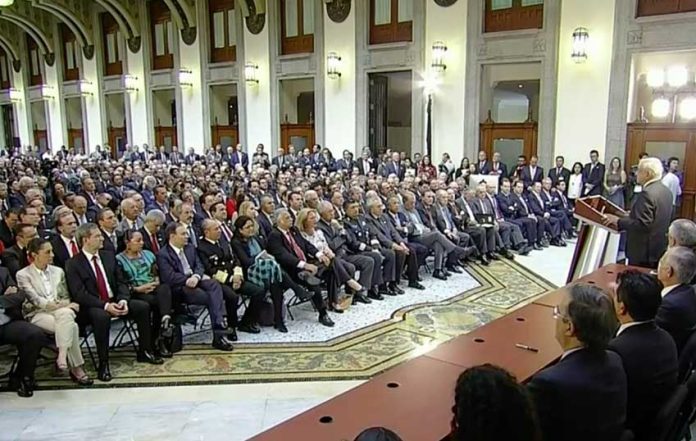
President López Obrador announced today the creation of a new government investment council before a gathering of business leaders in Mexico City which included the nation’s richest man, Carlos Slim.
The new entity, the Council for Investment Promotion, Employment and Economic Growth, will be headed up by the president’s chief of staff, Alfonso Romo.
He said the council’s objective will be to stimulate economic growth with the private, public and social sectors working together.
The secretariats of Agriculture (Sader), Communications and Transportation (SCT), Economy (SE), Energy (Sener), Finance (SHCP), Environment (Semarnat), Foreign Affairs (SRE), Labor (STPS) and Tourism (Sectur) will all be represented on the council, he explained.
Representatives from academia, business, technology, labor and civil society will also join the council through positions on different committees.
Alfonso Romo will head new council.
“It will be a forum for discussion and analysis that will be supported by specific committees in the mentioned sectors. All of you are involved,” Romo said.
“They entrusted me, and I quote the president verbatim, ‘to promote the convergence of the public, private and social sectors to get out of the economic stagnation that has meant growing at a rate of barely 2% for more than 30 years,’” Romo added.
The chief of staff, a former Olympic equestrian show-jumper and business tycoon, said the council will prioritize innovation, the adoption of new technologies and providing support for small and medium-sized businesses.
“If we want to offer opportunities to young people we must accelerate the focus on innovative technologies, industries of the future, information technology, biotechnology, robotics, artificial intelligence, genomics and renewable energy. We must transition to this new reality,” Romo said.
He acknowledged that a lot of challenges must be overcome to achieve greater economic growth and development, specifically citing protectionism, trade wars and regional geopolitical tensions, but stressed that Mexico could “turn those threats into opportunities.”
Romo added: “[We can] turn Mexico into an investment paradise and a competitive country. To do that, it’s necessary to bring the public, private and social sectors together for national economic development . . .”
“Public, private and foreign investment is required. We need investment to take growth from 2% to 4% . . . that’s the goal, that’s the task of Poncho [Romo]. It’s what we have to achieve between all of us with the coordination of Alfonso Romo . . .” he said.
López Obrador thanked the business leaders present for their support. In addition to Slim were Miguel Alemán Magnani, executive president of the airline Interjet, Ricardo Salinas Pliego, founder and chairman of Grupo Salinas, a conglomerate that includes Banco Azteca, TV Azteca and Elektra, and Business Coordinating Council (CCE) president Juan Pablo Castañón.
“. . . We’re going to work together, we’re always going to put the general interest first, the national interest. I know that you love Mexico very much,” the president said.
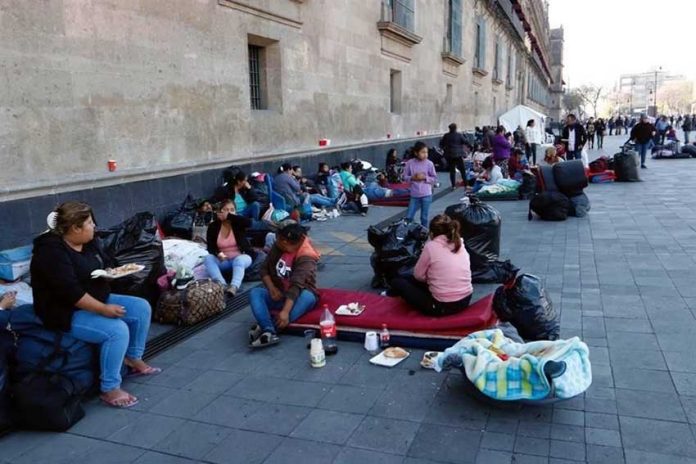
Displaced by violence, citizens from Guerrero camp outside the National Palace.
Displaced families from Guerrero and oil workers from Gulf of Mexico states are among hundreds of people protesting in front of the National Palace in Mexico City today.
More than 400 people displaced by violence in the Guerrero municipalities of Leonardo Bravo and Zitlala traveled to the capital yesterday in buses and pickup trucks and camped out in front of the seat of executive power, located in Mexico City’s downtown.
The residents are demanding a meeting with President López Obrador to seek his assistance to return home or to be relocated elsewhere.
Cresencio Pacheco González, spokesman for the displaced people, told the newspaper El Universal that Guerrero Governor Héctor Astudillo Flores hasn’t shown any interest in resolving their problem.
Those displaced from Leonardo Bravo, an opium-poppy growing municipality in the state’s sierra region, left their homes on November 11 after around 2,000 armed men – self-declared community police members – took control of 10 communities.
More than 1,600 people have since stayed in crowded conditions in an auditorium in the municipal seat of Chichihualco.
The other group of displaced persons currently in the capital left their homes in Tlatempana, Zitlala, on November 8 after receiving threats from self-defense force members who have controlled the town for four years.
The same self-defense force has been engaged in a dispute with another vigilante group from the municipality of Chilapa. The dispute left 12 people dead last month.
The Zitlala residents say it is impossible for them to return home while the violence continues.
Joining the Guerrero residents in central Mexico City are Pemex employees from the states of Veracruz, Tabasco and Campeche.
The members of Section 47 of the Petroleum Workers’ Union are protesting at the entrance of the National Palace to denounce the sale of positions within the state oil company and to demand the full payment of their salaries.
In addition, members of the indigenous Triqui community, a group originally from Oaxaca, are staging a sit-in to demand they be given a space in the capital to sell their arts and crafts.
Shortly after López Obrador took office on December 1, metal barricades that prevented citizens from getting close to the National Palace were removed.
In the ensuing two and a half months, scores of different groups, organizations and individuals with a range of different complaints and petitions have staged protests within what they hope is the president’s earshot.
Before he took power, hundreds of people arrived daily at López Obrador’s transitional headquarters in the Mexico City neighborhood of Roma to ask for the then president-elect’s assistance to cure all manner of ills and wrongdoings, underscoring the staunch faith many Mexicans have in the political veteran.
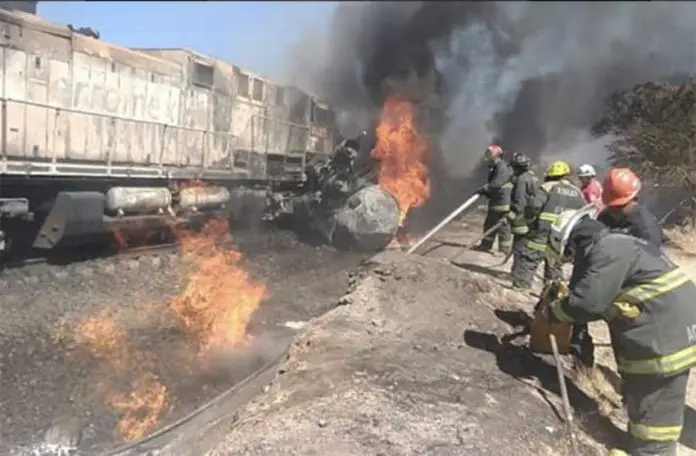
Firefighters at the scene of the tanker truck-train crash.
At least two people are dead and four injured after a tanker truck carrying gasoline was struck by a freight train in Aguascalientes this morning.
According to initial reports, the truck was attempting to beat the train to a crossing in the community of Coyotes, to the south of the city of Aguascalientes.
The driver of the tanker and a passenger died trapped in the truck’s cab after the vehicle exploded and caught fire.
President López Obrador launched another attack on autonomous government agencies today, describing them as “a great farce,” while a cabinet secretary offered details about a conflict of interest accusation leveled at the head of Mexico’s energy sector regulator.
Speaking at his morning press conference, López Obrador accused the autonomous regulators of the energy sector – namely the Energy Regulatory Commission (CRE) and the National Hydrocarbons Commission – of being complicit with the corrupt management by past governments of state-owned companies such as Pemex and the Federal Electricity Commission (CFE).
“They maintained relationships with private companies that benefited from contracts both with the CFE and Pemex,” he said.
López Obrador was also critical of the conduct of the regulators of the banking and telecommunications sectors, among others.
The rebuke follows a claim from the president last week that autonomous public organizations have been guilty of “facilitating theft” by corrupt officials.
On Friday, López Obrador also leveled a conflict of interest accusation at CRE chief Guillermo García Alcocer, although he didn’t present any evidence to support it.
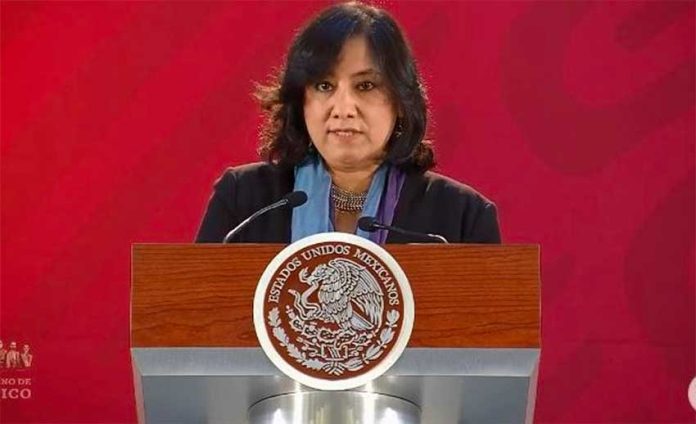
Public Administration Secretary Irma Sandoval elaborated on the allegation today, saying that a contract had been found for the transportation of natural gas that was awarded to a company at which a family member of García works.
The contract, awarded in June 2017 to the energy company Fermaca – whose director, Santiago García Castellanos, is the first cousin of García’s wife – was not declared by the CRE chief, Sandoval said.
The cabinet secretary said that a probe into the awarding of the contract is taking place, adding that the government is also investigating whether there are any other agreements approved by the CRE which have benefited García or his relatives.
Sandoval pointed out that Alcocer himself admitted in 2016 that his wife’s brother, Mario Barreido, works for the Danish wind turbine manufacturer Vestas.
Alcocer argued at the time that his brother-in-law’s employment at the company didn’t represent a conflict of interest because Vestas is not regulated by the CRE.
But Sandoval said today that Barreido actually works for Vestas’ Mexican subsidiary, which is regulated by the CRE.
She also said that Barreido is the legal representative of three other companies which have interests in Mexico’s energy sector.
“He [García] shouldn’t be there [at the head of the CRE],” López Obrador declared.
The president’s initial unsubstantiated accusation against the official came after the latter criticized the president’s choice of candidates to fill four positions on the CRE’s governing body.
García subsequently said he had “nothing to hide” and was waiting for the government to present its evidence against him.
López Obrador said today that his view that García should not be CRE chief is “not because he questioned us,” stating that “the issue is deeper than that” and that “he deceived the people of Mexico.”
He also pledged to “purify” autonomous government agencies “because they were completely at the service of private interests.”
The organizations’ budgets have already been cut, a move that the government has explained is in accordance with its policy of austerity.
The National Electoral Institute (INE), the National Human Rights Commission (CNDH) and the Federal Telecommunications Institute (IFT) are among the autonomous agencies that have seen their 2019 funding slashed to the tune of hundreds of millions of pesos.
There has been greater activity at El Popo since Sunday morning.
The restless Popocatépetl volcano had a very active 24 hours starting yesterday morning, with several explosions and ash plumes that rose as high as two kilometers above the mountain.
The National Disaster Prevention Center (Cenapred) said this morning it had identified 20 gas and water vapor exhalations at El Popo, with the first three recorded yesterday at 9:56am. The most recent was recorded this morning at 7:04.
Wind sent the ash in a north-northeast direction away from the crater.
There were also two recorded episodes of harmonic tremors — a sustained release of seismic and infrasonic energy typically associated with the underground movement of magma — lasting five and 10 hours respectively.
There was a slight ash fall in the Tlaxcala towns of Tlaxco, Xalostoc, Nativitas, Hueyotlipan, Amaxac de Guerrero, Tepetitlá de Lardizábal and Texoloc.
Cenapred said the activity was expected to continue, as will the wind direction.
The agency advises the public to stay away from the volcano, especially from its crater, due to the release of water vapor and gas plumes and a light fall of ash in nearby areas, along with incandescent fragments.
The alert level also warns of the possibility of eruptions causing pyroclastic flows and mudslides carrying debris, although at such a small scale that evacuation of neighboring inhabited areas is not required.
A security perimeter is in place in a 12-kilometer radius of the crater, and traffic is controlled at Paso de Cortés between the towns of Santiago Xalitzintla and San Pedro Nexapa.
In case of rain, people should avoid deep ravines due to the slide hazard.