Home Blog Page 2166

Mexico scores big win against US in World Cup basketball

0
Mexico's national basketball team.

Mexico scored a big upset last night in a qualifying game for the 2019 basketball World Cup by beating the United States 78-70 in Mexico City.

It was only the second time the U.S. has lost to Mexico in 30 games; the other defeat was in 2011.

The last time the teams met, in November, the U.S. won by 36 points. But as ESPN noted, the Mexican team is a different one.

Players who were still playing in various professional leagues last fall are now on the roster.

U.S. coach Jeff Van Gundy had warned his team that the game would be a challenge.

“We can’t underestimate how hard it is going to be to play on the road, at altitude, and against a team desperate to qualify for the FIBA World Cup,” Van Gundy said before the game. “We have to make sure we match that type of intensity and passion that we know they’ll bring.”

After the game, he conceded that Mexico dominated from the start “and that’s on me. We were not ready to compete at the level Mexico did. Give them all the credit, they played a great, great game.”

The teams played before a full house — 5,000 fans — at Juan de la Barrera stadium. Mexican officials said the game sold out in just 45 minutes.

The International Basketball Federation World Cup takes place next year in China.

Source: Infobae (sp), ESPN (en)

3 political assassinations in Oaxaca, Guerrero, San Luis Potosí

0
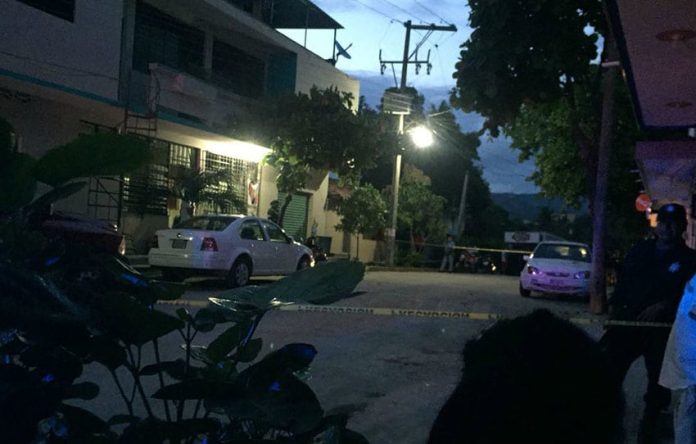
Scene of yesterday's assassination of a party official in Pinotepa Nacional, Oaxaca.

An election official in Oaxaca, a party official in Guerrero and a campaign worker in San Luis Potosí were assassinated in the last two days.

A Oaxaca employee of the National Electoral Institute (INE) was gunned down and killed yesterday evening outside his home in Pinotepa Nacional.

Armed civilians fired several times at Joaquín Andrés Bernal, 52, according to early reports.

The murder came on the same day that two other electoral personnel in the Coast region city resigned their posts.

The president of the district council and its executive secretary both quit due to insecurity. Death threats had been made against them and their families.

In Guerrero, Jorge Luis Vargas of the Democratic Revolution Party was killed in gunfire at the campaign headquarters of the candidate for mayor of Chilapa.

Another incident occurred yesterday afternoon on the highway between Chilapa and Hueycantenango when six armed civilians intercepted a convoy accompanying the Institutional Revolutionary Party candidate for mayor of José Joaquín de Herrera.

Two municipal police officers were wounded.

In San Luis Potosí, a campaign worker for the candidate for mayor of Vanegas was murdered Wednesday night outside his home. Mateo Puente, 47, was working for the For Mexico in Front coalition candidate, Bertha Amaya.

Source: Milenio (sp), Excélsior (sp)

Graves discovered in southern Mexico City are 2,700 years old

0
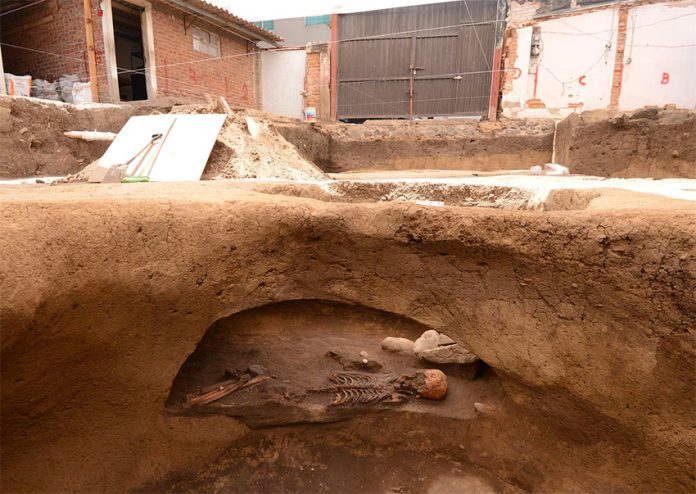
A skeleton found inside one of the graves.

Experts from the National Institute of Anthropology and History (INAH) have discovered 26 ancient graves dating back 2,700 years at a site in Mexico City.

Located in the south of the capital and adjoining a modern-day cemetery, the site measures 360 square meters and archaeologists believe that it might have been used by women for activities related to the care of infants.

During excavations over the last four months, the INAH team has found the graves at depths between 1.2 and 3.3 meters below street level. About 20 of them are in a perfect state of conservation.

“Until now, we have detected four stages of settlement; four historical periods linked to the start of the 20th century, the Porfiriato [the period of more than three decades when former president Porfirio Díaz was in power], Mexico’s independence and the pre-Hispanic period,” said Antonio Balcorta Yépez, an INAH archaeologist working on the project.

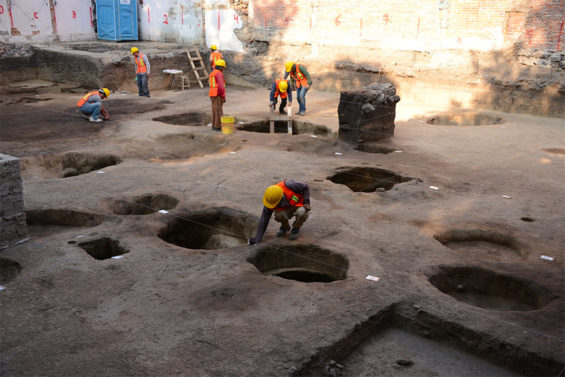
Graves discovered in southern Mexico City.
Ancient graves discovered in southern Mexico City.

Of the 26 graves found, 11 are in the form of a truncated cone, while the archaeologists have also found vestiges of walls from pre-Hispanic structures.

“We’ve made a series of discoveries that have revolutionized the knowledge we had about graves in the pre-classic period. The context suggests to us that we are at a village where they carried out specialized activities. The height [of the site and] its geographical and strategic position indicates to us that the people [who lived on] this hill may have had greater control over certain resources compared to the village of Copilco,” Balcorta said.

Truncated cone graves were not only used for funeral purposes but also to store grains, artifacts and waste materials, he explained.

However, there is also evidence that indicates that at least two of the graves may have been used by women for everyday activities related to caring for their children, such as giving an herbal steam bath to a newborn baby.

That theory is supported by the discovery of more than 130 figurines in the graves, most of which represent pregnant women, while a smaller number are of infants. The ceramic pieces feature red, yellow and black colorings on their different body parts.

The INAH team has extracted samples from different parts of the graves to carry out chemical and pollen analyses aimed at confirming or rejecting the perinatal care hypothesis.

The archaeologists have also made discoveries from more recent times including remnants of ammunition used in the Mexican revolution and parts of adobe bricks and other building materials that formed part of a house that stood on the site at the end of the 19th century.

Because it is 2,296 meters above sea level, it is believed that the site was not affected by lava flows following the eruption of the Xitle Volcano between 245 and 315 AD and for that reason it has remained in well-conserved condition.

Source: Milenio (sp)

Presidential election results available between 10 and 11:30pm Sunday

0
Thousands turned out last night for AMLO's campaign finale. It was dubbed AMLOFest.
Thousands turned out last night for AMLO's campaign finale, dubbed AMLOFest.

Results of the so-called quick count for the presidential election will be made public between 10:00 and 11:30pm Sunday, the president of the National Electoral Institute (INE) said today.

Lorenzo Córdova told broadcaster Milenio Television that whether there is “a wide margin or a very narrow one” between the four presidential candidates, he will appear on national television between those times to announce the tally of the conteo rápido, or quick count.

Asked whether the trend shown in the count — which is based on a sample of votes collected from 5% of all polling stations across the country — would be “scientifically irreversible,” Córdova responded “absolutely.”

The INE president said the quick count will provide information about voter turnout and give a range for the percentage of the vote that each candidate obtained.

“Candidate A will win between this and that percentage [of the vote], Candidate B [will win] between this and that percentage . . .” Córdova explained.

He said responsibility for the quick count falls to a technical committee made up of nine of Mexico’s most esteemed mathematicians and statisticians.

Four of the numbers gurus are academics at the National Autonomous University of México (UNAM), three come from the Autonomous Technical Institute of Mexico (ITAM) and two are from the Metropolitan Autonomous University (UAM), Córdova said.

All have previous experience in conducting quick counts with “a high degree of precision” and “have never been wrong,” he added.

After polls close on Sunday evening, Córdova said, Mexico will enter into a “very delicate moment in the political life of the country” and therefore it is important that the “information vacuum” is “filled with official information from the INE” rather than speculation and hearsay.

He also called on citizens to turn out and vote en masse on Sunday in order to send a clear message that they are not intimidated by political violence. Almost 50 candidates have been killed since the electoral process officially began last September.

The official campaign period concluded at 12:00am today, meaning that an advertising blackout is now in force and thousands of candidates around the country — including the four presidential hopefuls — can no longer lobby the electorate for their votes.

Leading presidential candidate Andrés Manuel López Obrador officially closed his campaign last night with a massive rally at the country’s largest sports stadium, the Estadio Azteca in southern Mexico City.

The enthusiastic crowd received the candidate with a rapturous chant of “presidente! presidente!” as he appeared on stage to make his final public pre-election address.

Ricardo Anaya, who has consistently polled in second place, held his final campaign event in León, Guanajuato, with thousands of supporters of the three-party right-left coalition he heads.

Anaya once again declared that the For Mexico in Front coalition is the only alliance that can stop López Obrador from winning the presidency and called on the electorate to cast a voto útil or strategic vote in his favor.

Independent Jaime “El Bronco” Rodríguez, who took leave as governor of Nuevo León to contest the election and has shocked the public at times with proposals such as chopping off thieves’ hands, finished up his bid for the presidency with a live virtual event on Facebook.

Preparations for Sunday’s elections, the biggest in Mexico’s history, have been hindered this week with the theft of ballots in Oaxaca, Tabasco and Veracruz.

Polls will open across the country at 8:00am Sunday, with millions of voters casting ballots for thousands of positions at municipal, state and federal levels.

Source: Milenio (sp), Forbes (sp), El País (sp), El Sol de México (sp)

Woman suffers extensive injuries after parasailing disaster in Puerto Vallarta

0
Katie Malone and brother Brendan.

A woman suffered severe injuries in a parasailing accident earlier this month in Puerto Vallarta, Jalisco, when a storm came up, flipped the tow boat and snapped the towline.

Katie Malone was celebrating her 29th birthday in the Pacific coast tourist destination when the freak accident occurred during the 10-minute parasailing excursion.

After an approaching storm brought strong winds and turned the boat over, Malone spent the next 45 minutes being whipped through the air at the mercy of intense gusts of wind.

Malone’s brother Brendan said in an interview that the men operating the boat quickly took off.

“We’re beyond unhappy,” he said. “Those guys left the scene of the crime. They flipped the boat back over and . . . bailed while my sister was floating away.”

When Malone finally crash-landed near the city’s airport, she suffered cuts to her face, a fractured pelvis and skull, four broken ribs and a collapsed and bleeding lung.

“It’s one of those calls you never want to take and of course you’re thinking the worst,” said Katie’s father, Kelly Malone, when he received the news.

An online fundraising campaign was created to help pay for an air ambulance back to the United States and as of this morning, nearly US $50,000 had been raised.

Former U.S. Rep. Duncan L. Hunter also helped make financial arrangements for the family.

“Once we got him involved, everything just went real smooth. He had some contacts. I believe he even contacted the consulate in Washington D.C. and then after that everything just went really, super fast,” Kelly Malone said.

After undergoing several surgeries and spending the last few weeks in a Jalisco hospital, Katie Malone was flown to San Antonio, Texas, on Tuesday, where she will undergo further treatment.

Doctors believe she will make a full recovery, but she isn’t expected to walk again for months.

“She is a miracle, she is progressing way quicker than most people expected her to, on so many levels,” her brother said. “She’s great, she’s a fighter, and she is not giving up.”

The parasailing company hired by Malone is currently under investigation by the state Attorney General’s office.

Source: WLKY (en), Vallarta Independiente (sp)

Lower demand, price for poppies has devastated Guerrero communities

0
Corralitos, Guerrero: 90 families have fled.

Thirty years ago, a kilogram of opium paste sold for as much as 80,000 pesos in the mountains of the southern state of Guerrero, remembers a long-term resident.

But today, says Arturo López, who lives in the municipality of Leonardo Bravo, a kilo of the same product fetches just 5,000 pesos (US $250) or 16 times less.

The drastic price slump — exacerbated recently by a reduction in demand for opium paste due to its substitution in heroin production with the synthetic opioid fentanyl — has had a devastating impact on the sierra region, which is located in the geographical center of the state.

“I’ve been living in this place uninterruptedly for 35 years and 90% of the people here grow poppies, there’s no reason to fool ourselves,” López told the newspaper Milenio.

“Thirty years ago, a kilo [of opium paste] was bought for 50,000 or 80,000 pesos. The farmers handed it over to the narcos, who paid very well . . . They took care of transporting it to the clandestine laboratories and distributing it,” he explained.

However, the much lower price that campesinos are now paid for their illicit crop has “sunk the sierra into many problems,” “especially because we can’t grow anything else and if we did, we wouldn’t even earn 5,000 pesos per kilo.”

Guerrero security spokesman Roberto Álvarez Heredia recognizes that violence in the region has increased in recent years.

“We understand that there are two criminal groups fighting among themselves, one that operates in Chichihualco and the other in Tlacotepec . . . [They’re involved] in a violent battle that is causing a spike in violent homicides,” he told Milenio.

Álvarez explained that cartels that ship heroin to the United States previously used only opium as the raw material in the drug’s production, but now they have largely substituted that product with fentanyl, which he said is “cheaper and three times more potent.”

As a result, drug cartels are buying much less opium paste from growers in Guerrero.

Because criminal organizations based in the north of the country — where fentanyl is produced — have cut into local cartels’ profit margins, Álvarez explained, the latter “started to diversify their activities.”

Those groups — including the organization controlled by Juan Castillo (El Teniente) as well as others such as Los Rojos, Los Ardillos and the Sierra Cartel — have turned to “extortion, kidnapping, robbery [and] homicides,” the security spokesman said.

However, “above all, they’re relentlessly pursing the farmers so that they abandon their homes, give up their land and cede control,” Álvarez added.

The tactic appears to be working.

Earlier this month, around 90 families who lived in the Leonardo Bravo community of Corralitos fled their homes because of the violence that is plaguing the region.

On Tuesday of this week, the mayor of the neighboring municipality of Eduardo Neri was the target of an attack by armed men. Although he was uninjured, a woman and child were killed in the incident.

In those two municipalities as well as inHeliodoro Castillo and Zumpango, residents have been cultivating opium poppies for 50 years.

However, it has only been in more recent times that violence has become so bad that some residents have felt that they have no option but to leave.

Arturo López’s daughter is among those who left the sierra region but unlike many others, she has returned.

After finishing high school in Chichihualco — the municipal seat of Leonardo Bravo — Yuritzia López moved to the state capital Chilpancingo to study medicine and after years of hard work she qualified as a doctor.

But while Yuritzia was away from her home town to study and work, her father and other residents of the community of Filo de Caballos received so many threats from organized crime that she decided to abandon her medical career. She decided to enter politics with the hope of restoring peace to the region.

At state elections that will coincide with the presidential election on Sunday, Yiritzia López is aiming to become a congresswoman for the state’s 19th electoral district, representing the right-left For Mexico in Front coalition.

At the end of last month, the candidate released a campaign video that was partially filmed in a location that she knows only too well: a field filled with opium poppies in bloom.

But instead of railing against the plant and the damage that drugs can cause to people’s lives as many might have expected she would do, López instead proposed the legalization of the plant’s cultivation for use in the manufacture of legal pharmaceuticals.

She told Milenio that “we could be making what Mexico is consuming and in that way, we would save a lot of money.”

Speaking again while surrounded by opium poppies, López said that taxes collected via the sale of the pharmaceuticals could be used for infrastructure and security initiatives in the municipalities where the poppies are grown.

[wpgmza id=”31″]

She added that legalizing opium poppy cultivation for medicinal purposes would avoid farmers being imprisoned for what essentially is their only means of survival.

Guerrero Governor Héctor Astudillo has previously said that legalizing cultivation would solve the region’s violence problem although that view is not shared by everyone.

“. . . I don’t think that [legalization] would definitively end the [violence] problem,” said Crescencio Pacheco, a farmer and self-defense group leader in Leonardo Bravo.

Whether opium poppy cultivation is legal or not, the violence will continue, he said, because it’s not opium paste that the criminal gangs are fighting over anymore but rather the control of territory in which to carry out extortion and robberies.

Source: Milenio (sp) 

Governor of Tamaulipas wants to play golf but club won’t let him

0
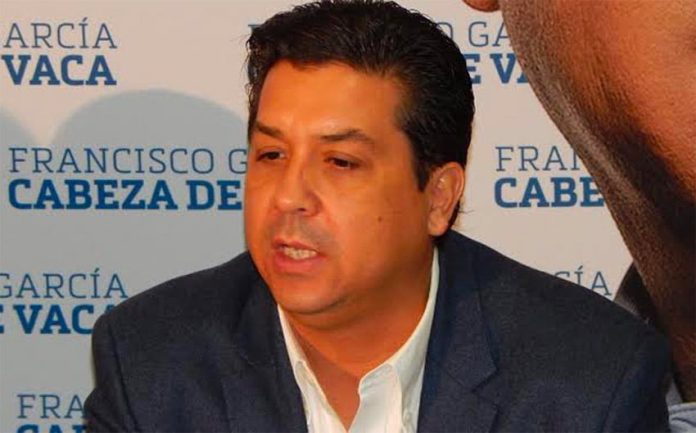
Tamaulipas Governor García.

As Tamaulipas continues to make a name for itself as one of Mexico’s most violent states, the governor wants to play golf.

Francisco Javier García Cabeza de Vaca has gone to the Supreme Court with a case of alleged discrimination against him by a golf club. Yesterday, the court agreed to hear the case.

The story began in December 2013 when García bought a 14.3-million-peso apartment (US $1.1 million at the time) in the Mexico City neighborhood of Bosques de Santa Fe, which also has a golf club.

But the club’s management has denied him access to it, claiming that he did not fulfill certain requirements.

García asserts that the purchase of the apartment made him a shareholder at the golf club, and his wife and daughters members.

The club, however, says that shareholder status is not automatic.

García filed a formal complaint in 2016, charging that he and his family had suffered moral damage and discrimination and demanded compensation. Two courts ruled in the governor’s favor and ordered the golf club to pay compensation for moral damages in US dollars.

But a federal court ruled that the defendant had fully justified and documented its position in not recognizing him as shareholder.

More legal maneuvers followed until yesterday when the case arrived at Mexico’s highest court, where the first chamber agreed to look at it.

Source: Milenio (sp), El Universal (sp)

One-third of voters offered something for their vote; 17% said no: poll

0
election ballots
How much for your vote?

A survey has revealed that one-third of Mexican voters have been approached by political parties to buy their vote in Sunday’s general election, and 17.3% declined.

Conducted by three non-governmental organizations, the poll found that parties offered money, goods or services in exchange for the vote of 33.5% of those polled.

Only 17.3% of those approached refused the offer. Those who agreed to sell their vote stated that the transaction was not binding, so no actual conditions had been placed on them.

Alberto Serdán of Citizen Action Against Poverty, one of the NGOs behind the poll, found some hope in the numbers.

He said it was a source of hope that the 79% who received something for their vote felt they were not obligated to vote for someone in particular.

“A lot of people received offers, but very few people feel threatened about supporting a particular party. For this reason, we make an open call for a massive turnout during the July 1 elections as a means to counter the effects of the buying [of votes].”

The poll also broke down vote-buying by political party: 21.5% responded that “all the parties” had made offers, while 5.9% identified the governing Institutional Revolutionary Party (PRI) and its coalition allies as the buyer.

Another 5.5% said the left-right For Mexico In Front coalition had tried to buy their vote and 0.7% identified the other coalition, Together We’ll Make History, as the buyer.

The poll was conducted between June 6 and 26 in at least one electoral area of each of the 32 states.

Source: Milenio (sp)

He’s running for mayor but no one has seen him during the entire campaign

0
Avellaneda, distance campaigning.

The internet has been a boon for a candidate for mayor of Pungarabato, Guerrero: he can campaign without even entering the municipality — and stay alive.

Luis Avellaneda Pineda isn’t even in the state, he told the newspaper Milenio in an interview, for fear that a criminal gang would follow through on its threats against him.

He takes those threats seriously: his father, a melon farmer, was assassinated in 2012 in Rivapalacio, a neighboring municipality in Michoacán.

Earlier this month, voters in Pungarabato were wondering where the Morena party’s candidate was. He didn’t even show up when party leader Andrés Manuel López Obrador visited for a campaign rally on June 2 at the municipal seat, Ciudad Altamirano.

Publicly, party leaders too wondered where Avellaneda was. Privately, it was commonly known: gangsters had threatened that they would make him disappear.

The 45-day election campaign has come to an end and Avellaneda has made no public appearances.

“I had to leave the municipality for reasons of security, threats and other things,” he told Milenio. “I am outside the state and from here I’m conducting my campaign on the internet, and with friends who want real change.”

Working through social media is the only way to avoid physical risk, he said.

Some candidates who remained in their communities “are no more,” he said, having lost their lives.

The virtual candidate said the threats against him were made first on the telephone, but later they were made in person.

That was when he and his family left town.

Pungarabato is not the only municipality where candidates have opted not to campaign, Animal Político reported. Anonymous sources within Morena said it was the same story in Arcelia, Apaxtla de Castrejón, Eduardo Neri and Quechultenango.

Their caution is not without justification. According to the latest tally, 48 candidates have been assassinated since last September.

Source: Milenio (sp), Animal Político (sp)

Pumps at BP, Pemex stations in Puebla closed for irregularities

0
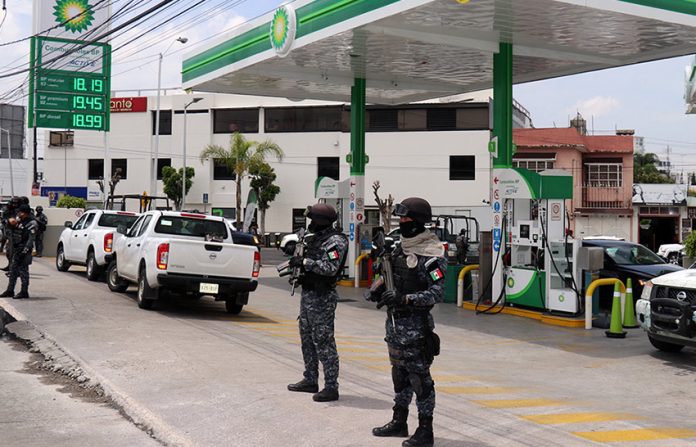
Police stand guard at a BP gas station in Puebla.

In an unprecedented move the federal consumer protection agency (Profeco) requested support from the Federal Police to carry out an operation in Puebla this week that resulted in the closure of pumps at two gas stations.

Profeco said in a statement issued yesterday that it resorted to asking the security force’s National Gendarmerie for backup due to repeated refusals from two gas station owners to allow their pumps to undergo calibration checks, which are required twice annually.

At about 11:00am Tuesday, Profeco officials arrived at a British Petroleum (BP) station located in the Santa Cruz Los Ángeles neighborhood of the state capital where they closed five of 18 pumps.

Four of the pumps were closed due to fuel leaks while the fifth was shut down because of “clear defects,” the agency said.

Hours later, Profeco shut down all 20 pumps at a Pemex station in the La Libertad neighborhood of the city.

At that station, the agency said, none of the pumps was displaying valid calibration certification.

The statement also said that staff refused to grant access to Profeco officials to conduct inspections in other areas of the gas station despite the presence of the gendarmerie forces.

BP responded to the closure of its pumps by saying that it was working as quickly as possible to resolve the issues detected by authorities.

The company also said in a statement that its Santa Cruz Los Ángeles station would continue to operate as normal and reiterated its commitment “to providing quality service to Mexican consumers and complying with the obligation of selling fuel in the correct way.”

Profeco said in its statement that in accordance with reforms to federal consumer law promulgated by the current government, it has the power to apply measures in order to “coercively enforce its requirements or decisions,” which includes requesting the assistance of security forces.

Until this week the agency had never called for backup from police.

A report released in April said that 21 Pemex gas stations were closed in Puebla last year because they were selling stolen fuel, known colloquially as huachicol.

The central Mexican state, and in particular the region known as the Red Triangle, is a hotbed of petroleum theft from state-owned pipelines, a crime which the Pemex CEO said in April costs the company 30 billion pesos a year (US $1.5 billion).

Source: El Popular (sp), e-consulta (sp), Milenio (sp)