Home Blog Page 2245

The fish with the Mona Lisa smile faces extinction due to loss of habitat

0
Axolotl in Guadalajara’s Michín Aquarium
Axolotl in Guadalajara’s Michín Aquarium.

Alejandro Prieto is an award-winning Mexican nature photographer whose pictures have graced the pages of publications like National Geographic and BBC Wildlife Magazine.

Prieto was born and lives in Guadalajara and has distinguished himself for his ability to capture dramatic images of elusive creatures like the Mexican jaguar, in their native habitat.

I sat down with Prieto recently to learn about his newly completed project to point his camera at Mexico’s extraordinary “walking fish,” the axolotl.

The species Ambystoma mexicanum is a kind of salamander which remains in its larval state all its life. It is not a fish at all, but it does have gills — feathery growths outside its body — as well as lungs. As if that were not enough, the axolotl can also breathe through its skin.

These abilities, however, pale before this amphibian’s true “super power:” it can regenerate not only its limbs, but just about every part of its body, including its heart and brain, for which reason it has been called “the Peter Pan of exotic creatures.”

Naturally, these characteristics have made axolotls the subject of much research into ways to regenerate human body parts, especially since the successful sequencing of its genome (10 times the size of ours) that was announced in February.

So you’d think the “Mexican Amphibian with a Mona Lisa smile” as the New York Times called it ought to be just about the most prized and protected creature on the planet — but if you had opened a newspaper a year ago you would have read that it was about to go extinct in its native habitat.

Why was such a thing allowed to happen?

This was the question that occurred to Alex Prieto a year ago when he decided to go find the answer for himself and, fortunately for the rest of us, to document and photograph everything he discovered.

I caught up with the photographer at his home high in the hills overlooking Jalisco’s Primavera Forest.

“Why is the axolotl in trouble?” I asked.
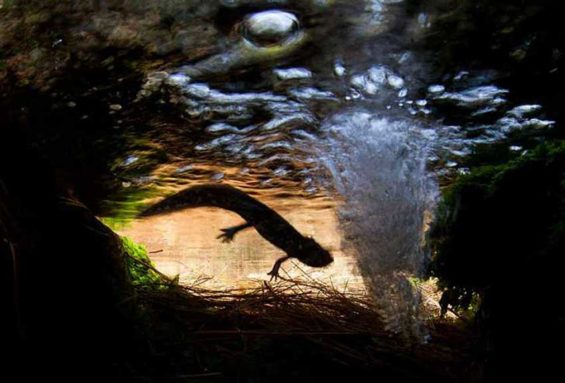
The axolotl.
The axolotl.

“First of all,” he said, “I should point out that the Ambystoma mexicanum is endemic to Mexico and found nowhere else. There are simply not a lot of them around to begin with. So the world was shocked not long ago when it was announced that the population of ajolotes in Lake Xochimilco — where they had thrived in pre-Hispanic times — had dropped from 6,000 per square kilometer in 1998 to only 35 in 2014, after which some researchers had claimed they couldn’t find any at all.”

The cause for this dramatic change, Prieto told me, was simply loss of habitat. Mexico has some of the world’s most stringent laws forbidding water pollution, but rarely enforces them. Axolotls can only survive in clean water and Xochimilco had serious problems.

But this is only half the problem. The other half is tilapia. This Middle East-African fish has been introduced into the lake for commercial purposes. As it is an omnivore, it not only devours the axolotl’s food, it also eats their eggs.

Even though a few axolotls can still be found in this city-enclosed lake, the species will have a hard time rebounding despite a National Autonomous University initiative launched in May.

After observing the situation in Xochimilco, Prieto traveled to visit the habitats of other varieties of Ambystomas in the rest of Mexico. He says, “I found a very beautiful kind of ajolote in Lake Zacapu in Michoacán. It’s called Ambystoma tigrinum and indeed it looks like a tiger. Unfortunately, this lake is suffering from an invasive water plant locally referred to as lirio that covers the surface and removes oxygen from the water.

“In Lake Pátzcuaro, also in Michoacán, there is another species that I believe is the biggest of all and can reach a length of about 30 centimeters, a foot long. Unfortunately, pollution is a problem in both lakes and both species are considered endangered.”
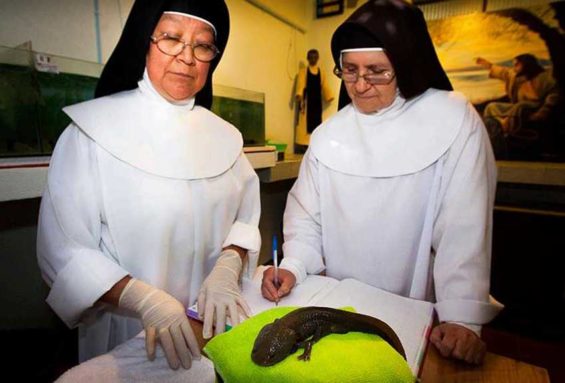
Michoacán nuns have world’s largest axolotl farm

Prieto walked over to his coffee table and brought me back a thick book. “You may be surprised, but there are nuns in Pátzcuaro who breed axolotls. They’re called the Sisters of the Monastery of the Dominican Order. They raise them for medicinal purposes and sell a number of traditional products derived from axolotls.

“At the same time they cooperate in conservation projects and donate specimens to researchers who are studying these creatures. They are raising the foot-long species I mentioned before, Ambystoma dumerilii, which is yellow with red fins. So these nuns have the biggest axolotl farm in the world raising the biggest species and they have been doing this for 150 years.”

Discovering that a new species of axolotl has recently been discovered in the Sierra de Manantlán Biosphere Reserve, Prieto went to this sanctuary, which straddles the border of the states of Colima and Jalisco and, for the first time, was able to photograph an Ambystoma swimming in unpolluted water.

“In Manantlán, the water’s clean,” he told me, “but is also freezing cold, so I needed a diving suit of seven-millimeter neoprene. Another problem is that you often have to squeeze into tight spaces.

“On the other hand, it’s relatively easy to photograph axolotls because they’re not very active by day. They’re only on the move at night, when they’re hunting. They may look like they are always smiling, but when it comes to feeding or reproducing, they become very aggressive. They usually eat insects and larvae, but they are also cannibals and quite happy to eat another axolotl.”

The word axolotl, Prieto told me, means “The god who fears death,” perhaps indicating that the pre-Hispanic inhabitants of Mexico associated its ability to regenerate body parts with everlasting life.

“They had legends,” Prieto explained, “that this curious creature — often seen in their art — originated with a god who was chosen to be sacrificed but refused the honor and ran away. Finally, they say, he jumped into the water and was turned into an ajolote.”

Actually, axolotls as a species had no cause at all to fear death in pre-Hispanic times, but in the 21st century the amazing Mexican walking fish may have good reason to worry about its survival.

(Parts of this article previously appeared in The Guadalajara Reporter.)

The writer has lived near Guadalajara, Jalisco, for more than 30 years and is the author of A Guide to West Mexico’s Guachimontones and Surrounding Area and co-author of Outdoors in Western Mexico. More of his writing can be found on his website.

[soliloquy id="56314"]

 

AMLO’s austerity plan includes 50% pay cut for lawmakers, slashing bureaucracy

0
López Obrador presented his austerity plans yesterday.
López Obrador presented his plans yesterday.

President-elect Andrés Manuel López Obrador has begun outlining a strict austerity plan that Mexico’s next government intends to implement when it takes office later this year.

Slashing the upper levels of government bureaucracy by 50%, eliminating undersecretaries as well as state branches of federal offices and some parliamentary committees, reducing politicians’ salaries and cutting a range of other government expenses are all on the incoming administration’s agenda.

After meeting yesterday with a group of lawmakers from the three parties that make up the coalition that swept him to a landslide victory on July 1, López Obrador told a press conference that the next Congress will propose a 50% reduction to the wages paid to federal deputies and senators.

If approved, members of the lower house in the next Congress will earn a gross monthly salary of 37,336 pesos (US $1,983) while senators will be paid 58,700 pesos (US $3,120).

López Obrador also said that the gross salary he will receive as president will be halved from its current monthly level of 209,135 pesos (US $11,090) and that perks and benefits for all politicians — such as health insurance covering major medical expenses — will be eliminated.

The president-elect said that pensions for former presidents are also on the chopping block because having worked in the public service they are already entitled to ISSTE state workers’ pensions.

In addition, if they are over 65, they can claim old-age pensions, which López Obrador has said he will double.

The political veteran, who made stamping out corruption central to his bid for the presidency, said that whether the Morena party he leads decides to accept the 1.5 billion pesos (US $80 million) it will be entitled to next year due to the high percentage of votes it won on July 1 will be subject to analysis.

López Obrador also presented a plan to the lawmakers elected under his Together We Will Make History coalition entitled Considerations for deputies and senators.

The president-elect said that he and his team believe that the changes proposed in the plan “will be sufficient to fulfill [the government’s] commitments and to carry out the . . . transformation of the country.”

The Morena-led coalition will have a majority in both houses of federal Congress, although it will likely need to negotiate with opposition parties in order to pass constitutional reforms that require two-thirds support.

The Considerations document, which serves to set priorities for the government’s legislative agenda and instruct Congress, proposes 12 “possible reforms to the legal framework” that López Obrador read out at yesterday’s press conference. They are:

  • Changing article 127 of the constitution, which currently stipulates that no public official can earn a higher salary than the president.
  • Establishing a federal Secretariat of Public Security.
  • Eliminating political immunity known as the fuero and other privileges currently afforded to government officials.
  • Including corruption, petroleum theft and electoral fraud on the list of serious crimes for which there is no right to bail.
  • Transferring responsibility for preparing the federal budget to the Secretariat of Finance.
  • Incorporating the Estado Mayor Presidencial — the institution charged with protecting the president of Mexico — into the Secretariat of Defense.
  • Overturning the recent decree which privatizes water.
  • Modifying or repealing the 2013 educational reform.
  • Establishing the right to free, public education at all school levels in article 3 of the constitution.
  • Establishing a legally-binding consultation mechanism that enables the presidential term to be revoked.
  • Reviewing the need to increase the minimum salary in the northern border region.
  • Carrying out the changes to laws, regulations, decrees and agreements to adjust the administrative structure of the government in accordance with the federal austerity plan.

Source: El Universal (sp), Milenio (sp)

Beltrán Leyva cartel plaza chief in La Paz, BCS, arrested

0
'El Pájaro,' La Paz plaza chief.

A man identified as a drug cartel plaza chief in La Paz, Baja California Sur, was arrested yesterday without incident at a home in the Pueblo Nuevo neighborhood.

Andrés “N,” also known as “El Pájaro,” is suspected of coordinating the distribution and sale of drugs in the municipality of La Paz for the Beltrán Leyva Organization, said Federal Police chief Manelich Castilla Craviotto.

The cartel boss carried out his operations from two houses in La Paz. Another man was arrested in the second house, located in Zona Central.

Drugs and firearms were seized during the arrests.

The capture of Andrés “N” was one of the principal objectives for security forces in Baja California Sur, Castilla said.

Source: El Sol del Centro (sp)

Geothermal energy potential found in deep waters off Los Cabos

0
Hydrothermal vents have been discovered off the coast of Baja California Sur.

Deep waters located off the coast of Los Cabos have high geothermal energy potential that is capable of meeting the electricity needs of the twin resort cities of Cabo San Lucas and San José del Cabo, according to scientists at the National Autonomous University (UNAM).

After searching for more than 10 years, a research team from the Department of Natural Resources at UNAM’s Institute of Geophysics has located a deep-sea deposit containing hydrothermal vents or “sea chimneys” off the southern coast of the Baja California peninsula.

Leading researcher Rosa María Prol said the geothermal energy potential of the team’s discovery is significantly greater than 500 megawatts, adding that there are other marine sites located up and down the 1,200-kilometer-long peninsula that could also be exploited.

She explained that while there are hydrothermal vents located in the Pacific Ocean further to the south of Mexico, it was thought that there wouldn’t be any geothermal activity in the area where the find was made because it was not known to have tectonic activity.

However, it has now become evident that there is a very deep area of the ocean where tectonic plate fractures do exist and where sea water that has been heated to very high temperatures is emitted.

Prol explained that the UNAM team first detected the presence of geothermal activity during visits to the area between 2004 and 2006.

“We found that there were wells [with water] of 90 degrees C. When we went to get samples, we calculated that the temperature of the deposit was close to 200 C, which suggested that it could produce a lot of energy,” she said.

However, it wasn’t until this year that by using the echo sounding sonar technique, the exact location of the deposit was found.

Following further deep-sea exploration, the team hopes to find water that is hot enough for turbines to convert it into electricity that could supply homes, hotels and other businesses in Los Cabos.

“This marine energy source will be permanently renewed, which doesn’t always happen on land . . . We are also planning to deliver the final results [of our research] to authorities so that they know that this resource exists and the benefits of exploiting it,” Prol said.

She added that “with what we have discovered, we believe that Los Cabos has sufficient geothermal resources to not have to depend on the energy that is supplied from La Paz.”

Source: Milenio (sp)

Guerrero farmers grow more than just opium poppies

0
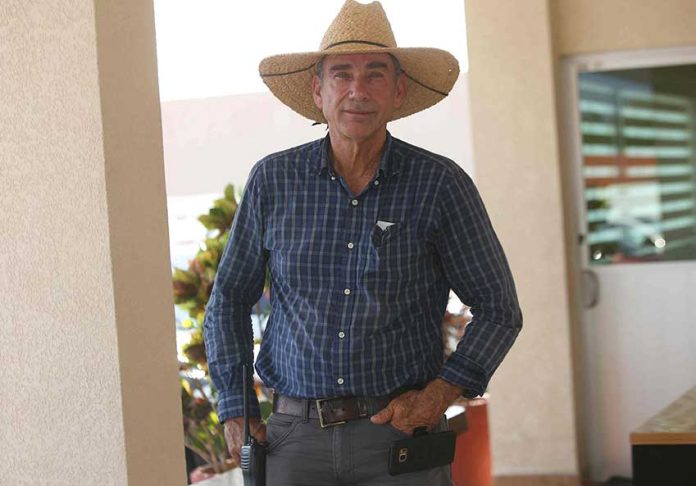
Lee Shipley, Guerrero melon farmer.

In the Tierra Caliente region of Guerrero, an area notorious not just for hot weather but drug production and lawlessness, one farmer has been producing some of Mexico’s most delicious melons for the past 35 years.

“My dad was a farmer in Sonora, that’s where I got to know the fields and I became interested in growing cantaloupes,” Lee Shipley told the newspaper Milenio.

“We grew grapes and sent them to Mexico City with a distributor,” he added.

“He [the distributor] spoke to me about a place called [Ciudad] Altamirano, where there was a lot of water and a lot of land. That’s how I heard about this region. He sent me here with a guide, I started planting [cantaloupes] and now I’ve been here 35 years.”

Production increased over time and Shipley is now the largest melon grower in the country.

[wpgmza id=”35″]

All these years later, Shipley still arrives at the farm every day before sunrise and throughout his work day he is constantly busy, allocating tasks to his workers, monitoring his melons, checking them for insects and disease and thinking about what he can do to improve the quality of his crop.

The farmer, who admits to being obsessed with achieving perfection in his fruit, said the introduction of drip irrigation and the use of hybrid seeds had been particularly beneficial for his business.

“The hybrids that we started using in 1986 helped a lot. Production increased by between 20% and 30% and the fruit also had a longer shelf life,” Shipley said.

He also said that bees have played a vital role in his success, explaining that farm workers first found African beehives on his property in 1990, at which time officials from the federal Secretariat of Agriculture (Sagarpa) “saw them as a threat.”

Shipley explained that “there are African [bees] and Italian [bees] and the secret is to treat them with respect” regardless of their origin.

“. . . We learned to look after them and not to kill them because they’re at the service of pollination. When we fumigate by tractor, we do it at night when they are not there and that way we preserve them,” he said.

Shipley is proud that he has been able to achieve a dream that he first had in his childhood and remains committed to producing the best fruit he can.

“The sweetness of a melon is one thing and the flavor is another. We’re looking for the best flavor [and] the best color, which without a doubt is the key to having the highest possible internal and external quality of each fruit.”

Source: Milenio (sp)

For the second year, San Miguel de Allende named world’s top city

0
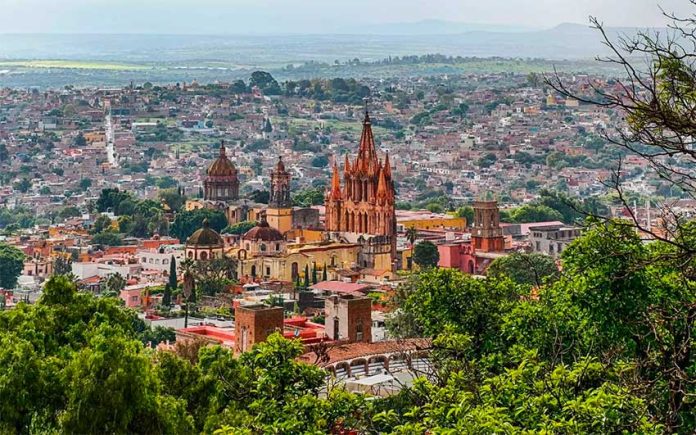
San Miguel de Allende, No. 1 city in the world
San Miguel de Allende, No. 1 city in the world. travel+leisure/getty images

Three Mexican cities have made the list of the world’s top 15 cities for 2018 and San Miguel de Allende has ranked No. 1 for the second year in a row.

Oaxaca city, capital of the state of the same name, moved into second place from last year’s sixth and Mexico City returns to the list, placing 11th.

The annual awards program is operated by Travel + Leisure magazine, whose readers choose their favorite cities based on sights and landmarks, culture, food, friendliness, shopping and value.

What makes a city truly great, the magazine says, is “jaw-dropping architecture, distinctive restaurants, a rich array of cultural offerings, and intriguing shops . . . . A teeming street life, a friendly population, and a harmonious relationship with nature are equally essential.”

Travel + Leisure said it was “no wonder” that San Miguel, with a score of 91.94, topped the list again. “With its colorful, flower-festooned architecture and cobblestoned streets, San Miguel has the feel of a village, but its large population of artists lends it a cosmopolitan air.”

Said one reader, “This is one of the best cities in the world. There are lots of stores selling local artisan crafts, jewelry and art. Bring an extra suitcase!”

Oaxaca was not far behind with 90.52, while Mexico City scored 87.65.

In third place was Udaipur, India, followed by Ubud, Indonesia; Kyoto, Japan; Florence, Italy; Luang Prabang, Laos; Hoi An, Vietnam; Chiang Mai, Thailand; Charleston, South Carolina; Mexico City; Cape Town, South Africa; Rome; Istanbul; and Beirut, Lebanon.

On the list of the world’s best hotels 10 are in Mexico, led by the Viceroy Riviera Maya in Playa del Carmen leading in 20th place.

The other nine were Cala de Mar Resort & Spa in Ixtapa, Guerrero; the Resort at Pedregal, Cabo San Lucas; Las Ventanas al Paraíso, San José del Cabo; the Rosewood, San Miguel de Allende; the Banyan Tree Cabo Marqués, Acapulco; Nizuc Resort & Spa, Cancún; Chileno Bay Resort & Residences, Cabo San Lucas; Rosewood Mayakoba, Playa del Carmen; and Esperanza, Cabo San Lucas.

Mexico News Daily

Musical mayor cancels free programs, lays off staff after losing election

0
Aguero on the campaign trail.
Agüero on the campaign trail.

The musical mayor of Jiutepec, Morelos, lost his reelection bid on July 1 and appears to have been peeved by the results.

Following José Manuel Agüero Tovar’s loss at the polls in Morelos’ second largest municipality there has been a massive layoff of non-unionized municipal workers and the suspension of his administration’s free public services and social programs.

Those programs were highlighted last May in a promotional video online in which Manolo, as the mayor is known, leads a choreographed dance routine with children, men and women of all ages and a clown.

The emphasis of the video is a long list of his administration’s achievements, all of which were free: garbage collection, shoes and school supplies for children, public transportation, scholarships, medical examinations and parks.

Continuing those free services and programs became Agüero’s campaign promises.

On election day, close to one-third of the voters — more than 27,000 — chose to stick with Manolo but it wasn’t enough to beat the Together We Will Make History coalition candidate, Rafael Reyes Reyes, who received more than 38,000 votes, or 46%.

One week later, Agüero suspended the free solid waste collection service, announcing there would be a charge of 50 pesos per garbage can and four pesos per garbage bag.

He also fired 300 non-union municipal staff, allegedly for not supporting his reelection campaign.

That was the accusation made by one of the fired employees, Ana Luisa Méndez Corona, who worked for 18 months in the municipal water department. She was laid off on July 3, two days after the election.

She told the newspaper El Universal that her firing was part of a “political vendetta.” Non-unionized workers like her, she said, were told to attend political rallies and events in support of Agüero during their leisure hours. She and other workers refused.

“During the campaign I received text messages in which I was told ‘We don’t see you sharing,’ ‘We don’t see you participating or joining the campaign,'” said Méndez.

Agüero explained that the layoffs and the suspension of free services and programs were intended to close off his administration and hand over a healthy financial situation to his successor in December.

Source: El Universal (sp)

Parents claim negligence, blame infection for deaths of 10 babies

0
Mothers give a press conference after the deaths of their babies in a Morelos hospital.

Parents of newborn babies that died in the Doctor José G. Parres General Hospital in Cuernavaca have charged that the deaths — at least 10 — were caused by a bacterial infection and claim negligence on the part of the hospital.

Patricia Aguirre told a press conference she gave birth to premature twins late last month but one died on June 28.

The following day, two more babies in the hospital died and four more succumbed between June 30 and July 1. On July 2 came the second blow for Aguirre when her second child died. Two more deaths followed.

Aguirre said her babies had been moved to an isolation ward because they had contracted what the hospital described as a very contagious bacteria.

Worried about her newborns, Aguirre questioned one of the physicians, who told her that they were infected with Klebsiella, which can be spread through person-to-person contact or, less commonly, by contamination of the environment. The bacteria is not spread through airborne contact.

Another mother who lost her child told reporters that a doctor told her the infection was contracted within the medical facility.

América Jocelyn León said a night shift doctor told her it could have been a result of reusing equipment that had not been properly disinfected.

The two mothers said that they would file formal complaints.

State Health Secretary Patricia Mora wrote on Twitter that she was in touch with the parents and explained that state and federal health authorities are collaborating in an investigation of the Cuernavaca hospital, including its facilities, equipment, supplies and procedures.

Mora gave an assurance that the cause of the deaths would be found.

Source: Milenio (sp)

Morelos mayor won election while in jail. Now his supporters want him freed

0
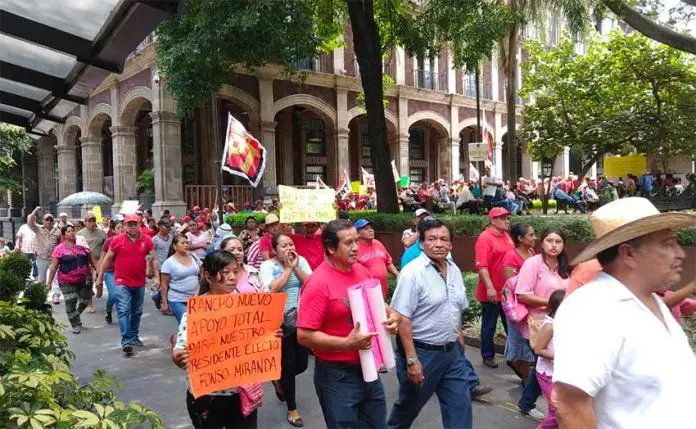
A march for the mayor yesterday in Cuernavaca.

In Amacuzac, Morelos, the candidate who won the election for mayor on July 1 did little campaigning because he could not: he was behind bars.

This week, some of his supporters held a protest in Cuernavaca demanding his release and that president-elect Andrés Manuel López Obrador intercede on his behalf.

Alfonso Miranda Gallegos ran for mayor under the three-party coalition Together We Will Make History, led by López Obrador’s party Morena.

Miranda was arrested in May on charges of organized crime and kidnapping his political rivals in May. Miranda has served as mayor of Amacuzac before. But federal authorities say there is evidence that he used his position to protect the Rojos crime gang.

After his arrest he was sent to a federal penal facility in Durango, where he was able to record a message to voters, asking for their support. The message was posted online where it seemed to have the right effect. Miranda won 3,672 votes on July 1; his closest rival won fewer than 1,000.

The mayor-elect, who has also served a three-year term as deputy in the Morelos state Congress, is the uncle of Los Rojos leader Santiago “El Carrete” Mazarí Hernández. Rumors about Miranda’s alleged criminal connections and illicit activities started circulating as early as 2009, his first year as mayor.

Yesterday, his supporters marched in the state capital. “He’s our leader and many of us want him . . . we want him before January 1st [the date the mayor-elect is sworn into office],” said spokesman Roberto Fernández.

He claimed Miranda’s arrest was part of a “political vendetta” and threatened a massive protest in Cuernavaca if he is not released.

Miranda’s lawyer told the newspaper Milenio that he’s awaiting a legal ruling that would allow his client to leave prison and be sworn in.

Christian Fragoso Velázquez said he was confident that the court will rule favorably, there being no concrete evidence backing up the charges against him.

Source: El Universal (sp), Milenio (sp)

A Canadian farmer is feeling the effect of Mexico earthquake

0
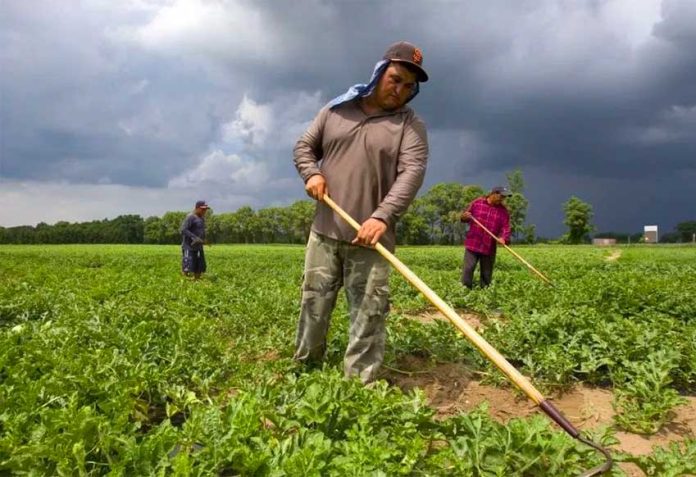
Mexican workers at a farm on a cloudy day
The president once again highlighted the contributions of Mexican emigrants to the U.S. economy during her Sunday speech. (File photo)

It’s a long way from Mexico City to Ontario but that didn’t stop the ramifications of the September 19 earthquake being felt by a watermelon farmer in the Canadian province.

Pete Gubbels, who has a 120-acre farm about 25 kilometers west of the city of London, has legally hired seasonal workers from Mexico for years to tend to and harvest his crops.

He welcomed more Mexican farm hands to his property this week but due to the partial collapse last September of a building in Mexico City that housed labor secretariat offices, some of the familiar faces he has relied on in past years were absent.

The paperwork and the database necessary to hire his regular workers were destroyed or lost in the rubble.

“Some of the guys we normally had aren’t coming because the paperwork was destroyed,” Gubbels told Ontario newspaper The London Free Press. “So they sent us new people instead.”

The farmer said he had filed the necessary paperwork in January but “from there it just turned into a nightmare for us.”

Gubbels also explained that he had been in regular contact with some of his previous employees who told him that they couldn’t travel to Canada to work without government approval and that their applications were bogged down in a slow bureaucratic process stemming from the earthquake.

The London Free Press said that “it was an unexpected glitch” for Gubbels and other local farmers who have come to depend on Mexican labor and “who are constantly on a deadline to plant, tend and harvest their crops.”

One of Gubbels’ most reliable workers finally made it to Canada this week, two months after he was supposed to arrive.

However, others who were slated to arrive in May and June are still waiting for their paperwork issues to be cleared up in order to board flights north.

“There’s nothing we can do on this end,” Gubbels said. “It all has to be done in Mexico.”

A spokesperson for the Canadian agency that helps farmers connect with foreign workers also said that there were no issues on the Canadian end.

Canadian farmers have been legally inviting Mexican workers to the fertile southern Ontario farm belt for decades.

According to Mexicans who have worked on Gubbels’ watermelon farm, working in Canada in a legal program with a mandated minimum wage is like winning the lottery compared to the exploitative wages and conditions illegal agricultural workers sometimes face in the United States.

All told, Gubbels said that he employs 14 foreign workers and 40 Canadians, who work either part or full time, but added that he still needs more staff.

“We cannot find enough Canadians to do this job, but the guys from Mexico would gladly do this,” he said.

Source: The London Free Press (en)