"De donde viene la gente" (Where the People Come From), by Huichol artist Hilaria Chávez, one of artists featured in the Third Biennial of Huichol Art, on display until Nov. 30 at the Presidente Intercontinental Hotel in Mexico City.
The third Biennial of Huichol Art exhibit is now showing at the Presidente Intercontinental Hotel in Mexico City, with a collection of 50 masterworks by some of the most outstanding Huichol artists alive.
Artists showing their work at the hotel in the Polanco neighborhood include Hilaria Chávez, Maximino Renteria and Gregorio Barrio, whose pieces have traveled the world as part of different expositions. Maestro Santos Motopohua, the only Mexican to ever be exhibited at the Louvre Museum, will also have work on display.
In an interview for the website Chilango, Jerónimo Martínez, one of the event’s organizers, said that the exposition “[…] is the most important exhibition of the beads and yarn technique because it highlights a work of popular art in the context of the Huicholes.”
The Huichol people, known in their native tongue as wixárika, are an indigenous group from the central northwest Mexico who have acquired global recognition for their colorful bead and string folk art. Each piece of art features traditional symbols, animals and designs of great spiritual significance to their people.
The curated pieces of this exposition – many of which were created by entire families – tell different stories in the Huichol cosmogony about the first deities that lived on Earth before Father Sun (Tawexika) was born. With the use of an augmented reality tool on a smartphone, visitors will be able to immerse themselves in the spiritual meaning of these pieces and the stories they tell.
Technology will be also present in the form of NFTs (non-fungible tokens). According to Martínez, this will be the first collection of Huichol artwork to be introduced in the NFT market in direct collaboration with the creators of the pieces.
The third Biennial of Huichol Art will remain until Nov. 30 at the hotel, located at Campos Elíseos street, #218. It will later tour the cities of Puebla, Mérida, Cancún and Tulúm before it moves abroad to Germany and Qatar.
The outbreaks of the virus on three poultry farms in Sonora and Nuevo León are just the latest to occur in recent weeks. Graciela López Herrera/Cuartoscuro
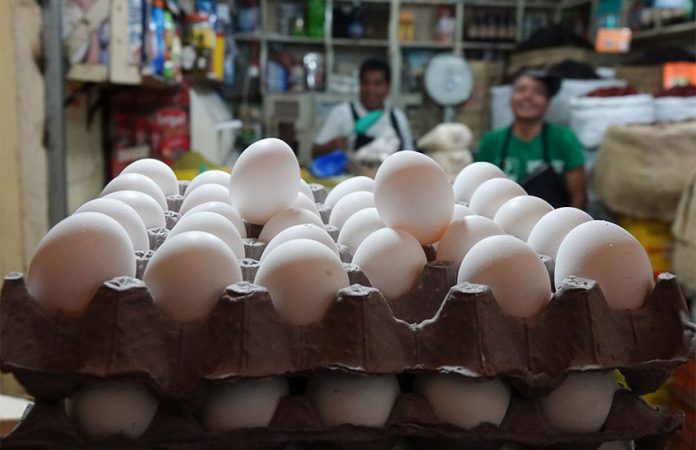
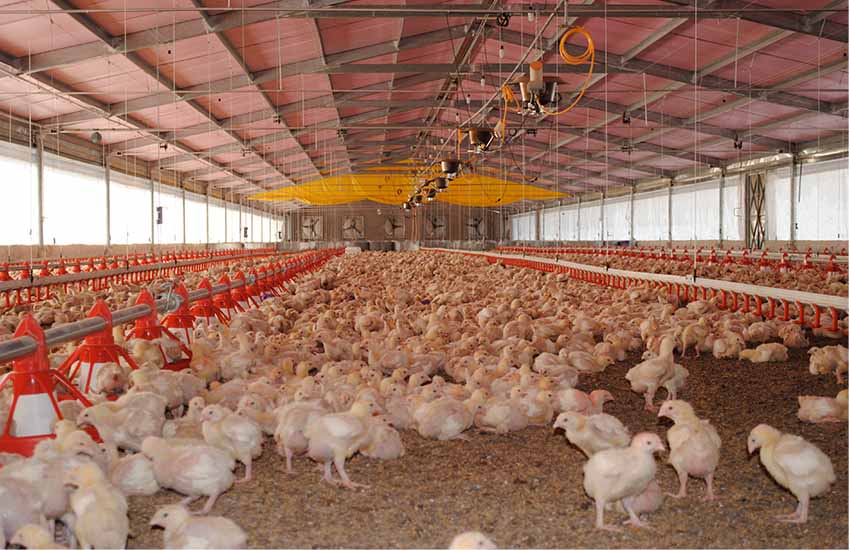
Chicken and eggs could be harder to find in parts of Mexico for a while due to an avian influenza outbreak in Sonora and Nuevo León, which could also send prices up for some customers.
Almost 300,000 chickens had to be slaughtered after the bird flu was detected on two farms in the Yaqui Valley near Ciudad Obregón, Sonora, and on one farm in Montemorelos, Nuevo León, according to federal agriculture authorities.
Plutarco Sánchez Patiño, an Agriculture Ministry official in Sonora, said that a total of 296,000 chickens were killed at the two Sonora farms, while agriculture sanitation authority Senasica said that that figure applied to the farms in both Sonora and Nuevo León.
Not all the chickens were infected with avian flu, but they were all destroyed to stop the disease’s outbreak from spreading, Sánchez said.
Avian flu can be found in both wild and farmed birds. Outbreaks at poultry farms often result in large groups of chickens being slaughtered to stop the disease’s spread. Government of Mexico
At the affected farms in Sonora and Nuevo León, Senasica specialists established the “relevant quarantine,” the authority said, adding that the “poultry production units,” or UPAs, were disinfected and depopulated.
The incidents also have made it harder for all farms located in the two states to do business for the time being, due to steps taken by Senasica.
“Due to the findings at the commercial UPAs, Senasica also ordered an internal quarantine in both states, which means that farms located in Sonora and Nuevo León can’t move poultry products that don’t have a permit from the federal health authority,” it said.
“… With the aim of avoiding the spread of the disease and protecting national consumption of poultry products, prior to moving [such products] UPAs must demonstrate via tests carried out at official laboratories that the products are free of [avian flu],” Senasica also said.
According to an Excélsior newspaper report, poultry suppliers and vendors in Sonora, as well as restaurants and rosticerías (rotisseries) have warned that there could be a serious shortage of chicken and eggs in the coming weeks due to the birds’ slaughter. Prices for those products are expected to rise due to the anticipated shortage.
Poultry suppliers said that measures to mitigate the risk of avian flu spreading, including a quarantine, would also contribute to the predicted scarcity.
Governor Alfonso Durazo chaired a meeting of a “special committee against avian influenza” on Saturday and subsequently reported on Twitter that it was a priority of the Sonora government to “comply with strict health controls to guarantee high safety standards in the food industry in our state.”
Alejandro Romero Ayala, an economist, told Excélsior that the anticipated shortage could worsen if avian flu spreads beyond the farms where it was detected. He recalled that some 22.3 million chickens were killed in 2012 after a bird flu outbreak in Jalisco.
Egg prices surged 40% as a result, while chicken prices rose 14%, according to central bank data.
Sonora and Nuevo León aren’t the only states where avian flu has been identified in recent weeks. Senasica said in a statement last Friday that it had detected the disease in birds in seven states, including on a family-run chicken farm in the southern state of Chiapas. Avian flu was also detected in wild birds in Baja California, México state, Aguascalientes and Jalisco, Senasica said.
Senasica said that the entry of bird flu to Mexico via migratory birds was “foreseeable” due to the presence of the disease in the United States and Canada. An animal health emergency protocol known as Dinesa was activated in June, and that has allowed agricultural authorities to respond quickly to avian flu outbreaks, Senasica said.
In October, Mexico's transport and communications sector saw the most growth in formal jobs, at 7.8%. Fotografías con Limón/Unsplash
Formal sector job generation hit the highest increase on record for a single month in October, with 207,968 new jobs, bringing Mexico’s current total of formal jobs in existence to 21.6 million as of Oct. 31.
According to Mexico’s Social Security Institute (IMSS) the October increase represents a 1% growth compared to September and 4% growth compared to October 2021.
A total of nearly 1 million new jobs have been created so far this year, the second-highest total of jobs created between January through October since recording began in 2000, according to IMSS Director Zoé Robledo.
The highest figure for jobs created ever recorded between January and October occurred in 2017, when Mexico created 1.7 million jobs. Of 2022’s current total of 997,178 new formal jobs, 68.4% have been permanent.
Mexico City saw 29,732 jobs created in October, the highest figure for new jobs across Mexico’s 32 states. oscar reygo/unsplash
October’s job creation increase was also well spread out around the country: Sonora was the only state that reported a decrease in the 10th month of the year, with 1,639 jobs lost.
All other entities across the country registered upward progress last month, the highest being Mexico City (29,732 jobs), followed by México state (23,516), Jalisco (23,294), Nuevo León (14,861) and Sinaloa (12,746).
On an annual basis, Tabasco showed the best improvement, with 13.7% growth compared to last October, followed by Quintana Roo at 11.2% and Baja California Sur at 11.1%.
At the other end of the spectrum, the states that registered the least progress in formal employment creation compared to last October were Sinaloa (0.8%), Morelos (1.2%) and Zacatecas, the only state that also showed an annual decrease of -0.2%.
The highest concentration of new jobs occurred in the transport and communications sector, which saw 7.8% growth. The construction sector followed with an improvement of 5.9%, and the business services sector showed an advance of 5%.
In terms of labor income, IMSS said that workers’ average daily salary in October went down by 80 pesos to 479.90 (US $23.99), compared to 480.70 pesos in September. Workers in October on average made 14,397 pesos (US $719.85) per month.
Despite the financial setback, the average daily salary represented an 11.1% increase compared to October 2021, and according to IMSS, the current employment rate is 4.87% higher than it was before the COVID-19 pandemic.
“As of October, in its comparison with the pre-pandemic numbers, 30 of the 32 entities show a complete recovery in employment,” Gabriela Siller, an economist and director at Banco Base, told El Economista. However, she pointed out that compared to employment growth between 2000 and 2019, October’s figure shows a deficit of as many as 650,329 jobs.
The National Institute of Statistics and Geography (INEGI)’s latest citizen poll on employment revealed that the informal market still exceeds the formal: six of every 10 Mexicans have an informal job, meaning that it’s not counted by the government.
However, a bit of good news is that of the 21.6 million Mexicans who have formal employment, 86.4% of them are permanent employees, which is an improvement over the figures at the beginning of the pandemic.
The Bank of México (Banxico) is expected to raise its benchmark interest rate by an additional 75 basis points on Thursday. Deposit Photos
The Mexican peso appreciated for a fifth consecutive day on Monday to close at its strongest level against the U.S. dollar since 2020.
Buoyed by the expectation that the Bank of México (Banxico) will raise its benchmark interest rate by an additional 75 basis points on Thursday, the peso was selling at just under 19.45 to the dollar at the close of trading on Monday.
Banxico data shows that the exchange rate was the strongest end-of-day position for the Mexican currency since March 2020, when the cost of a greenback dipped below 19.4 pesos.
The peso appreciated 0.36% on Monday, increasing its gains over the past five trading days to 1.82%. It had weakened slightly to about 19.5 to the dollar at 9 a.m. Central Time on Tuesday.
Gabriela Siller, director of economic analysis at Banco Base, said that the current strength of the peso is related to the expectation that the Bank of México will once again follow the lead of the U.S. Federal Reserve and raise its key rate by 0.75%.
Banxico holds its monetary policy meetings the week after the Fed makes its rates announcements, and appears likely to match the U.S. central bank’s 0.75% hikes for a fourth consecutive time this Thursday as inflation – 8.5% in the first half of October – remains well above its target rate. The official interest rate in Mexico would thus reach 10%, more than double the 3.75-4% range in the U.S.
Siller said that another factor contributing to the peso’s strength is that significant amounts of money are flowing into Mexico in the form of payments for Mexican exports, remittances and foreign direct investment.
In addition, “the dollar has weakened a little” because the Fed is nearing the end of its tightening cycle, she said.
“Few interest rate increases remain, and even though there continues to be a restrictive monetary policy [in the U.S. for now], the light at the end of the tunnel is now visible,” Siller said.
The analyst said that the peso could strengthen further if Banxico lifts rates by more than the predicted 0.75% this Thursday, or if it indicates in its monetary policy statement that it will continue along an aggressive tightening path. Such a scenario could see the peso strengthen to 19.2 to the dollar, Siller said.
Looking further into the future, the deputy director of economic analysis at the brokerage house Vector said that the Fed is likely to start cutting rates before Banxico, and such a situation would benefit the peso.
“It’s becoming increasingly clear to the market that when we reach the interest rate peak in Mexico and the United States, it’s very probable that the United States will think about lowering … [rates] before Mexico. … That issue … helps the exchange rate [here],” Luis Adrián Muñiz said.
Muñiz, Siller and Monex analyst Janneth Quiroz – all of whom were cited in an El Economista newspaper report – agreed that the peso could also benefit from an additional decrease in the inflation rate in the United States. If data to be published this Thursday shows that the annual rate in the U.S has declined for a fourth consecutive month, the dollar will weaken, giving the peso more scope to appreciate, they said.
The British bank Barclays offered a rosy forecast for the peso late last month, saying that it could appreciate to 19 to the U.S. dollar by the end of next year. In contrast, Moody’s Analytics said earlier in October that the peso could depreciate 20% against the U.S. dollar in the coming months due to tightening monetary policy in the United States.
The peso has been one of the best performing currencies in 2022, gaining over 5% against the dollar at a time when many other currencies have lost ground against the greenback, which is seen as a safe-haven currency in times of economic uncertainty.
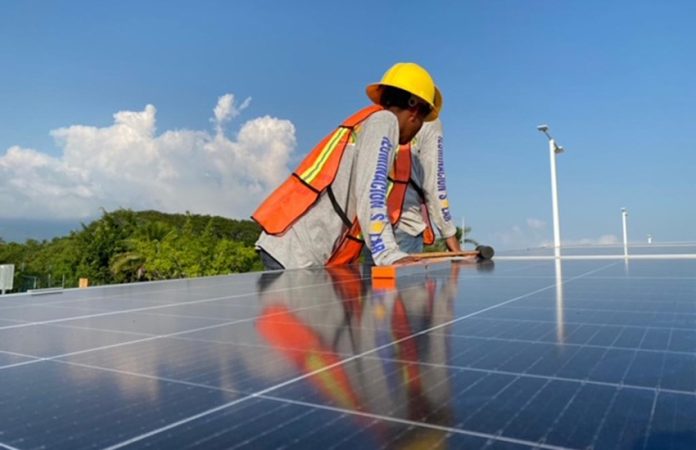
Workers at EDISSustentable in Ixtapa-Zihuatanejo, Guerrero, install solar panels at a customer site.
In 2017, when Cubans Rodelaine Martínez Torres and his wife Virginia Campos discovered Zihuatanejo, they liked it so much that they decided to stay.
With a background in engineering and solar experience at a thermal electric plant at Pinar del Rio in Cuba, Martinez quickly saw the potential to start his own solar panel company in the resort area, where according to Google, the sun shines on average 340 days a year.
Today EDISSustentable, which sells panels, generators and hybrid systems, has more than 100 customers, including the International Ixtapa-Zihuatanejo airport, their largest project to date.
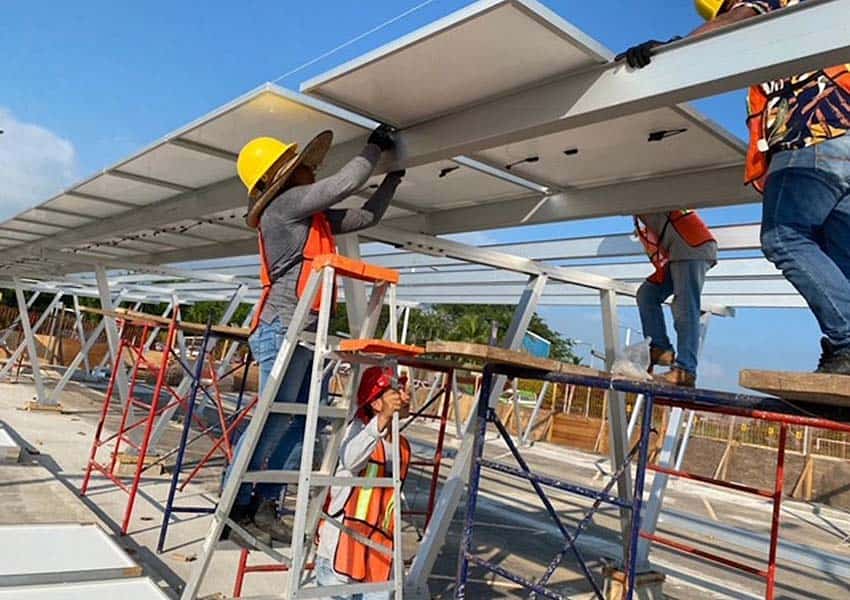
Martínez and Campos also give back to the community. It brings programs to schools to educate kids about renewable energy, and it also has a paid internship program that hires students from the nearby Technological University of Costa Grande in Petatlán, a win-win situation for both sides: students get long-term hands-on training, and the company benefits from training students who become a skilled local labor pool it can hire from.
Rodelaine Martínez Torres, owner of EDISSustentable solar panel company in Zihuatanejo, is originally from Cuba and fell in love with the resort city so much, he changed from a tourist to a resident.
César Eduardo Martínez Najera, a graduate of the program, who worked 190 hours as an intern at the company and eventually became an employee, had nothing but good things to say about his experience.
“This aspect had me very excited, as at the university, the theory was 30% and 70% was in practice.”
When solar power got going in Mexico around 2015, according to Martínez, Mexico’s federal government first began supporting the industry’s development with simplified permitting procedures for 500-kilowatt- to 2-megawatt projects. There are also several subsidies available for those who buy solar systems, including a 100% tax incentive.
However, the current Mexican government is not as open to renewable energy as it used to be, Jeremy Martin of the Institute of the Americas, a think-tank based at the University of California San Diego, recently told the financial magazine Forbes.
Installers install panels at Ixtapa-Zihuatanejo Airport, EDISSustentable’s largest client to date. Some of the company’s workers are graduates from a paid solar industry internship program the company runs.
“Overall, [President] López Obrador is prioritizing fossil fuels at the expense of renewable energy and has disparaged wind turbines for polluting the visual landscape in rural areas,” he said. “Globally, the energy trend lines are clear. Net-zero and climate actions are the imperatives driving the world’s policy choices and regulations.”
But for many potential solar customers, the bottom line isn’t how much federal support there is but how much savings they can get on their electric bill. And what can stop people from progressing from consideration to execution is not knowing how such systems work, how to judge a solar panel system’s usefulness or how to evaluate the company promising to install it.
Martínez explains that a consultant should visit your home or property to ascertain the roof’s slope, the house’s size, electrical units and appliances. Then, they check your electric bills to see your current consumption to determine how substantial your savings would be. Next, a converter is attached to a charge center system on a separate meter, which measures what your panels produce and consume.
A phone application can track all this for you.
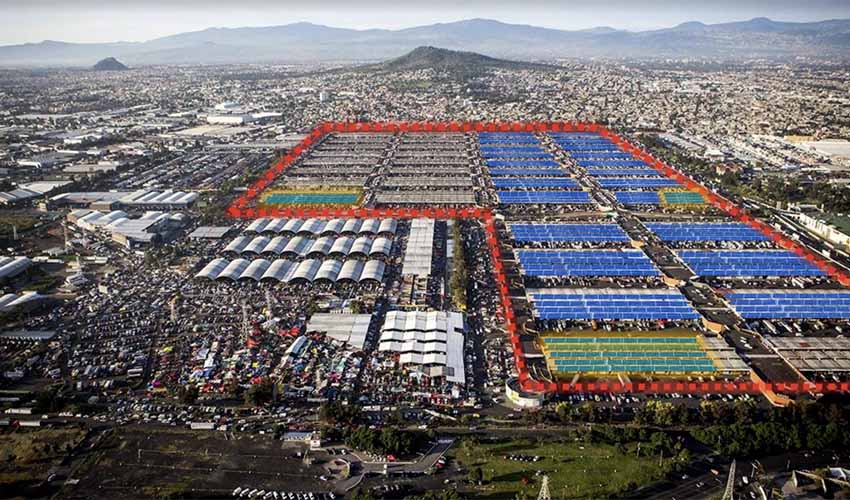
Solar energy is becoming more accepted in Mexico’s daily life, as this huge solar array in progress on Mexico City’s municipal public market, the Central de Abastos, shows.
The sun’s light and the amount of sunshine make the panels more effective; an average of 28 degrees Celsius temperature is ideal. Once the light hits, it passes through a microinverter connecting four panels simultaneously. If something interferes with one of the panels functioning — such as dirt dropped from a passing bird — the other panels continue to work. Getting the panel to work again is simply a matter of hosing off the boards with water, something homeowners typically need to do once a month.
The normal life expectancy of panels is 25 years.
And how long does it take for solar panels to pay for themselves? EDISSustentable’s customer service representative Marianna Best says that you can normally expect a return on investment within three to four years. “As soon as the panels are installed and the meter is changed, customers can expect a 98% decrease in current electrical bills.”
But, she cautions, “It is important to ensure you are dealing with a reputable company. Things to watch for are whether the engineers are qualified and certified. In addition, you need to check that the panels, the microinverters, and the materials are of the quality that the company says they are. Consumer reports and reviews help.”
To learn more about EDISSustentable, you can contact them through their website.
The writer divides her time between Canada and Zihuatanejo.
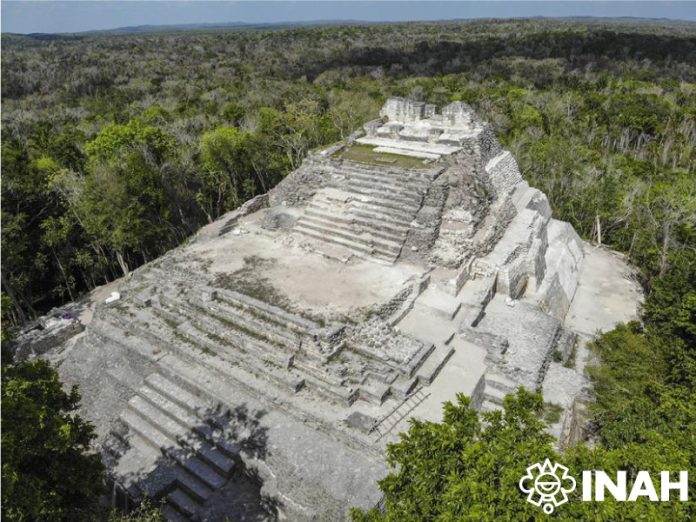
Ichkabal was rediscovered by researchers in 1994. INAH
On route to the Bacalar lagoon in Mexico’s Yucatán Peninsula, the site of the ancient Maya city of Ichkabal (City of Snakes) will soon open to visitors, according to Diego Prieto Hernández, Director of the National Institute of Anthropology and History (INAH).
Although there is no confirmed date for its opening, researchers and authorities hope that the first tangible results of work on the project will be seen by tourists by mid-2023.
“Ichkabal is not open to the public because it is not easy to access the area,” Prieto said at a press conference.
With a large portion of the city still lying beneath the jungle, the site is currently being excavated by the National Institute of Archaeology and History (INAH) as part of the Program for the Improvement of Archeological Sites (Promeza), an initiative to improve and/or develop archaeological sites along the route of the under-construction Maya Train, a commuter and tourist railroad route that will have stops near many tourist cities and attractions in southern Mexico.
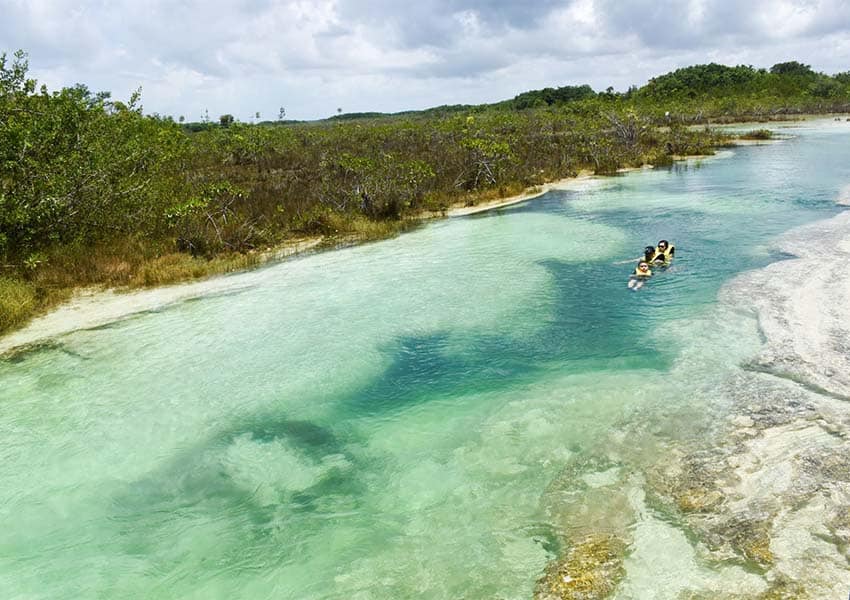
Ichkabal is located near Bacalar, Quintana Roo, a quiet municipality that federal and state officials believe is ripe for more tourism. Cuartoscuro
Located 30 kilometers away from what would be the Bacalar station of the railway project, Ichkabal was only discovered 28 years ago by archeologists Enrique Nalda Hernández and Javier López Camacho, although there had been talk of an archaeological site in the region since the 1930s.
So far, excavation at Ichkabal has revealed a central set of five buildings that are at least 2,400 years old. Standing out among them is a 40-meter-high pyramid twice the size of the large Kukulkán temple in Chichén Itzá. The Ichkabal pyramid has a base area similar to that of the Pyramid of the Sun in Teotihuacán.
The building’s size supports the findings of previous investigations of the site, which have suggested the importance of Ichkabal for the Maya. Some researchers believe the city is the origin of the Kaanu’l (serpent) dynasty, one of the most powerful ruler groups of the Maya civilization.
Ichkabal has been a site Quintana Roo has wished to develop for years. In 2016, the federal government via INAH agreed to invest more than 11 million pesos in preparing the site for tourism. Sedetur
Archeological findings at the site ranging from between the Pre-Classic period and the Maya civilization’s collapse (400 B.C.–A.D. 900) demonstrate the city’s permanence through time, also an indicator of the site’s importance.
The artificial lagoons used as water reservoirs for the ancient city have also surprised archaeologists. In an interview with the newspaper La Jornada, INAH archeologist Sandra Balanzario said that the lagoons used an advanced hydraulic technique to avoid erosion and water seepage, allowing the lagoons to support the daily life of a city of 100,000 inhabitants spread over an area of 60 square kilometers.
To date, 26 archaeological zones along the Mayan Train are currently undergoing renovation work, with Quintana Roo being home to the largest number of zones in the program.
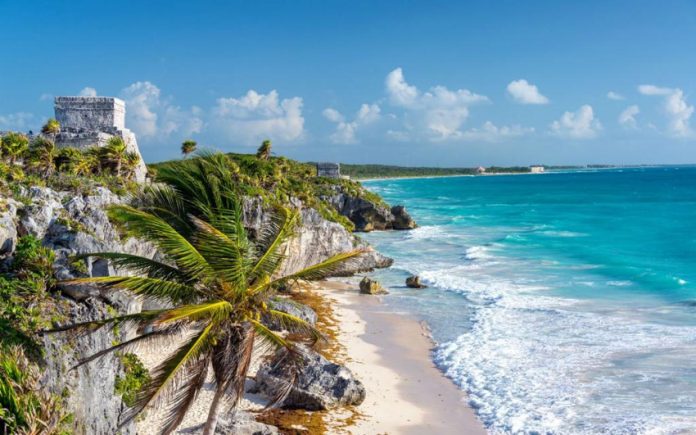
Both tourism infrastructure projects have had setbacks Tulum Photo: Sectur
Despite setbacks, President López Obrador remains determined to build the final two sections of the Maya Train project and a new international airport in Tulum, Quintana Roo.
Speaking in Tulum alongside Quintana Roo Governor Mara Lezama and army officials on Saturday, López Obrador said that the government will announce inauguration dates for sections 6 and 7 of the 1,500-kilometer railroad and the airport in three weeks.
It wasn’t clear whether he was referring to the dates that construction of the railroad sections and the airport will start or the dates they will begin operations. The army has been assigned responsibility for building all three projects.
With 550 kilometers of tracks, sections 6 and 7 will connect Tulum to Escárcega, a municipality in southern Campeche.
López Obrador said last month that construction of the Maya Train railroad in southern Quintana Roo and Campeche was in doubt due to the opposition of local landowners. But leaders of five of six ejidos – community-owned parcels of land – have now agreed to sell their land, the newspaper La Jornada Maya reported Monday.
As for the planned airport – first announced in late 2020 – the environmental impact of the project is currently being evaluated, the federal Environment Ministry (Semarnat) said in a statement Friday.
There were reports and social media posts asserting that Semarnat had determined that the project is “unviable” after the Ministry of National Defense submitted documents in August seeking environmental and “change of land use” authorization, but the ministry denied that was the case.
“[It’s] important to clarify that the official letter that has been disseminated via publications on social media is part of one of the administrative procedures Semarnat carries out in response to requests from both public and private developers. However, it should be noted that the official letter issued by Semarnat at no time described the Tulum airport project as unviable, and therefore we believe that the information published, as well as the official letter presented, were manipulated,” the ministry said, adding that a crime may have been committed.
“There is no reference in the publications to the fact that the project … [is subject to] a new and active evaluation process. … The purpose of clarifying … this disinformation is to avoid confusion … and guarantee the transparency with which the government of Mexico is run,” Semarnat said.
López Obrador has previously said that the Tulum airport will open in 2023, while the US $10 billion tourist, commuter and freight railroad – which will connect cities and towns in five southeastern states – is also slated to begin operations next year.
The president inspected progress of the latter project from the air on Sunday, and posted footage of his flyover to social media.
“There are 184 kilometers from Mérida to Campeche and 37 kilometers of tracks – 20% [of the distance] in other words – have been laid,” he wrote above the footage.
De Mérida a Campeche hay 184 kilómetros y se han tendido 37 kilómetros de vía, o sea, el 20 por ciento. Parece poco, pero no son tacos de cochinita pibil ni pan de cazón. El Tren Maya va. pic.twitter.com/HdVCoYsW6I
“It doesn’t seem like much but [laying tracks isn’t like eating] tacos de cochinita or pan de cazón,” he wrote, mentioning two Yucatán Peninsula gastronomic specialities. “The Maya Train is going ahead.”
As part of the 2022 tax reform, SAT announced the replacement of the digital receipt (CFDI) 3.3 with the latest version 4.0 FOTO: MARIO JASSO/CUARTOSCURO.COM
The Tax Administration Service (SAT) has postponed the mandatory issuance of the electronic payroll invoice version 4.0 to April 2023. The change was originally scheduled for Jan. 1, 2022.
Taxpayers obliged to issue payroll-type receipts, “will have the option to do so in the 3.3 version until March 31, 2023, so that during said period they can comply with all tax requirements for the issuance of the 4.0 CFDI version,” said SAT in a statement released on Nov. 1.
The tax authority also extended to the same date the period to obtain the electronic signature without it meaning a breach of tax provisions.
The extension, however, only applies to those who issue payroll receipts, since all other types of Digital Tax Receipt (CFDI), such as utility bills or lease receipts, still have Jan. 1, 2023 as a deadline for compliance.
As part of the 2022 tax reform, SAT announced in 2021 the replacement of the 3.3 (CFDI) with the latest version 4.0. The update requires new mandatory data for the recipient of the payroll-invoice, such as Federal Taxpayer Registration, RFC, full name, and postal code of the employee’s tax address. If such data is not included, the pay-roll receipt will not be tax deductible and therefore, employers will be directly affected, said the Mexican Institute of Public Accountants.
For this reason, many employees not aware of their updated tax information, have requested from SAT their Proof of Tax Status (Constancia de Situación Fiscal) to hand it over to their employers, as this document contains the identification data required for the CFDI 4.0.
The CFDI 4.0 came into force in January 2022. However, at the time, the Taxpayer Defense Attorney’s Office (Prodecon) and the National Employers Federation (Coparmex) insisted on the need to extend the CFDI 4.0’s familiarization period before making its use mandatory.
Since then, SAT has postponed the deadline four times: the first time it was extended to May. The second one, to July. The third one, to Jan. 2023, and the last and current one, to April 2023.
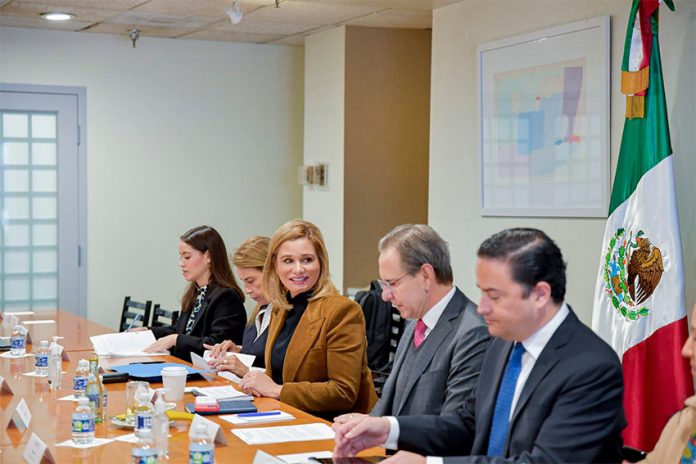
Chihuahua Governor Maru Campos Galván (center) in a Nov. 1 meeting with U.S. industry representatives. Twitter @MaruCampos_G
The northern Mexican state of Chihuahua is looking to attract investors from the aerospace and semiconductor industry as part of a plan to draw $8 billion in foreign direct investment (FDI) in the next five years.
Governor Maru Campos Galván held meetings in the U.S. with Intel, Boeing, and other companies to promote Chihuahua as an attractive destination for foreign investment as the state seeks to move up in the supply chain. The goal is to build on the region’s traditional strength in auto parts and electronics, which helped position Chihuahua as Mexico’s largest goods exporter to the U.S. The state currently exports more than US $58 billion worth of goods a year to its northern neighbor.
In the meetings, Governor Campos assured companies that Chihuahua is ready to welcome foreign companies with incentive packages through an economic policy aimed at strengthening a diverse range of manufacturers including the semiconductor and aerospace industries. To date, Chihuahua is home to 15% of aerospace manufacturing in Mexico.
To attract investment, the local government has pushed talent development strategies, the strengthening of local suppliers and the promotion of innovation and applied technology. “I want to be the spark plug of the US-Mexico border,” Campos said in an interview with Bloomberg on Monday, as part of her tour in Washington, D.C.
Joining the meetings was Mexico’s ambassador to the U.S., Esteban Moctezuma, who said that benefiting from its strategic location bordering the U.S., Chihuahua plays a key role in the relationship between Mexico and the U.S. and its common goal of promoting economic regional growth.
The ambassador added that Chihuahua forms part of a highly integrated region with Texas and New Mexico, connected with efficient, state-of-the-art ports of entry, railways, and airports. The position offers a unique manufacturing and logistics platform to compete in the global market, he said.
The meetings were held as part of the state government’s “Chihuahua Month” in the U.S., which drew representatives from Intel, HP, Honeywell Boeing and Bombardier.
Polls suggest conservatives have a strong chance of winning a majority in the House. Jonathan Simcoe / Unsplash.com
The results of Tuesday’s midterm elections in the United States have the potential to impact Mexico and Mexicans in a range of ways, according to a group of political observers consulted by the newspaper Reforma, with several warning of serious consequences if the Republican Party seizes control of one or both houses of Congress.
Voters will elect lawmakers to occupy all 435 seats in the U.S. House of Representatives, while 35 of 100 Senate spots, and the governorships of 36 states, are also up for grabs.
The Republican Party will seize control of the House if it picks up five seats, and take charge of the Senate if it wins just one additional seat. The news agency Reuters reported Monday that “nonpartisan election forecasters and polls suggest Republicans have a very strong chance of winning a House majority, with control of the Senate likely to be closer fought.”
As voters prepare to head to polling stations north of the border, Reforma asked a range of experts to offer a view on how the results of the United States midterms will affect the bilateral relation between Mexico and the U.S.
Rodrigo Aguilar Benignos, a former Mexican government official and member of the Council on Foreign Relations — a New York-based think tank — said that política de mano dura, or heavy-handed (U.S.) policy, will intensify in a range of areas if the Republicans win a majority in the House and/or Senate. Among the policy areas he cited were migration, border security, trade and transnational organized crime, all of which affect Mexico and Mexicans, including those already in the United States and those intending to migrate there — legally or illegally — in the future.
Álvaro Santos, a law professor at Georgetown University, offered a similar opinion. “A Republican victory would place pressure on Mexico with regard to migration [to the U.S.],” he said, perhaps recalling that the Mexican government ramped up enforcement against migrants when former U.S. President Donald Trump threatened to impose blanket tariffs on Mexican exports in 2019.
Santos also said that a Republican triumph could result in the U.S. increasing pressure on Mexico in areas such as energy and agriculture “within the context of the USMCA” — the North American free trade pact that superseded NAFTA in 2020.
Corn exports and energy policy are two recent points of contention that could be exacerbated by changes in political leadership. Depositphotos
Genaro Lozano, a political analyst and columnist, told Reforma that Republicans will push for economic sanctions on Mexico if they take control of one or both houses of Congress, as they believe the Mexican government has violated the free trade agreement with energy policies that favor state-owned companies over private and foreign ones.
“For now the Biden administration is waiting for the result of this election to move forward in the dispute with Mexico,” he said. “… If the Republicans … [win] they will push hard for Mexico to be sanctioned.”
The U.S. government retains the right to request a dispute panel to make a ruling on Mexico’s energy policies. If a panel rules in its favor, it could impose punitive tariffs on U.S-bound Mexican exports.
One Mexican export that wouldn’t be subject to any tariffs the United States imposes are illegal narcotics. However, one former Mexican ambassador to the U.S. believes that a Republican victory in Tuesday’s midterms could lead the U.S. to ramp up pressure on Mexico to combat the production and northward flow of fentanyl, a powerful synthetic opioid that killed tens of thousands of Americans last year.
Republican control of Congress would also mean “less … sympathy for the Mexican call to combat the illegal trafficking of weapons to our country,” said Martha Bárcena, ambassador to the U.S. between late 2018 and early 2021.
“[Republicans] will also seek a harsher migration policy,” she added. “Criticism of the situation of violence and insecurity in Mexico could intensify. We must also be very attentive to the results of the elections for governor in Arizona, Texas, California and New Mexico,” Bárcena said.
Texas and Arizona are currently led by Republican governors, while California and New Mexico are governed by Democrats. Of the border state governors, Greg Abbott of Texas and Doug Ducey of Arizona have both taken steps to enhance border security while calling on the U.S. federal government to do more to stop the illegal entry of migrants via the southern border with Mexico.
Abbott is facing a challenge from former representative Beto O’Rourke, while Ducey is nearing the end of his second term and cannot seek reelection.
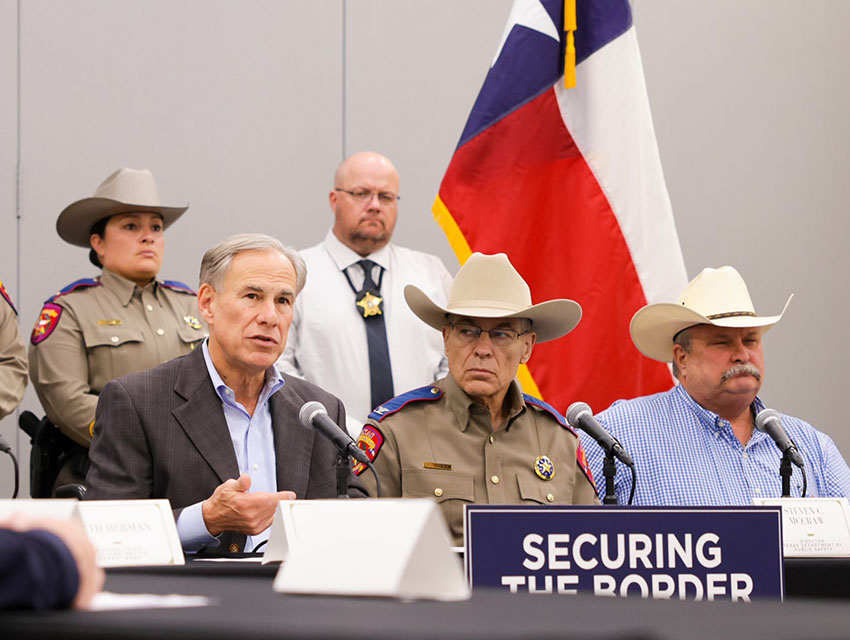
Texas Governor Greg Abbott, left, announced the designation of Mexican cartels as terrorist organizations in September. Greg Abbott/Twitter
Lozano said that Abbott — who recently designated Mexican drug cartels as terrorist organizations — “has exacerbated anti-migrant and anti-Mexican sentiment” in the U.S., adding that the Texas governor and Governor Ron DeSantis of Florida are leading exponents of “Trumpism” and their reelection could be a sign of things to come in 2024, when the next U.S. presidential election will be held.
Although President López Obrador demonstrated “open support” for Trump while the former U.S. president was in office, a lot of the latter’s “acolytes” are not fans of Mexico or Mexican people, said Shannon K. O’Neil, a senior fellow for Latin America Studies at the Council on Foreign Relations.
After Tuesday’s midterms, the Republican Party can be expected to increase its efforts to stem the flow of migrants into the U.S., “limit trade” with Mexico and drive the two nations apart, she said.
José Díaz Briseño, a Reforma correspondent in the United States, said that “the main problem Mexico faces in United States politics is the poor perception Republican voters have of the country.”
“According to [polling company] Gallup, 33% of Republican voters have a negative view of Mexico due to issues such as violence and migration. This was a sentiment that Trump identified well in 2015 and it could be exploited again if the ‘Trumpist’ candidates win on November 8,” he said.
For her part, Ibero-American University historian Pía Taracena asserted that the Biden administration has been “very patient” with Mexico, but the results of the midterms could change that.
A lot of lawmakers’ attacks on Mexico that are related to sensitive bilateral issues such as migration and border security, and even AMLO’s “ideological positions” have been stifled because the Democrat Party controls the lower house of Congress and there is a tie in the Senate, she said, acknowledging that Republicans currently have 50 senators, while the Democrats effectively have the same number, as the two independents — Angus King and Bernie Sanders — caucus with that party.
That situation could change if the Republicans take control of the House, Taracena said, predicting that the party will adopt an aggressive posture toward Mexico in the lead-up to the 2024 election. “Unfortunately, Mexico will continue to be a political piñata,” the academic said.
Adding to that view, the director of the Center for the U.S. and Mexico at Rice University’s Baker Institute for Public Policy, Tony Payan, opined that an “essential part of populism” is to “create enemies that are convenient for focusing the negative attention of the followers of a leader.”
“In the case of the Republican Party, Mexico … has played a vital role among followers of United States populism,” Payan said, noting that it has been portrayed negatively for its response (or perceived lack thereof) to “common challenges such as the border, migration flows, trade [and] drug trafficking.”
In responding to Reforma’s question about how the election will affect bilateral relations, Mexican-born, U.S.-based journalist Andrés Martínez said he would like to cite “something very precise about policies and party proposals,” but instead contended that “the tragic thing at the moment is that stability and the viability of democracy [in the U.S.] is at stake, and the risk of contagion to civic culture is enormous.”
“If the tradition of not accepting electoral verdicts is consolidated in many parts of the United States, … [that wouldn’t be] a good omen for what might come in Mexico,” he said.
A vocal group of U.S. citizens believe the conspiracy theory that former president Donald Trump won the 2020 election. One expert said that such refusals to accept election results could spread to Mexican civic culture. Gerry Dincher via Flickr / CC BY-SA 2.0
Jorge Ramos, another Mexican-born, U.S.-based journalist, said that democracy is “for different reasons … being questioned or put to the test” in both Mexico and the United States.
“In the short term, if the polls are right, the United States will have a divided government and Mexico will be forced to have a relationship with both parties and [that comes with] the serious possibility of conflicts. In addition, a Republican victory on Tuesday, and the [possible] announcement of Trump as a presidential candidate [in 2024], will without the slightest doubt increase disinformation and anti-immigrant and anti-Mexican rhetoric. We have to prepare ourselves for what’s coming,” he said.
For his part, Mexico expert Duncan Wood said that a Republican victory would make things “more complicated” for López Obrador, but argued that nothing much would change in the short term.
“There isn’t much that the Congress can do to demand more action from the Biden administration to punish Mexico,” he said before acknowledging that it could pressure the U.S. government to request an energy dispute panel.
“Although it will be a less positive relationship [between Mexico and] … the Congress, the truth is that until there is a change of government [in the U.S.], … López Obrador can count on a more or less positive relationship with the government,” said Wood, a senior adviser to the Wilson Center’s Mexico Institute.
While the political observers consulted by Reforma focused on the ramifications for Mexico of a Republican victory on Tuesday, Aguilar (of the Council on Foreign Relations), considered the possibility that the Democrats will keep control of the House and the Senate. (Vice President Kamala Harris can cast a tie-breaking vote in the Senate, something she has done 26 times since the current U.S. government took office).
“If the Democrat majority is maintained in both houses, the Biden agenda [with regard to Mexico] will continue as it has until now,” Aguilar said.
López Obrador has maintained cordial relations with the U.S. president and met with him at the White House in July. At the time, both presidents committed to work together on a range of issues including trade, border security, climate change and security.
More recently, Mexican and U.S. officials held high-level security talks in Washington, where they reaffirmed their commitment to combat the smuggling of weapons and fentanyl across the two countries’ shared 3,145-kilometer-long border, which remains porous despite efforts by both countries to stop the flow of the illicit goods.