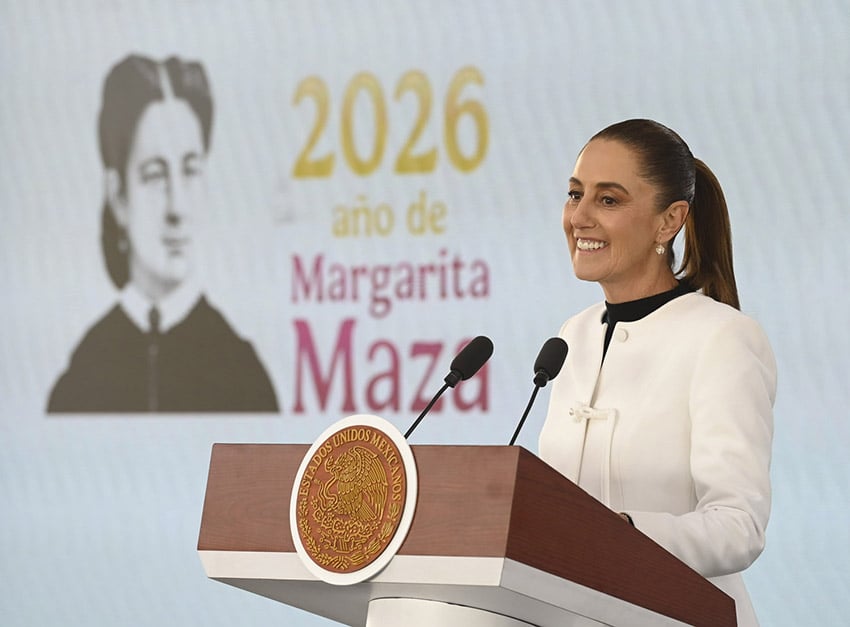
President Claudia Sheinbaum held her Friday morning press conference in Ecatepec, one of Mexico’s largest municipalities by population.
Governor Delfina Gómez and other officials from México state, where Ecatepec is located, joined various federal functionaries at the mañanera.
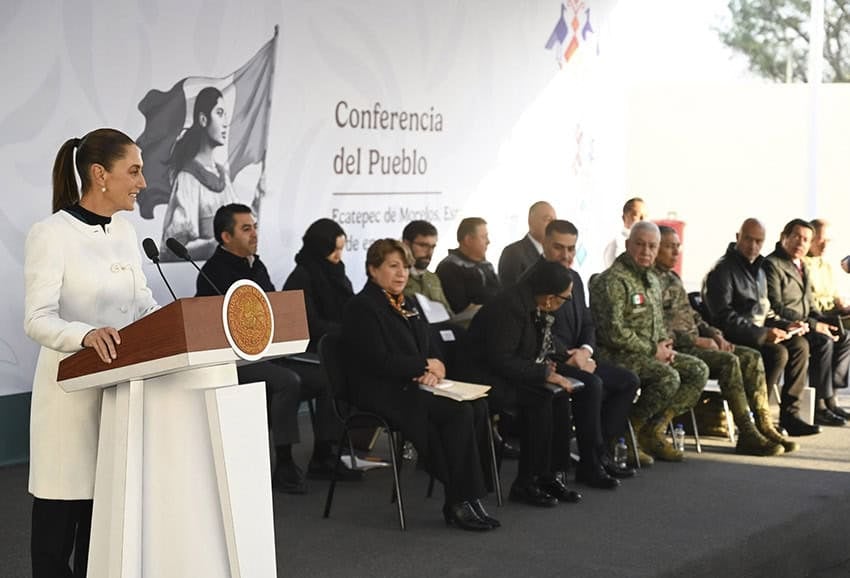
“Presidenta, your presence [here] strengthens us,” Gómez said in an introductory address.
Later in the press conference, Sheinbaum responded to questions on a range of topics including the electoral reform proposal she is expected to soon present to Congress, and the earthquake that activated the Seismic Alert System in Mexico City at around 12:40 a.m. Friday.
She also defended her government’s record on security, after the U.S. State Department’s Bureau of Western Hemisphere Affairs said in a social media post that the United States has “made clear” to Mexico that “incremental progress in facing border security challenges is unacceptable.” (Read Mexico News Daily’s story on Sheinbaum’s remarks here.)
Sheinbaum discusses electoral reform proposal
During her Q&A session with reporters, Sheinbaum outlined the “central elements” that “the people” are asking for with respect to electoral reform in Mexico.
The president — who in the coming weeks is expected to present a wide-ranging electoral reform proposal to Congress — said that the Mexican people (and her government) are seeking a reduction in costs related to holding elections, and an electoral system in which proportional representation (plurinominal) candidates are not selected by party chiefs.

“There are deputies who have been plurinominal deputies their whole lives, senators [as well]. The objective of the reform is that the people also decide about proportional representation,” Sheinbaum said.
She also said that the reform proposal she will submit to Congress will aim to increase “citizen participation” in various facets of Mexico’s democracy.
“People should express their opinions and participate, that’s democracy,” said Sheinbaum, who also said that her reform proposal would aim to make it easier for Mexicans abroad, especially those in the United States, to “exercise their right to vote.”
On Thursday, she asserted that the National Electoral Institute — the authority responsible for organizing elections in Mexico and the nation’s electoral umpire — will not lose its autonomy as a result of the reform, as opposition politicians have claimed.
Indeed, opposition lawmakers have dubbed Sheinbaum’s proposed reform — which has not yet been drawn up — the “Ley Maduro,” or “Maduro Law,” after ousted Venezuelan President Nicolás Maduro, to whom the National Electoral Council of Venezuela awarded the 2024 presidential election even though he is widely believed to have lost.
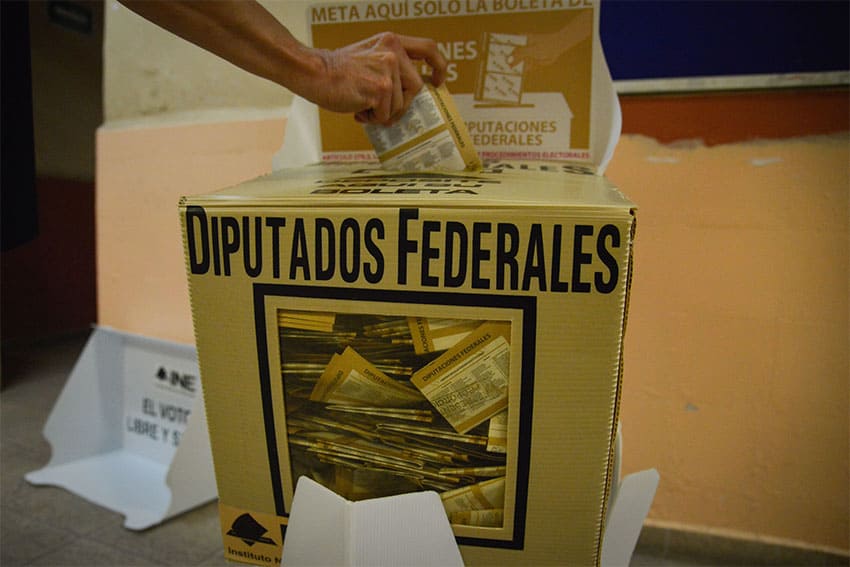
On Thursday, Sheinbaum said: “We don’t have the proposal yet [but] they’re already calling it Ley Maduro.”
She subsequently asserted that the aim of the reform is “the strengthening of democracy.”
“We’ve always fought for democracy,” Sheinbaum said Friday, referring to herself and her colleagues in the “fourth transformation” (4T) political movement she leads.
‘The transformation isn’t a political party, … it’s a decision of the people of Mexico’
Later in her press conference, Sheinbaum was asked to respond to claims that the 4T now control’s Mexico’s judiciary in light of the election at last year’s first ever judicial elections of many judges, magistrates and Supreme Court justices seen as supporters of, or at least sympathetic to, the Morena party.
Referring to the 4T, she responded that “the transformation is not a political party,” but rather “a decision of the people of Mexico in 2018 to change the regime of corruption and privileges.”
In 2018, Andrés Manuel López Obrador was elected president and the party he created, Morena, took office at the federal level for the first time.
Sheinbaum asserted that the “fourth transformation” is not represented by “la presidenta,” or a political party or groups of deputies or senators, although she acknowledged that “we are part” of the movement.
Rather, the 4T is “a collective desire to build a new country free of corruption and privileges, for the well-being of the people, with security and justice,” she said.
[It’s about] advancing toward what has always been the hope of the people: a better, more democratic, fairer, freer, sovereign country,” Sheinbaum said.
She added that the 4T is also about “the recovery or the rescue of our values” and acknowledgement of the people and “great civilizations” of the past, “the history of Mexico, our great heroes and heroines” and “the dignity of the people.”
“That’s the fourth transformation — a new model of development for the country. The transformation of the Supreme Court has to do with this new model, with this new vision of more justice for Mexico, of a true rule of law,” Sheinbaum said.
‘Fortunately, nothing happened,’ Sheinbaum says after 5.0 magnitude earthquake
Asked about the earthquake that occurred just after 12:40 a.m. Friday, Sheinbaum responded that “fortunately, nothing happened.”
“… There was no major damage,” she said.
The National Seismological Service said that the earthquake, whose epicenter was near San Marcos, Guerrero, was an aftershock of the 6.5 magnitude earthquake on Jan. 2. The epicenter of that temblor was also near San Marcos, located in the Costa Chica region of Guerrero.
Sheinbaum acknowledged that some homes were damaged in the Jan. 2 quake, and said that the federal government is working with authorities in Guerrero to support the affected homeowners.
By Mexico News Daily chief staff writer Peter Davies (peter.davies@mexiconewsdaily.com)