Mexico’s lower house of Congress on Wednesday rejected Claudia Sheinbaum’s electoral reform proposal, dealing a significant blow to the president.
While a majority of deputies voted in favor of the bill, the reform proposal required two-thirds support as it sought to amend Mexico’s Constitution.
All told, 259 deputies supported the bill while 234 opposed it.
Submitted to Congress by Sheinbaum last week, the reform proposal had a range of objectives included reducing the size of the Senate, changing the way plurinominal (proportional representation) deputies are elected and lowering election costs, including by cutting funding for political parties.
The bill ultimately failed to pass the Chamber of Deputies as the ruling Morena party’s allies, the Labor Party (PT) and the Green Party (PVEM), didn’t support it as they believed the proposed changes would hurt them electorally. Deputies with the National Action Party (PAN), the Institutional Revolutionary Party (PRI) and the Citizens’ Movement party also opposed the bill.
Just one of 49 PT deputies voted in favor of the proposal, while 12 PVEM lawmakers — less than one fifth of the party’s representatives in the lower house — supported it.
Sheinbaum’s electoral reform meets resistance on all sides as congressional vote looms

Since the two parties entered into an alliance with Morena in 2018, it was the first time they didn’t offer their broad support to an initiative backed by the ruling party.
Deputy Reginaldo Sandoval, PT’s leader in the lower house, said that his party had “no doubt” that its position on the electoral reform proposal was the “right” one.
Deputy Carlos Puente of the PVEM offered a veiled criticism of Morena’s lack of negotiation with its allies, saying that “reforms must be made by consensus so that the results don’t lack legitimacy.”
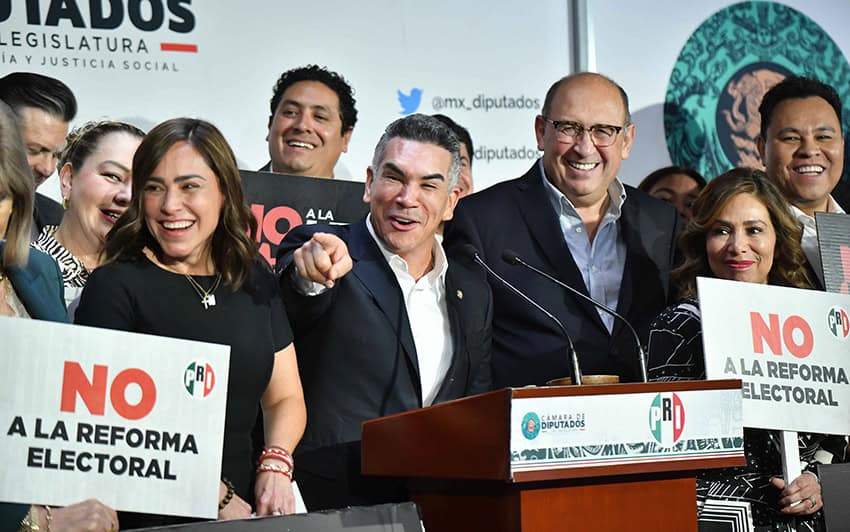
The PRI’s leader in the lower house, Rubén Moreira, asserted that the aim of the reform proposal was to establish an electoral system that “guarantees the permanence in power of the official party,” — i.e. Morena.
“What the initiative that we reject seeks to do is establish a single party for Mexico,” he said.
Sandoval, the PT leader, expressed a similar view, saying that his party was against the establishment of a “single, hegemonic party.”
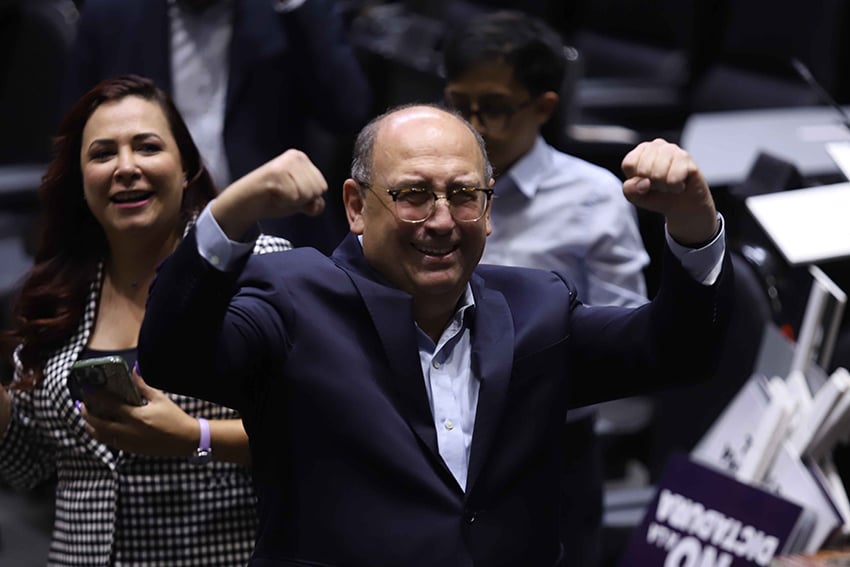
The PAN’s leader in the Chamber of Deputies, José Lixa, expressed satisfaction that a reform proposal “without dialogue with all the political forces” was rejected.
While one of the bill’s objectives was to establish greater oversight of resources allocated to and used by political parties and candidates, Lixa called on Sheinbaum to do more to stop the influx of “dirty money” into political campaigns.
He also urged an end to “narco-politics,” and to an alleged “pact” between the government and organized crime.
“While bullets and drugs govern, there will be no democracy, no country and no future,” Lixa said.
Sheinbaum’s plan B
At her Thursday morning press conference, Sheinbaum acknowledged that her electoral reform proposal didn’t pass the lower house of Congress and consequently outlined a “plan B” initiative. She asserted that the Chamber of Deputies’ rejection of the bill wasn’t a “defeat” for her, as by submitting the proposal to Congress she “fulfilled” her commitment to the people of Mexico.
The president will now seek electoral reform via changes to secondary laws, which Congress can pass with a simple majority. Sheinbaum said she will submit her “plan B” proposal to Congress on Monday.
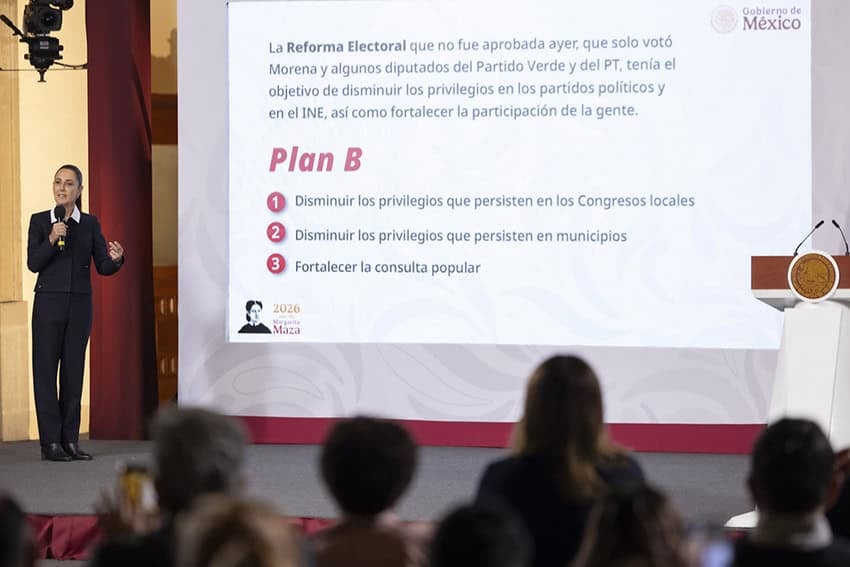
She said that the legislation has three main objectives:
- “Reduce the privileges that persist in local Congresses” — i.e. the legislatures in Mexico’s 32 federal entities.
- “Reduce the privileges that persist in municipalities,” of which Mexico has almost 2,500, each with their own municipal government.
- “Strengthen public consultation” — i.e. give citizens a greater say on important issues, including via referendums, several of which were held during Andrés Manuel López Obrador’s presidency.
Sheinbaum asserted that too much money is being spent on the operation of Mexico’s 32 state legislatures. She presented a table, which, for each entity, showed the population, the number of state lawmakers, the budget for the state legislature and the “cost per lawmaker.”
The annual “cost per lawmaker” — the budget for the legislature divided by the number of state lawmakers — ranged from 34.86 million pesos (US $1.95 million) in Baja California to 5.17 million pesos (US $290,000) in Colima.
Sheinbaum pointed out that the “cost per lawmaker” in Morelos — a state she said has “enormous needs” — is 31.8 million pesos.
She acknowledged that the “cost per lawmaker” is not equivalent to a politician’s salary, as a legislature’s budget is also used to pay workers and things such as electricity and water.
Still, Sheinbaum asserted that state legislatures’ budgets are too high, especially in some states. For example, Baja California and Colima have the same number of state lawmakers (25), but the budget for the legislature in the former state is almost seven times higher than that in the latter.
Sheinbaum shares her next steps after electoral reform setback: Thursday’s mañanera recapped
Sheinbaum said that her “plan B” proposal will seek to establish a “maximum limit” on resources that can be allocated to state legislatures and that savings will be allocated to “the needs of the people.”
Among the other specific objectives of the president’s “plan B” electoral reform are to:
- Reduce the number of councilors in certain municipalities that are seen as having too many such officials.
- Eliminate or reduce excessive benefits, which, according to Sheinbaum, allow some elected officials to earn as much as 500,000 pesos (US $28,000) per month.
- Broaden the range of “electoral issues” that can be subjected to public consultation.
Sheinbaum even suggested that her electoral reform proposal that was rejected by the Chamber of Deputies should be voted on in a referendum.
“The proposal yesterday wasn’t approved. Why don’t we ask the people?” she said.
With reports from El Financiero, Reforma, La Jornada, El Universal and El Economista