
Mexico’s security situation and a bilateral water dispute were the central focus of President Claudia Sheinbaum’s Tuesday morning press conference.
In the first half of the mañanera, security officials presented the latest data on homicides, arrests, firearm seizures and drug confiscations across Mexico.
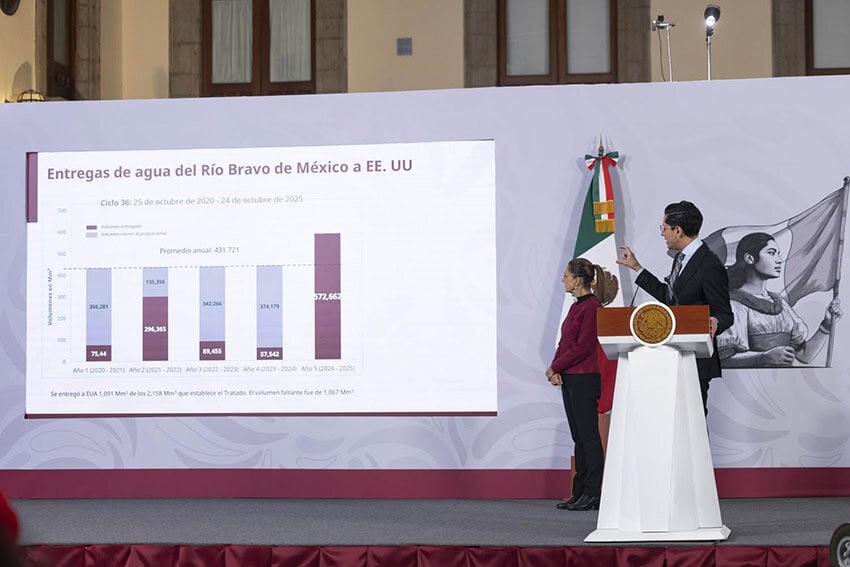
Later in the presser, Sheinbaum expressed confidence that her government would reach a deal with its U.S. counterpart to stave off Donald Trump’s threat to impose a 5% tariff on Mexican goods if Mexico doesn’t promptly release a significant quantity of the water it owes to the United States under the terms of a 1944 treaty.
(Read MND’s story on Trump’s tariff threat and Sheinbaum’s response here.)
Here is a recap of the president’s Dec. 9 mañanera.
Homicides down 29% in 2025
Marcela Figueroa Franco, head of the National Public Security System, presented preliminary data that showed there was an average of 65.1 homicides per day in Mexico during the first eleven months of the year.
The figure represents a decline of 29% compared to the daily average of 91.7 homicides across 2024.

Figueroa highlighted that the decline in homicides compared to 2018 — when former president Enrique Peña Nieto was in office for the first 11 months of the year — was 35%.
32 fewer murders per day in November than in the final month of AMLO’s presidency
At the start of her presentation, Figueroa reported that the average daily homicide rate in November was 37% lower than the average rate in September 2024, the final month of Andres Manuel López Obrador’s presidency.
There was an average of 54.7 homicides per day last month, according to preliminary data, whereas the daily average was 86.9 in September 2024.
The 37% reduction in homicides in November compared to September 2024 “is equivalent to 32 fewer homicides per day,” Figueroa noted.
Sheinbaum has attributed the decline in homicides during her presidency to the federal government’s security strategy, based on four key tenets, including the strengthening of intelligence and investigative practices and the enhancement of coordination between the different levels of government.

More than half of all murders in Mexico this year occurred in 7 states
Figueroa presented data that showed there were 21,743 homicides across Mexico in the first 11 months of the year.
Just over half of those murders — 11,031 or 51% of the total — occurred in just seven states:
- Guanajuato: 2,388 murders were committed in the Bajío region state between January and November. The figure accounts for 11% of all homicides in the period. Guanajuato has led Mexico in homicides in recent years. A number of organized crime groups operate in the state, including the Santa Rosa de Lima Cartel and its main rival, the Jalisco New Generation Cartel.
- Chihuahua: 1,661 homicides, accounting for 7.6% of the total between January and November. The northern border state’s largest city, Ciudad Juárez, is among Mexico’s 50 most violent municipalities.
- Baja California: 1,586 homicides, accounting for 7.3% of the total. This state’s largest city, Tijuana, is also among Mexico’s 50 most violent municipalities.
- Sinaloa: 1,541 homicides, accounting for 7.1% of the total. Rival factions of the Sinaloa Cartel have been engaged in a bloody war in the state for over a year.
- México state: 1,424 homicides, accounting for 6.5% of the total. México state is Mexico’s most populous state.
- Guerrero: 1,240 homicides, accounting for 5.7% of the total. The state’s largest city, Acapulco, is one of Mexico’s 50 most violent municipalities.
- Michoacán: 1,191 homicides, accounting for 5.5% of the total. The federal government last month presented “Plan Michoacán for Peace and Justice,” a 57-billion-peso (US $3.1 billion) initiative that the government devised in response to the murder of the mayor of Uruapan on Nov. 1 and general insecurity in the state.
Murders have declined in 26 of 32 states
Figueroa also reported that homicides declined in 26 of Mexico’s 32 federal entities between January and November compared to the same period of last year.
Zacatecas recorded the largest decrease, with murders declining 70.5%. There were 137 homicides in Zacatecas between January and November, the eighth lowest count among Mexico’s 32 federal entities.
Four other states recorded year-over-year reductions above 50%. They were:
- Chiapas: -57.9%
- Quintana Roo: -56.7%
- Nuevo León: -53.4%
- San Luis Potosí: -51.8%
Among the other states that recorded a decline in homicides between January and November were the two most violent ones. Murders fell 15.9% in Guanajuato and 11.5% in Chihuahua.
🚨De enero a octubre, Guanajuato, Estado de México, Baja California, CDMX y Sinaloa son los estados con una mayor número de delitos de violencia letal (homicidio doloso; homicidio culposo; feminicidio; otros delitos contra la vida y la integridad corporal; y personas… pic.twitter.com/Sgnx0hweHp
— México Evalúa (@mexevalua) December 9, 2025
The six federal entities where homicides increased in annual terms in the first 11 months of the year were Sinaloa, Campeche, Veracruz, Baja California Sur, Hidalgo and Nayarit.
4 states recorded fewer than 100 homicides between January and November
The data presented by Figueroa also showed that four states recorded fewer than 100 murders in the first 11 months of the year. They were:
- Yucatán: 28 homicides
- Durango: 56
- Coahuila: 73
- Aguascalientes: 95
Seven other states recorded 200 homicides or fewer between January and November. They were:
- Campeche: 108
- Tlaxcala: 109
- Baja California Sur: 127
- Zacatecas: 137
- Querétaro: 139
- Nayarit: 176
- San Luis Potosí: 200
Mexico City recorded the 14th highest number of homicides among the 32 federal entities, with 781 between January and November.
High-impact crimes down almost 14% this year
Figueroa presented data that showed that an average of 518.2 “high-impact” crimes were reported on a daily basis in the first 11 months of 2025, a reduction of 13.8% compared to 2024.
High-impact crimes include homicide, kidnapping, extortion and violent robbery, among other offenses.

Figueroa highlighted that the incidence of high-impact crimes is down 47% in 2025 compared to 2018. She noted that the incidence of most high-impact crimes, including femicide, kidnapping, burglary and violent vehicle theft, declined between 2019 and 2025, but acknowledged that reported acts of extortion increased 23.1% over the same period.
However, since the launch of the national strategy against extortion in July, reported acts of extortion have declined 20%, Figueroa said. She was referring to the reduction in extortion reports between July (an average of 32.03 per day) and November (25.6 per day).
Almost 39,000 arrests in 14 months
Federal Security Minister Omar García Harfuch reported that 1,761 people were arrested in November for allegedly committing high-impact crimes.
Since the current government took office on Oct. 1, 2024, a total of 38,773 people have been arrested for allegedly committing such crimes, according to data presented by García Harfuch.
The security minister didn’t say how many of those people have faced trial and been convicted of the crimes they allegedly committed. It is common for suspects in Mexico to remain in prison for extended periods of time before facing trial.
García Harfuch also presented data that showed that authorities have seized 311.7 tonnes of drugs over the past 14 months, including more than 4.3 million fentanyl pills, which are manufactured by Mexican crime groups with precursor chemicals illegally imported from China.
He said that 20,169 firearms were confiscated in the same period, and 1,760 methamphetamine laboratories were dismantled by the army and navy.
The dismantling of the clandestine drug labs “represents an economic impact of billions of pesos for organized crime,” García Harfuch said.
By Mexico News Daily chief staff writer Peter Davies (peter.davies@mexiconewsdaily.com)