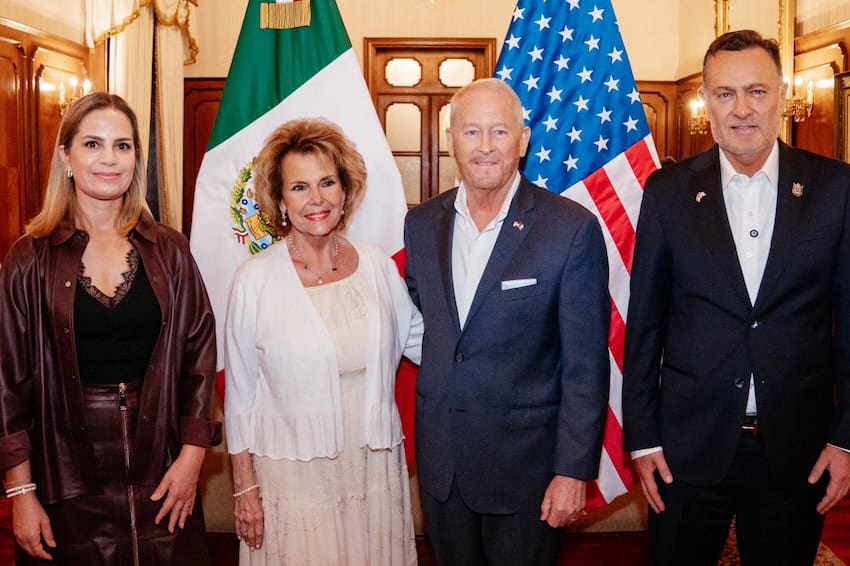
Querétaro Governor Mauricio Kuri notified Foreign Affairs Minister Roberto Velasco of U.S. Ambassador to Mexico Ronald Johnson’s Oct. 2 visit to Querétaro, but he didn’t say that the ambassador would be laying the cornerstone of a new International Police Training Academy in the Bajío region state.
The existence of Kuri’s Sept. 23 letter to Velasco came to light after President Claudia Sheinbaum indicated at her Monday morning press conference that her government knew little about the police academy project.
Sheinbaum questions binational police training academy in Querétaro: Monday’s mañanera recapped
She declared that such an academy — which Kuri called “a home” for “cooperation between the United States and Querétaro in the area of specialized police training” — can’t be established without federal authorization, and questioned why the Querétaro government didn’t invite the Mexican military, the federal Security Cabinet or the Ministry of Foreign Affairs to participate in the cornerstone-laying ceremony.
(Contrary to Sheinbaum’s suggestion, federal officials did in fact attend the event, according to the newspaper El Universal.)
After Kuri’s letter was leaked on Monday, the Ministry of Foreign Affairs (SRE) released an “informative note” acknowledging its receipt of the governor’s communication, while highlighting that as the International Police Training Academy is “a project involving security cooperation with a foreign government,” it is subject to “prior” federal approval — approval that has not been granted.

Sheinbaum said on Tuesday that a federal security group approved nine “cooperation projects” between the state of Querétaro and U.S. law enforcement agencies between December 2021 and October 2026. However, the International Police Training Academy was not one of them, she said.
In some ways, the United States’ collaboration with Querétaro on a police training academy is similar to the U.S. Central Intelligence Agency’s alleged participation with state forces in a drug lab raid in the northern state of Chihuahua in April. The federal government didn’t approve the CIA’s participation in the domestic security operation, just as it didn’t authorize collaboration between Querétaro and the U.S. government on a new police training academy. Another similarity between the two cases is that they occurred in states governed by the opposition National Action Party (PAN), a party that includes politicians who would like to see the U.S. take a more active role in combating organized crime in Mexico.
U.S. involvement in Mexican affairs — or “interference” as Sheinbaum has put it — has been a hot-button issue this year amid ongoing speculation that the Trump administration could unilaterally use the U.S. military to combat Mexican cartels on Mexican soil.
While the Mexican president has been resolute in rejecting U.S. meddling in Mexican affairs, there are signs that her government doesn’t want to make a major issue of the unauthorized cooperation between Querétaro and the United States. Officials from the Sheinbaum and Trump administrations continue to speak positively about bilateral security cooperation, even though there are a range of tensions in the security relationship, including ones related to U.S. prosecutors’ drug trafficking accusations against Sinaloa Governor Rubén Rocha Moya and other Mexican officials.
Kuri appears to contradict himself
In his letter to Velasco, Kuri wrote that on Oct. 2, “the executive power of the state of Querétaro” would host a visit by Johnson, “with whom various topics of common interest will be dealt.”
“It is important to point out that the interaction of local public servants and the [U.S.] diplomatic agent in the framework of said visits will be ceremonial in nature and in no way implies the establishment of direct mechanisms of international cooperation in the areas of security or administration of justice, nor the participation or intervention of foreign agents or governments in activities of investigation, prosecution of crime or roles reserved for the Mexican state or which correspond to Mexican authorities,” he wrote.
Despite writing that sentence in his letter to Velasco, Kuri wrote on social media on Oct. 2 that “the cooperation between the United States and Querétaro in the area of specialized police training now has a home in our state: the International Police Training Academy.”
Such cooperation would certainly appear to be an example of international cooperation in the area of security.
In his X post last Friday, Kuri also wrote:
“Today we laid the cornerstone of this space where we will continue the effort we’ve been making for years: investing in the preparation of our police, raising our standards and seeking experiences that allow us to better defend and serve the families of Querétaro. I am enormously grateful to the U.S. government and the Ambassador Ronald Johnson for the collaboration we’ve built and for the trust placed in our state, chosen to establish this international academy, the only one of its kind in Latin America.”
La cooperación entre los Estados Unidos y #Querétaro en materia de formación policial especializada, tiene ahora una casa en nuestro estado: la Academia Internacional de Capacitación Policial.
Hoy colocamos la primera piedra de este espacio donde continuaremos con el esfuerzo que hemos estado realizando por años: invertir en la preparación de nuestros policías, elevar sus estándares y buscar experiencias que nos permitan defender y servir cada vez mejor a las familias queretanas.
Agradezco enormemente al gobierno de los Estados Unidos, y al señor Embajador Ronald Johnson, por la colaboración que hemos construido y por la confianza depositada en nuestro estado, elegido para establecer esta academia internacional, única en su tipo en América Latina.
— Mauricio Kuri (@makugo) October 3, 2026
The title of a statement released by Ambassador Johnson on Saturday provided additional — and very clear — support for the view shared by the federal government and others that Querétaro and the United States are indeed collaborating on security via the establishment of an International Police Training Academy.
That title? “The United States and Querétaro Expand Security Cooperation with New State Interdiction Academy.”
“On behalf of President Trump, I joined Governor Kuri for the groundbreaking of Querétaro’s State Interdiction Academy. This facility highlights that confronting cartels and terrorist groups requires action, resources, and strong institutions, as Querétaro is demonstrating by investing in this academy,” Johnson wrote.
“Querétaro is an example of what we can accomplish when we work together. Over the past decade, the United States has invested more than $10 million in training support and equipment in Querétaro,” he wrote.
“The new academy builds on that cooperation as the first facility of its kind in Mexico and Latin America dedicated specifically to training law enforcement authorities to detect and interdict dangerous drugs, weapons, illicit bulk cash, and other contraband. Officers trained at the new academy will be able to take those capabilities back to their units, states, and communities throughout Mexico,” the ambassador wrote, suggesting that police from across Mexico could receive training at the facility.
On Monday, Sheinbaum questioned why Kuri was collaborating with Johnson rather than the federal Security Cabinet on an international academy focused on training police to combat organized crime.
Organized crime-related offenses are “federal crimes,” Sheinbaum emphasized.
“These are examples where I believe the limit between what should be and what shouldn’t be is reached,” she said.
SRE offers to assist Querétaro in seeking approval for police academy
In its information note, the SRE wrote that “in accordance with the National Security Law, any training or security cooperation project with a foreign government requires prior approval from the High-Level Security Group (GANSEG), an auxiliary body of the National Security Council.”
“The Foreign Ministry assists state and municipal governments in seeking that approval,” the ministry said.
In point No. 3 of a four-point statement, the SRE wrote that the International Police Training Academy in Querétaro is “a project involving security cooperation with a foreign government, so it must be submitted to GANSEG.”
“On the instruction of President Claudia Sheinbaum Pardo, Secretary Roberto Velasco Álvarez spoke directly with Governor Mauricio Kuri González and sent him an official letter offering the foreign ministry’s assistance in seeking that approval, in a spirit of institutional coordination,” the ministry said.
The offer of assistance suggests that the federal government is prepared to authorize the International Police Training Academy in Querétaro, provided state authorities make a commitment to adhere to all relevant Mexican laws.
In point No. 2, the SRE acknowledged its receipt of Kuri’s letter, noting that the governor “specified” that the visit ‘in no way implies the establishment of direct mechanisms for international cooperation on security or law enforcement.”
In point No. 4, the Foreign Affairs Ministry made it clear that Mexico’s cooperation with the U.S. government on security issues is a federal responsibility.
“Mexico and the United States maintain strong security collaboration, based on respect for sovereignty and territorial integrity, mutual respect and trust, shared and differentiated responsibility, and cooperation without subordination. This collaboration is conducted through the institutional channels of the Government of Mexico, in coordination with the states,” the information note said.
Sheinbaum: Querétaro government must ‘follow the procedures’
In addition to pointing out that cooperation between Querétaro and the United States on the International Police Training Academy hadn’t been authorized by GANSEG, Sheinbaum on Tuesday also said that her government was aware that U.S. agencies were slated to “participate” in the academy. Such “participation” would violate Mexican law if the involvement of U.S. authorities wasn’t authorized by the Mexican government.
Sheinbaum said her government “knows” that U.S. agencies were slated to “participate in the academy,” as Querétaro Security Minister Iován Pérez said as much at last Friday’s event.
“It’s not an assumption,” she said before asking for a video of Pérez’s remarks to be played.
“This international training center represents an important step,” the state security minister said.
“It is designed to receive specialized training from U.S. agencies and put it within the reach of Mexican public security institutions,” Pérez said.
Sheinbaum said that “the only thing” being asked of the Querétaro government is that it “follow the procedures” and ask GANSEG and the Ministry of Foreign Affairs to authorize the police training academy.
“If it’s going to receive support from the U.S. government, it should request authorization from the high-level group. Why? Because it’s the law,” she said.
“… Can [the Querétaro government] have this international academy? Yes. [But] under what conditions can it have the involvement of U.S. agencies? Under the authorization of the high-level [security] group and the Ministry of Foreign Affairs — if they believe it’s within the framework of our constitution,” Sheinbaum said.
With reports from Sin Embargo, Reforma and El Universal