President Claudia Sheinbaum is now approaching the 18-month mark of her six-year term, while U.S. President Donald Trump has been back in office for just over 14 months.
During this period, Mexican and U.S. officials have declared that the bilateral relationship is going very well, although there have been various pressure points. Think tariffs, threats of military strikes on Mexican cartels, an accusation from the White House that the Mexican government has an “intolerable alliance” with drug trafficking organizations, a declaration by Trump that he doesn’t care about the USMCA.
Still, Sheinbaum and Trump get on — although they are yet to have a formal bilateral meeting — and the former frequently asserts that the bilateral relationship is based on mutual respect.
Despite this, an El Financiero poll we reported on last September found that a majority of Mexicans — 56% of 1,000 respondents to be exact — believed that Sheinbaum was doing a bad job managing the relationship with Trump, while 51% said that the bilateral relationship was bad or very bad.
But what do Americans — i.e., U.S. voters — think about Mexico and the Mexico-U.S. relationship?
A poll conducted this month by Echelon Insights in conjunction with the U.S.-Mexico Foundation, the American Chamber of Commerce of Mexico and the Mexican Association of Industrial Parks sought to find the response to that question.
A total of 1,033 U.S. voters were surveyed in the poll, titled “U.S. Voter Attitudes Towards the U.S.-Mexico Relationship.”

Here are some key takeaways.
Mexico’s ‘net favorable brand image’ has declined over the past year
Poll respondents were asked whether they had a favorable or unfavorable opinion of eight countries, including Mexico, Canada, China and Russia.
Forty-four per cent of those polled said that they had a very favorable (13%) or somewhat favorable (31%) opinion of Mexico, whereas 38% said they had a very unfavorable (12%) or somewhat unfavorable (26%) view of the United States’ southern neighbor. The remainder of respondents either had no opinion of Mexico or hadn’t heard of the country (1%).
Mexico thus had a “net favorable brand image” of +6 with Americans who participated in the poll. That rating was on par with Israel, but well below the “net favorability” scores of Canada (+58) and the United Kingdom (+54).
The other countries included in the poll — Venezuela, China, Iran and Russia — all had negative net favorability scores.
Mexico’s score declined 14 points from +20 last April and 16 points from +22 last May. It is up four points from a recent low of +2 in December.
Cartel activity is the top reason why Mexico is seen as a bad neighbor
Almost six in ten of those polled (59%) said that “cartel activity coming across the border” is a way in which Mexico is a bad neighbor to the United States.
This is also Trump’s top concern about Mexico. In that context, his administration designated six Mexican cartels as foreign terrorist organizations early last year.
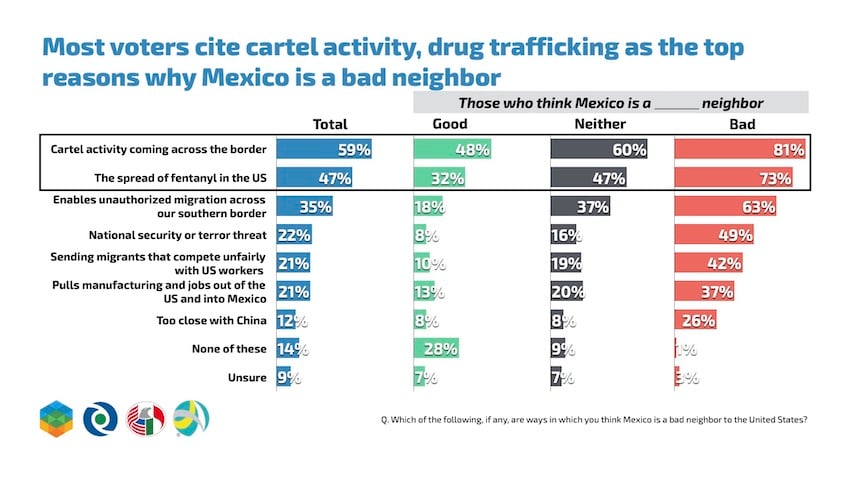
Almost half of respondents (47%) identified “the spread of fentanyl in the U.S.” as a reason why Mexico is a bad neighbor, even though the Mexican government has ramped up efforts to stem the northward flow of the synthetic opioid and other narcotics.
More than one-third of respondents (35%) said that Mexico is a bad neighbor because it “enables unauthorized migration across our southern border,” while 22% said the same because the country is a “national security or terror threat.”
Around one in five respondents said that Mexico is a bad neighbor because it is “sending migrants that compete unfairly with U.S. workers” (21%), and because it “pulls manufacturing and jobs out of the U.S. and into Mexico” (21%).
Twelve per cent of respondents said that Mexico is a bad neighbor because it is “too close with China,” although the Sheinbaum administration recently imposed new and increased tariffs on goods from the East Asian economic powerhouse.
Fourteen per cent of those polled said that none of the seven things mentioned above made Mexico a bad neighbor to the United States.
Tourism is the top reason why Mexico is seen as a good neighbor
Asked to identify ways in which Mexico is a good neighbor to the United States, 52% of poll respondents cited “tourism between the two countries.”
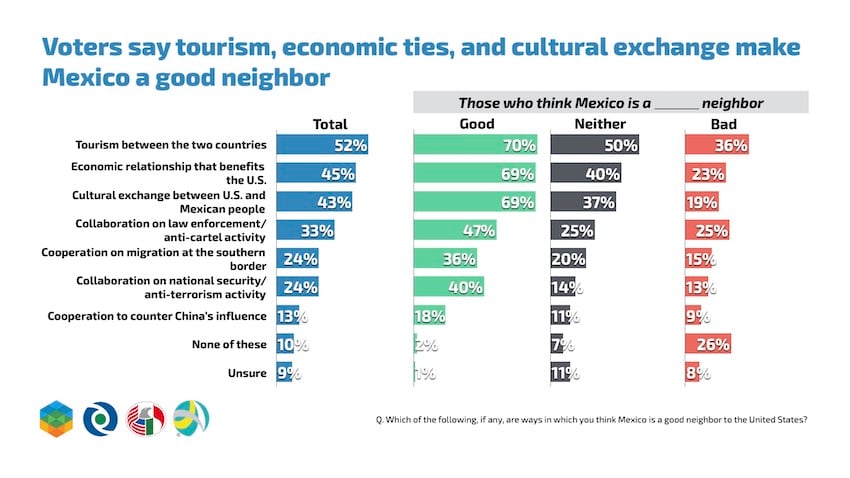
The percentages for the six other listed ways were as follows:
- “Economic relationship that benefits the U.S.”: 45% (Mexico and the U.S. are each other’s largest trade partner).
- “Cultural exchange between the U.S. and Mexican people”: 43%
- “Collaboration on law enforcement/anti-cartel activity”: 33%
- “Cooperation on migration at the southern border”: 24%
- “Collaboration on national security/anti-terrorism activity”: 24%
- “Cooperation to counter China’s influence“: 13%
One in ten of those polled said that none of the reasons listed above made Mexico a good neighbor.
Only 4% of Republicans consider Mexico a very good neighbor
“Thinking about the U.S.-Mexico relationship, do you think Mexico is a good or bad neighbor to the United States?”
All 1,033 respondents to the poll were asked to respond to that question.
Four in ten of those polled said that Mexico was either a “very good neighbor” (14%) or a “somewhat good neighbor” (26%).
Almost one in ten respondents (9%) said that Mexico was a “very bad neighbor,” while 19% said that the country was a “somewhat bad neighbor” to the United States.
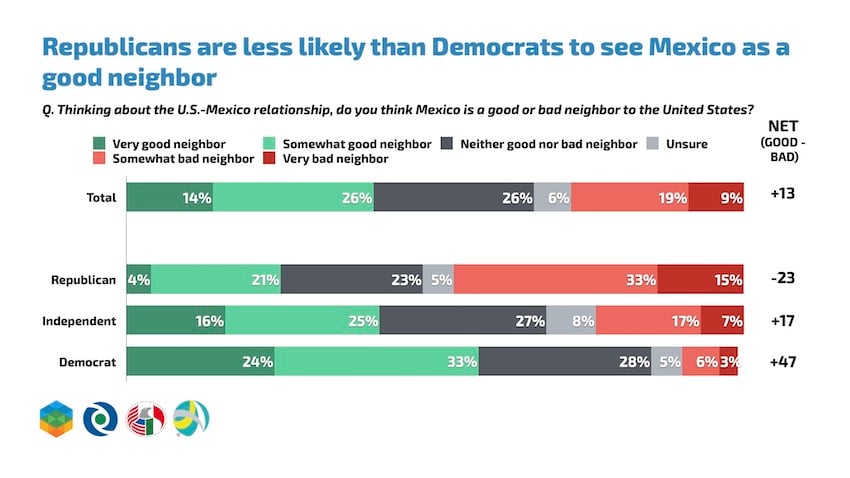
The remainder either said that Mexico was “neither good nor bad” as a neighbor (26%) or that they were unsure (6%).
Among respondents who identified as Republicans, just 4% said that Mexico is a “very good neighbor,” while 21% said the country was a “somewhat good neighbor.”
Almost half of Republicans surveyed said that Mexico was either a “somewhat bad neighbor” (33%) or a “very bad neighbor” (15%).
In contrast, just 9% of Democrats polled said that Mexico was a “somewhat bad neighbor” (6%) or “very bad neighbor” (3%).
A strong majority of respondents who identified as Democrats said that Mexico was either a “very good neighbor” (24%) or a “somewhat good neighbor” (33%).
A strong majority of Democrats oppose a blanket tariff on Mexican goods
Asked whether they supported or opposed the imposition of a tariff on “all goods coming into the U.S. from Mexico,” 76% of respondents who identified as Democrats said they were against such a measure. Almost six in ten of such people (57%) said they were “strongly” opposed to a blanket tariff, while 19% said they were “somewhat” opposed.
In contrast, 64% of Republicans said they supported a tariff on all Mexican goods. Almost four in ten of such people (38%) said they “somewhat” supported such a measure, while 26% said they “strongly” supported a blanket tariff on imports from Mexico.
Among respondents who said they supported tariffs on Mexican goods, 55% said they saw the duties as a way to “put pressure on Mexico to take action on migration, drugs, or crime.”
Trump has used tariffs — namely, 25% duties on non-USMCA compliant goods — in this way.
The other reasons why people said they supported tariffs on Mexican goods were:
- “To raise revenue for the U.S. government”: 41% of respondents in favor of tariffs cited this reason.
- “Because I generally think tariffs are good”: 30%
- “To make Mexican-made goods more expensive in the U.S.”: 22%
- “Because Donald Trump supports them”: 17%
A majority of all respondents (61%) said that (additional) U.S. tariffs on goods from Mexico would either make their cost of living “somewhat more expensive” (38%) or “much more expensive” (23%).
Almost half of respondents are unsure whether the USMCA should be extended
Poll respondents were also asked whether the United States should extend the USMCA free trade pact, which the U.S., Mexico and Canada will formally review this year.
Just over four in 10 respondents (41%) said that the U.S. should extend the agreement, while 49% said they were unsure whether the U.S. should support an extension of the pact.
Only 10% of those polled said that the United States should not extend the USMCA.
Even if Mexico, the United States and Canada don’t agree to extend the USMCA during the upcoming review process, it would not be terminated until 2036. If the three countries do agree to extend the USMCA, the pact will remain in effect until at least 2042.
The poll also found that 14% of Republicans believe the USMCA shouldn’t be extended, compared to just 7% of Democrats who don’t support an extension of the six-year-old trade agreement.
In order to make the USMCA a “fair deal” for the United States, a majority of Republicans said that the pact should “make sure factories and businesses stay in the U.S.” (51%) and “make sure American farmers and ranchers can sell their products in Canada and Mexico (51%).
A majority of Democrats (53%) said that “reducing tariffs within North America” is needed to make the USMCA a “fair deal” for the United States, whereas only 29% of Republicans said the same.
A majority of Democrats (53%) also said that “lowering prices on everyday goods” would make the USMCA a “fair deal” for the U.S., while 49% of Republicans said the same.
4 in 10 respondents are happy that US is co-hosting World Cup with Mexico and Canada
Forty-one per cent of poll respondents said they were glad that the United States is co-hosting this year’s FIFA men’s World Cup with Mexico and Canada.
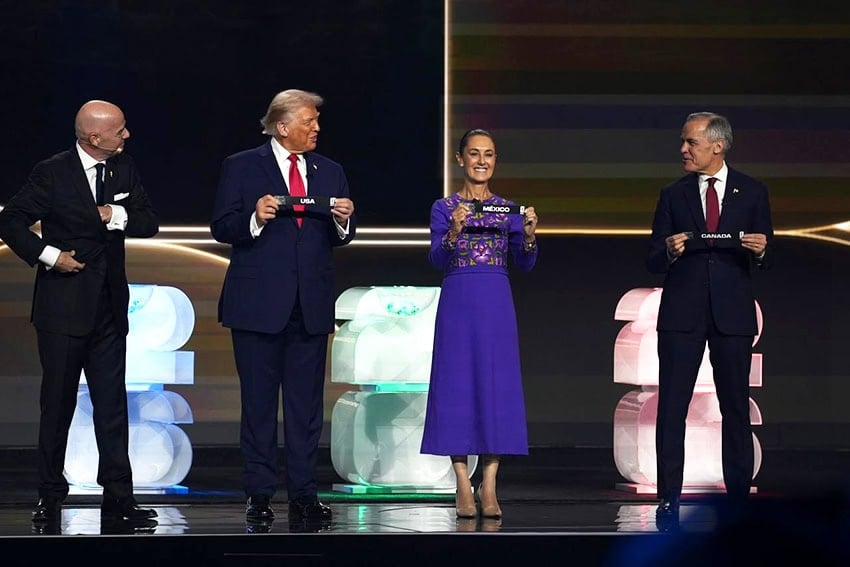
One in 10 of those polled said they wished the U.S. wasn’t co-hosting the tournament with Mexico and Canada, while 49% said they didn’t really care either way.
A majority of Democrats (53%) said they were happy the U.S. is co-hosting the event with its two neighbors, but only 31% of Republicans said the same. Fifteen per cent of Republicans said they wished the U.S. weren’t co-hosting the World Cup with Mexico and Canada, while 7% of Democrats said the same.
A total of 104 World Cup matches will be played in the U.S., Mexico and Canada this June and July. U.S. cities will host 78 matches, while Mexico and Canada will host 13 matches each.
Mexico and South Africa will play the opening match of the tournament in Mexico City on June 11.
By Mexico News Daily chief staff writer Peter Davies (peter.davies@mexiconewsdaily.com)