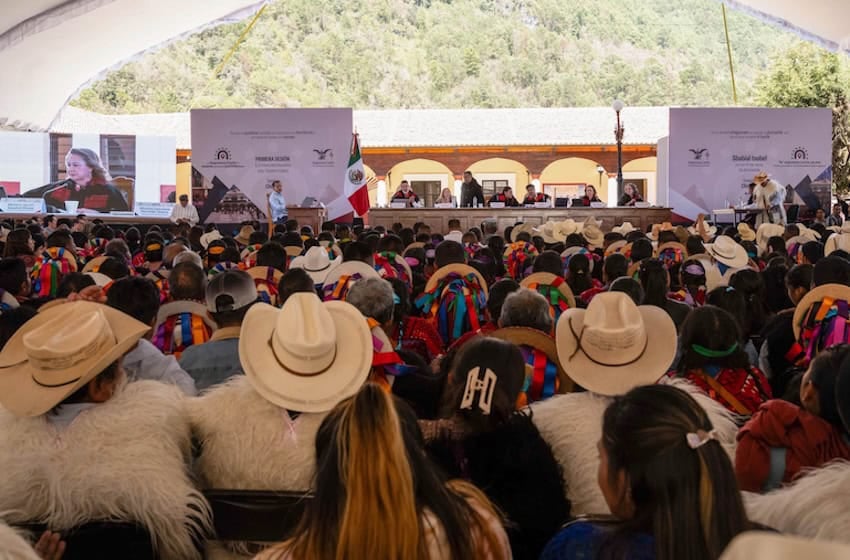
In its first session outside of the nation’s capital, Mexico’s Supreme Court convened in a remote mountain town in the southern state of Chiapas on Thursday, part of its plan to bring the country’s highest court to far-flung corners of the country.
Six of the nine Supreme Court justices traveled nearly 900 kilometers (560 miles) to hold an itinerant session which began with an introductory ceremony and informal greetings, followed by selfies and ovations from the audience.
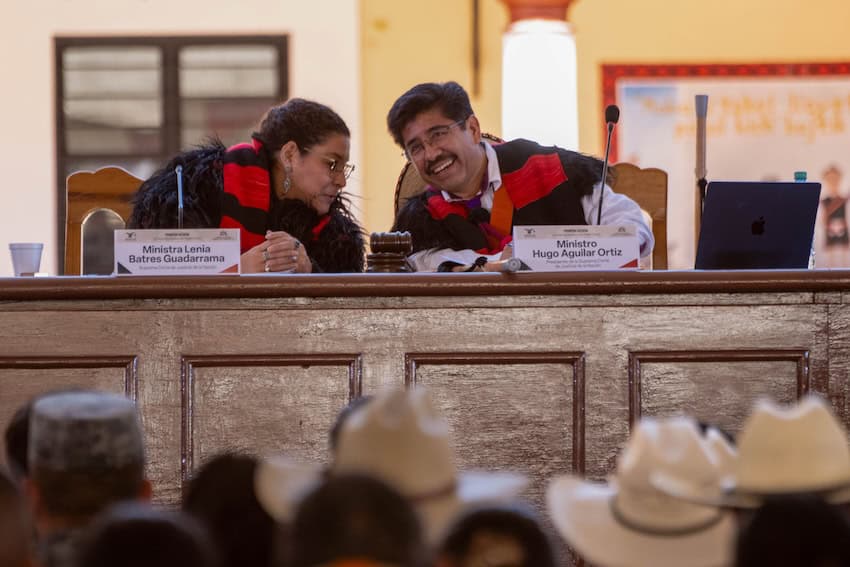
The justices appeared pleased to be wearing indigenous attire and traditional hats for their first “sesión en territorio,” designed to allow the magistrates to “connect with the people” and produce “a more inclusive and accessible legal culture.”
Chief Justice Hugo Aguilar, along with Lenia Batres, Sara Irene Herrerías and Arístides Guerrero wore local outfits, while Yasmín Esquivel and Loretta Ortiz sported robes adorned with community emblems.
Two of the justices — Irving Espinosa and Giovanni Figueroa — took part remotely, while María Estela Ríos did not participate.
In the modest central square of Tenejapa, some 2,000 people listened to the court’s deliberations. Some of the Indigenous leaders held signs reading “right to self-determination,” while others were content to listen and be part of a historic moment.
Though some publications criticized the occasion as a mere photo op (Animal Político described it as “a day marked by half-baked translations, restrained applause and political winks”), there was genuine gratitude among those present that the Court had come to them.

The appreciation evolved into gratification as the justices recognized the self-government of the Tzotzil community of La Candelaria located in the municipality of San Cristobal de las Casas.
La Candelaria had been demanding self-rule for years and, by a majority vote, the Court ordered the Chiapas state Congress to forge or adapt the legal framework necessary for the full exercise of self-government. It also ordered the state government to guarantee the direct delivery of the budget that corresponds to the small village which featured a population of 1,541 in 2020.
The Supreme Court said Tenejapa was selected due to its “clear social and territorial relevance,” adding that “Chiapas is home to the third largest Indigenous population in the country, with 12 of Mexico’s 68 Indigenous groups represented.”
The journey to Tenejapa, two hours from San Cristóbal de las Casas, proved an ordeal. The judicial entourage wound its way along a road that had become a broken track, riddled with narrow curves and numerous potholes that demanded a steady but cautious pace.
The ministers traded the majestic horseshoe-shaped table and imposing platforms of the grandiose art deco Supreme Court building just off of Mexico City’s main square for a simple rectangular table under a white tent, sitting face-to-face with attendees.
The current court is the first elected by the people. The rationale for doing so was partly to make it more responsive and accountable.
With reports from The Associated Press, Animal Político and La Jornada