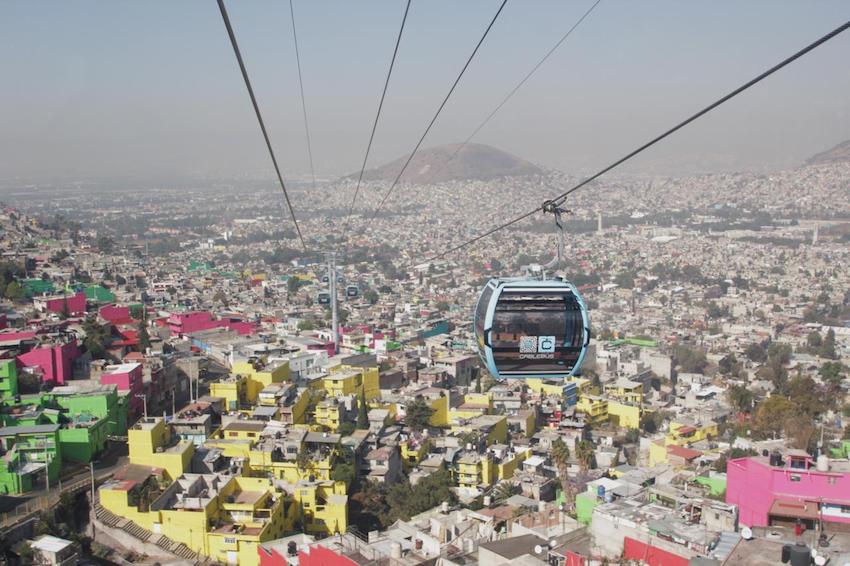
Mexico City is planning what officials say will be the world’s longest urban cable car line — a new Cablebús route that will span much of the capital’s western edge and link hillside neighborhoods to the city’s Metro network.
The city announced last week that it recently awarded a contract worth 7.9 billion pesos (US $441 million) to build Cablebús Line 5, a route of 15.2 kilometers (9.5 miles) that is expected to be completed by mid-2028.
Construction will be carried out as a joint venture between Doppelmayr, an Austrian-based firm with offices in Mexico, and the local engineering firm Gami Ingeniería e Instalaciones.
Mexico City’s Cablebús Line 2 in Iztapalapa is currently recognized as the world’s longest urban cable car for public transport at over 10.5 km (6.5 miles) — holding a Guinness World Record.
But at around 11.4 km (7.1 miles), and estimated to open possibly by next year, the upcoming Line 4 is set to surpass it, followed by Line 5 becoming the new longest line when it opens, expectedly in the second half of 2028.
Line 5 is slated to stretch 15.2 kilometers and include 12 stations crossing the boroughs of Álvaro Obregón, Magdalena Contreras and Benito Juárez — with a direct connection to the Mixcoac Metro station and Lines 7 and 12.
Officials say the route will connect 53 neighborhoods and Indigenous communities and cut current travel times from the western highlands by more than 50%.

Doppelmayr said the system will have capacity for up to 3,000 passengers per hour per direction, using cabins designed to carry 10 riders each.
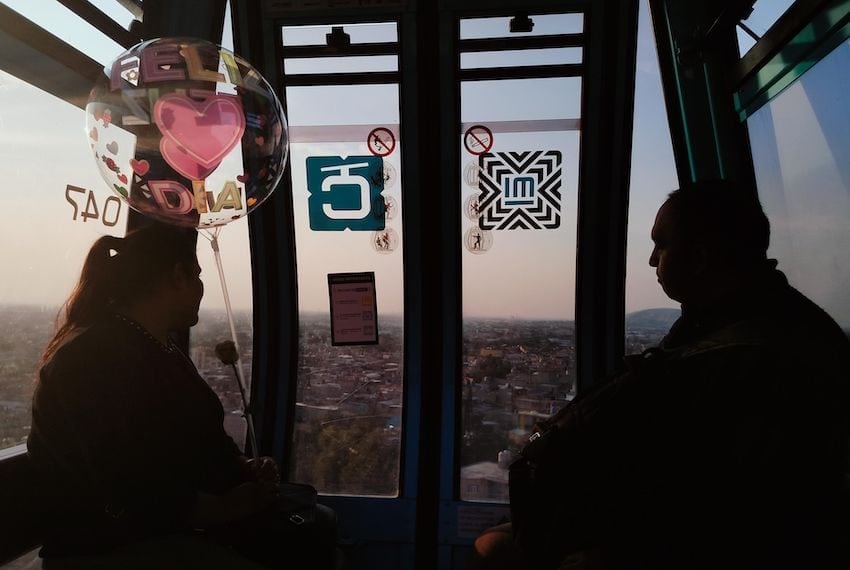
In materials cited in media reports, Doppelmayr said the system “requires significantly lower right-of-way acquisition costs, as it does not depend on surface infrastructure and has a minimal footprint, reducing its urban impact.”
Officials said the project is part of a broader electric-mobility push, backed in part by a green bond issued in 2025 for 3 billion pesos (US $167.5 million) to help finance new Cablebús lines.
The earliest planning for Mexico City’s Cablebús dates back to the early 2010s, though nothing really got cooking until the second half of the decade.
Since the successful opening of Line 1 in 2021, the system has grown to three lines carrying over 100,000 riders per day on average, according to local studies and city data. This includes a 2024 Bloomberg analysis that found the system was being used as daily transportation by “some 80,000 people a day.”
For the calendar year 2025, Line 2 moved 22.9 million riders, Line 1 moved 19.3 million and Line 3 transported 5.5 million, according to figures from the newspaper El Universal.
With reports from El Financiero, Chilango.com, Forbes and Mexico Business News