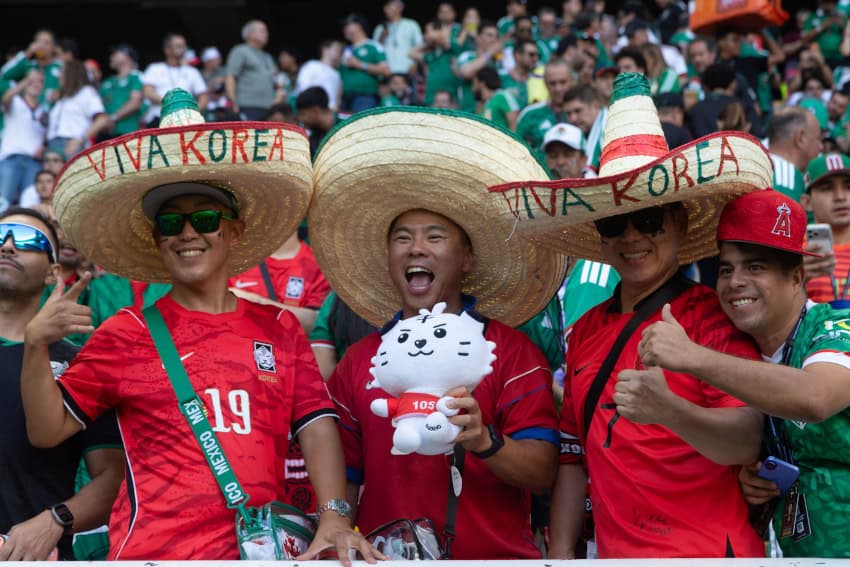
The tourism boom Mexican authorities anticipated from co-hosting the FIFA men’s World Cup didn’t materialize, official data shows.
The national statistics agency INEGI reported on Thursday that 4.11 million international tourists came to Mexico in June, an increase of just 1.1% compared to the same month of last year. The term “international tourists” refers to visitors who spend at least one night in the country.
En junio 2026, ingresaron al país 8,189,014 viajeras y viajeros internacionales, 2.1% más que en junio 2025.
De esta cantidad:
▪️50.2% entraron como turistas internacionales (residentes en el extranjero que se hospedaron al menos una noche en México)
▪️49.8% lo hicieron como… pic.twitter.com/UyPkARgn73— INEGI INFORMA (@INEGI_INFORMA) August 13, 2026
The year-over-year growth in international tourists was the lowest of any month so far this year, even though Mexico hosted 12 of its 13 World Cup games in June. (The 13th game was July 5.)

Mexican authorities had anticipated that the World Cup would bring up to to 5.5 million additional tourists to Mexico, but that prediction proved to be overly optimistic.
INEGI’s data shows that the number of international tourists who arrived in Mexico by air in June fell 5.3% annually to 1.75 million. Therefore, only 42.6% of the international tourists who came to Mexico in June flew into the country. The remaining 57.4% of international tourists entered the country by land from the United States, Guatemala or Belize.
International traveler numbers increased 2.1% in June, spending rose 5.9%
INEGI reported that just under 8.19 million international travelers came to Mexico in June, an increase of 2.1% compared to the same month of last year. The term “international travelers” refers to both international tourists and international day-trippers.
In June, 4.07 million international day-trippers — including cruise ship visitors — came to Mexico, a 3.2% annual increase. That figure represents 49.8% of the total number of international travelers to Mexico last month. The remaining 50.2% were international tourists.
The most positive takeaway from INEGI’s latest tourism data is that international travelers’ spending in Mexico increased 5.9% annually to US $2.91 billion in June. In May, expenditure declined 0.3% annually.
Spending by international tourists increased 6.3% annually to $2.65 billion in June, representing 91.1% of the total. Spending by international day-trippers increased 1.5% annually to $259 million.
The average expenditure in Mexico of international tourists in June was $645.20 per person, an annual increase of 5.2%. Among international tourists who arrived by air, the outlay per person was almost double at $1,283.80, an annual increase of 9.6%.
International day-trippers spent an average of just $63.50 per person during their visits in June, an annual decrease of 1.7%. Within that category, spending in Mexico by cruise ship passengers was higher at $87 per person, a 7% annual increase.
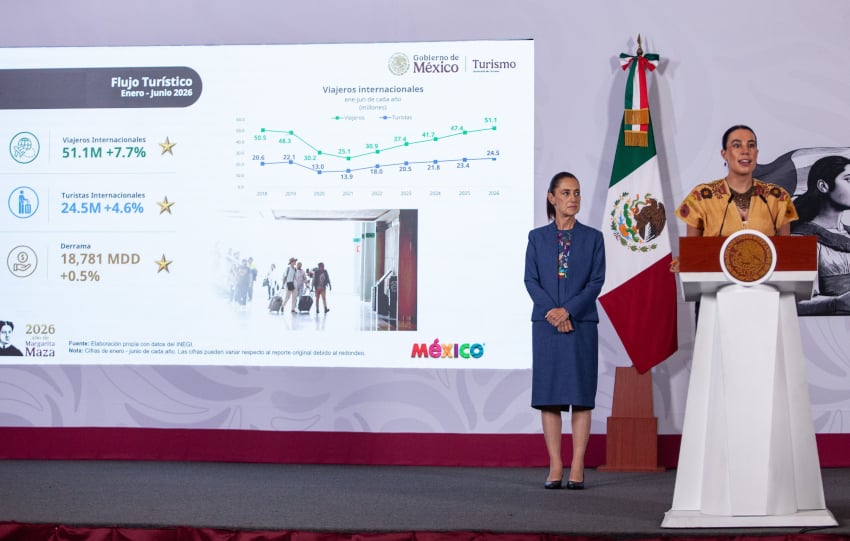
At President Claudia Sheinbaum’s Thursday morning press conference, Tourism Minister Josefina Rodríguez said that spending by international travelers in June was the highest this year.
While the overall growth in tourists was modest, she highlighted that visitors from some countries increased significantly in annual terms in June, including Japan (+131.7%); Australia (+89.1%); Colombia (+74.4%); Ecuador (+62.6%); and South Korea (+46.7%).
The national soccer teams from four of those five countries played World Cup matches in Mexico in June. Australia was the only team that didn’t play a match in the country.
The US was the top source of international ‘non-border’ tourists
INEGI published data that showed that 2.2 million of the 4.11 million international tourists who came to Mexico in June were “non-border tourists” — i.e. they spent at least one night in parts of the country not located near Mexico’s northern or southern borders.
Of those 2.2 million people, almost 1.53 million people, or 69.2% of the total, live in the United States.
INEGI also reported that in June:
- 303,721 non-border international tourists came from South American and Caribbean countries. That figure represents 13.8% of the total.
- 124,709 non-border international tourists came from Canada (5.7% of the total).
- 99,180 non-border international tourists came from Central American countries (4.5% of the total).
- 77,875 non-border international tourists came from European countries (3.5% of the total).
- 43,400 non-border international tourists came from Asian countries (2% of the total).
- 31,002 non-border international tourists came from “other regions” of the world (1.4% of the total).
Tourism minister presents record January-June tourism data
At Sheinbaum’s Thursday press conference, Rodríguez also reported that a record high 51.1 million international travelers — including overnight visitors and day-trippers — came to Mexico in the first six months of 2026, an annual increase of 7.7%.
She said that numbers of international tourists (referring only to overnight visitors) also reached a record high at 24.5 million between January and June. That figure represents a 4.6% year-over-year increase.
Rodríguez reported that spending by international travelers increased 0.5% annually in the first six months of the year to reach a record high $18.78 billion.
Although the increase in spending was minimal, the tourism minister stressed that expenditure didn’t decline “despite the inflation affecting the United States and the increase in the cost of flights, especially long-distance ones.”
Rodríguez also reported that a record high 6.6 million cruise ship passengers visited Mexico in the first six months of the year, an annual increase of 15.2%. She said that “spending by cruise ship passengers, which is what we’re looking for,” was a record $575 million between January and June, an annual increase of 18.7%.
Rodríguez highlights increase in domestic tourism
Rodríguez also reported that 53.6 million Mexicans spent at least one night in a hotel in Mexico in the first six months of the year. She said that figure represented an increase of 733,000 people compared to the same period of last year.
Rodríguez stressed the importance of domestic tourism to Mexican destinations.
“Not all destinations are filled with foreign tourists. Rather, a lot of them, 80% of them, depend on us,” she said.
With reports from EFE and El Sol de México