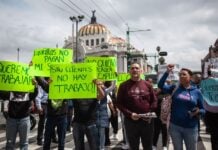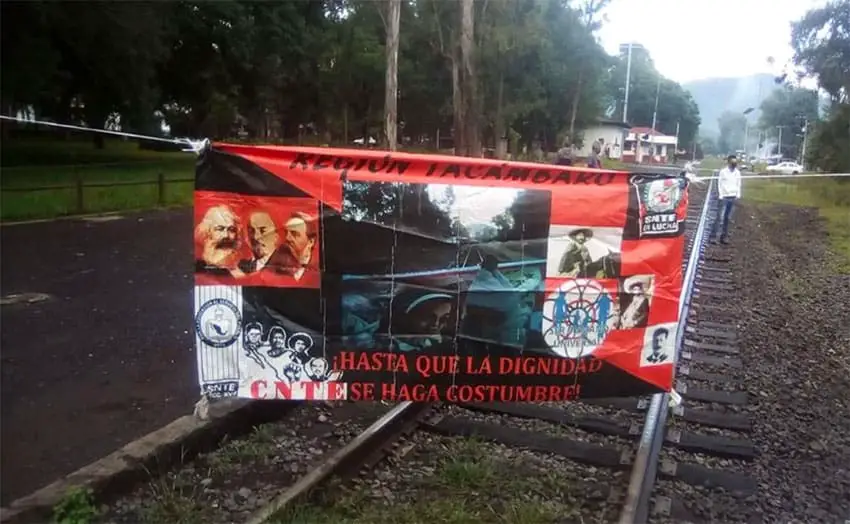
Teachers and teachers in training blocked railway tracks at four different points in Michoacán on Monday to demand the payment of bonuses and scholarships and the automatic allocation of jobs to teaching graduates.
Members of the dissident CNTE teachers union stopped trains in the municipalities of Pátzcuaro, Múgica, Maravatío and Uruapan.
Six trains traveling to Michoacán from Nuevo León and three that departed the port city of Lázaro Cárdenas were affected by the blockades, according to the Michoacán Industry Association (AIEMAC).
The blockades were reestablished after being removed at the end of last week. Teachers and teaching students known as normalistas had blocked rail tracks for more than three weeks, causing extensive economic damage.
The National Guard attended all four blockades in Michoacán on Monday but took no action against the protesters.
AIEMAC, which estimated last week that each day of blockades costs industry about 50 million pesos (US $2.3 million), said it was regrettable that teachers and students had returned to the tracks. Their actions damage the state economy and Mexican families, the association said.
AIEMAC president Carlos Alberto Enríquez Barajas said the protesters justify their blockades by saying “this is the way things are done in Michoacán.”

But he rejected that sentiment, declaring that the disgruntled teachers and their way of protesting “don’t represent us.”
Enríquez said the rail blockades scare off investors and drive up logistical costs that reduce Michoacán’s competitiveness.
He said Michoacán’s geographical advantage – its Pacific coastline provides trade access to the west coast of the United States as well as Asian markets – is being squandered due to problems in the state, including the teachers’ protests.
Enríquez urged the federal government to intervene to end the rail blockades so that third parties aren’t affected and “we can all continue carrying out our operations.”
Indigenous Yaqui people in Sonora have also blocked railway tracks this year to protest against the government’s failure to fulfill social commitments, while farmers in Chihuahua have done the same to denounce a 1944 bilateral water treaty that requires Mexico to send water to the United States.
There have also been blockades of tracks in Puebla, Veracruz, México state and Tamaulipas.
Felipe de Javier Peña, president of the transportation commission of the Confederation of Industrial Chambers, said there have been rail blockades on 100 separate days this year, 36 more than during all of 2019.
He said the blockades affect the transportation of goods within Mexico and are an impediment to exports via Pacific coast ports such as Lázaro Cárdenas and Manzanillo, Colima.
“Hopefully [the government] can negotiate [with the protesters] because they’re paralyzing the country,” Peña said.
He called on federal and state authorities to uphold the rule of law and promptly seek solutions to the issues that cause different groups to erect blockades on Mexico’s rail network.
Source: El Universal (sp), Reforma (sp)