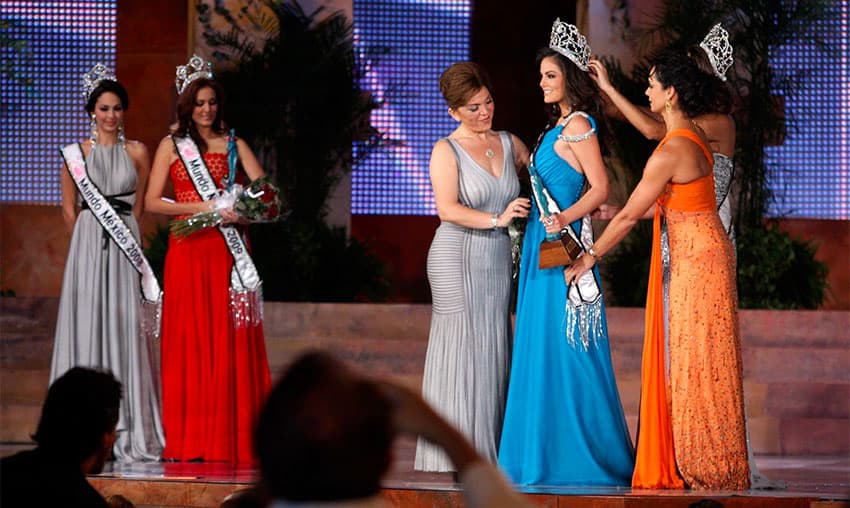
Mexico’s Chamber of Deputies approved a measure this week that if approved by the Senate will characterize beauty pageants and other such gender-based competitions based on appearance as symbolic violence against women.
The lower house voted to add a provision to the General Law of Women’s Access to a Life Free of Violence, adopted in 2007 and intended to combat gender-based violence. The bill was approved with two votes against and six abstentions and now goes before the Senate.
The law, which Amnesty International and other organizations have claimed has not had much effect on the prevalence of violence against women in Mexico, does not currently include “symbolic violence” as a category of such violence. It only covers physical, psychological, sexual and economic violence.
If the bill passes the Senate, contests, elections, competitions and other types of events that promote gender stereotypes and that evaluate the physical form of women or girls would be considered symbolic violence. As such, government institutions would not be allowed to distribute financial resources to nor publicize those events.
“Promoting the competition among women based on their physical attributes promotes sexist and ‘macho’ patterns that stigmatize, objectify, and minimize the role women play in our society,” says the bill’s text.
If passed, the law would not make such contests illegal but simply prohibit the government from supporting them in any way, Deputy Frida Esparza Márquez told the digital newspaper Animal Político.
“In general, these events are organized and financed by state or municipal governments supposedly to promote tourism and traditions and customs. It’s a true contradiction that the state promotes a form of symbolic violence,” she said.

As evidence of the problem, Márquez pointed out that in 2019, for example, Jalisco allocated 4 million pesos towards combatting violence against women, giving 3.85 million pesos to 11 municipalities.
Yet in the same year, she said, five Jalisco municipalities alone spent 8.48 million pesos on beauty contests.
The bill defines symbolic violence as “the expression, transmission or broadcasting by any media, whether privately or publicly, discourses, messages, or stereotypical patterns, signs, values, icons, and ideas that transmit, reproduce, justify, or normalize the subordination, inequality, discrimination, and violence against women in society.”
Also included in the bill are provisions that would target “media violence” — meaning the promotion of gender stereotypes or glorification of the exploitation, humiliation or discrimination against women via print, broadcast or digital media — as well as gender-based political violence and “obstetric violence,” in which medical professionals conduct procedures or make medical decisions for pregnant or postpartum women without consent.
Sources: El Financiero (sp), Animal Político (sp)