A company in Michoacán is putting avocado waste to good use, transforming it into biogas and organic fertilizer.
Using some 100 tonnes of waste such as seeds and skin, Energías Verdes de Michoacán (Green Energy of Michoacán) is currently producing 10,000 cubic meters of natural gas every 24 hours as well as 40,000 liters of organic fertilizer.
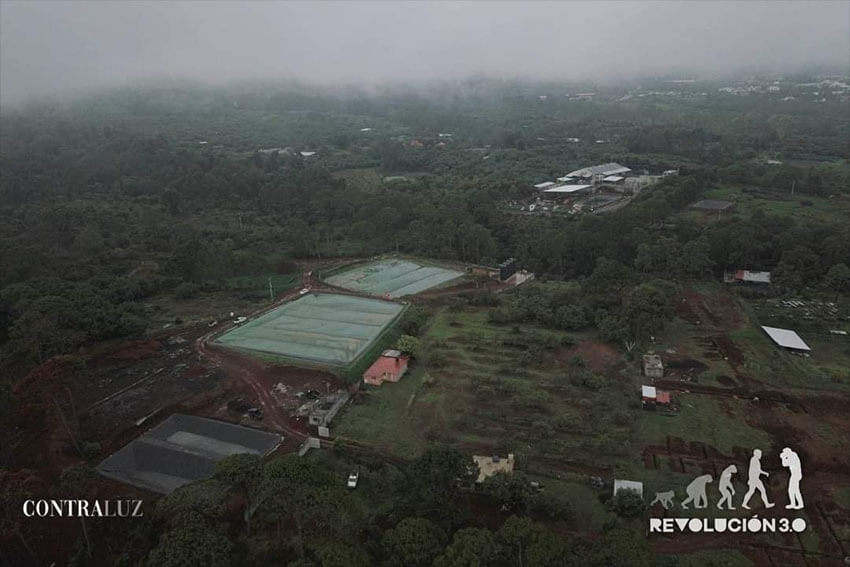
The transformation takes place at a plant in Peribán, a municipality some 200 kilometers northwest of Morelia on the border with Jalisco. Michoacán is Mexico’s largest avocado-growing state with annual production of some 1.8 million tonnes.
The origin of Energías Verdes de Michoacán (Enavem) can be traced back to a chance meeting between Rogelio Sosa López, a businessman and owner of a company that makes biogas out of nopal, and a young avocado oil producer identified only as Víctor in a report by the news website Mi Morelia.
After Víctor told him that his business was struggling to cope with the vast quantities of avocado waste generated by the oil-making process, Sosa suggested that a biodigester — a system that digests organic waste in order to convert it to biogas and fertilizer — could be a solution.
The two men decided to explore the idea and subsequently formed Enavem, a company whose work today wouldn’t be possible without the expertise and skills of a team of engineers, agronomists, biologists and other experts.
The company began operations six months ago and consequently solved Víctor’s gargantuan waste problem. Instead of the avocado refuse accumulating, rotting and emitting methane into the atmosphere, it is now fed into two biodigesters that transform the organic matter into gas and fertilizer without the need for any chemical additives.

The natural gas can be transformed into “any kind of energy,” Sosa said. “We currently use it just for the boilers at the [avocado] oil factory and for vehicles but this is the first renewable clean energy with the potential to substitute gasoline and any other kind of energy obtained from fossil waste,” he claimed.
Methane-rich biogas produced from a wide range of raw materials is in fact already used as fuel for vehicles, including in Michoacán where some cars with modified fuel tanks run on Sosa’s nopal gas.
According to the International Renewable Energy Agency, Germany, Sweden, Switzerland, the United Kingdom and the United States were the largest producers of biogas as vehicle fuel in 2016 and China, France, the U.K. and Scandinavian countries are among the nations that have strongly supported the transition to biogas use in the transport sector. The agency said that switching to biogas as vehicle fuel can reduce greenhouse gas emissions between 60% and 80% compared to fossil-based fuels like gasoline and diesel.
Sosa asserted that the avocado biogas produced in Peribán “doesn’t contaminate, although there is still combustion.”
The lower levels of contamination generated by the use of the biogas is compensated by the carbon capture capacity of avocado trees as they grow, he explained.
Enavem is planning to start using a third biodigester soon and intends to continue increasing its capacity to produce biogas and fertilizer from avocado waste. Greater production could open the door to broader use of the environmentally-friendly products outside the avocado industry. For now, however, Enavem’s ingenuity mainly benefits the sector on which it depends.
“For the extraction of [avocado] oil high temperatures are needed and they’re now generated with the natural gas. The fertilizer … is reintegrated in the same orchards … [from which the avocados came] in order to stop using chemicals. In this way we’re closing a complete cycle in agricultural production, we’re returning the nutrients to the land,” Sosa said.
“We’re proposing alternatives in order to have clean water, soil and air and to stop indiscriminately and criminally contaminating our natural resources,” he added. “It’s true that the change of land use for the cultivation of avocados generates other [negative] impacts but that’s within the purview of the state. We’re not going to get involved in that issue, what we’re doing is a … solution to one part of the problem.”
With reports from Mi Morelia