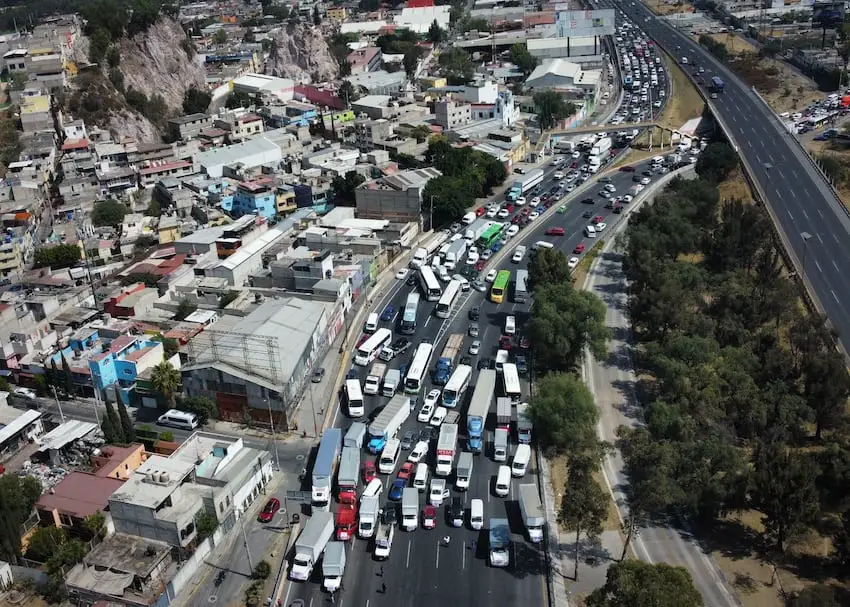
Demanding the government provide better security on the nation’s highways, Mexican truck drivers began a nationwide strike Thursday morning, disrupting traffic on a handful of major federal highways.
Protests in several spots around the country began at 8 a.m., and by late morning main roads, including all lanes of the Mexico City–Cuernavaca highway — the nation’s busiest — were blocked in both directions.
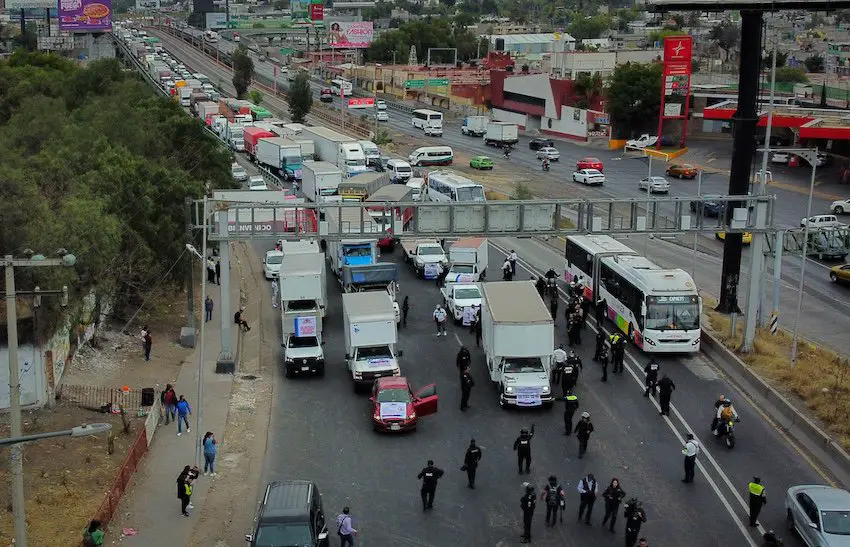
Long lines of trucks being driven at slow speeds created the blockages, although there were reports that protesters in at least two locations eventually agreed to free up lanes to allow motorists to pass.
Other highways affected by the protests included Mexico City–Puebla, Mexico City–Pachuca, México-Querétaro and the Arco Norte, and the Vía Morelos road from Ecatepec in México state to CDMX.
The protesters, who say they are fed up with an alarming increase in transport robberies, were aiming to reach the National Palace in Mexico City, to seek a dialogue with authorities.
The union stated that roads would not be blocked as long as the Army and other authorities did not intervene. The Mexican Alliance of Transport Organizations (AMOTAC) also asked for the understanding and support of the citizenry.
The nation’s truckers and transporters had postponed the strike for a week, but it was put into action after a previous dialogue with authorities that union officials called “not constructive and not favorable.”

Interior Minister Luisa María Alcalde Luján countered that she has negotiated frequently with drivers and government agencies including the Infrastructure, Communications and Transportation Ministry (SICT) and the National Guard.
But, Alcalde added, AMOTAC members “decided to get up from the table and establish various blockades that affect citizens.”
AMOTAC members reportedly account for 83% of the national transport vehicle fleet, and the union has 270 chapters nationwide.

Alcalde called their strike unjustified because the demands of the transporters are being met, adding that it was being driven by “political interests.”
President Andrés Manuel López Obrador refused to receive the protesters and their negotiators at the National Palace, dismissing AMOTAC’s actions as a politically motivated action against his government.
The union simply says it wants better safety for its drivers.
According to figures from the Executive Secretariat of the National Public Security System (SESNSP), there were an average of 38 assaults every day on truck drivers transporting goods between cities in 2023, an increase of 4% over 2022.
And of the 38, approximately 25 per day were robberies — an increase of 2.8% over 2022. Moreover, 85.6% of the robberies included violence.
Julieta Tolentino, a national coordinator for AMOTAC, told Mexico Business News that the National Guard is failing to ensure highway safety due to disorganization and a lack of training. She also said truck drivers face numerous challenges, such as the absence of a standardized tariff system and insufficient rest areas in addition to a dearth of safe places to stop.
Miguel Ángel Santiago of AMOTAC told MVS Noticias that action taken by the government so far has been “insufficient to address the issues and the phenomenon we are currently experiencing.”
A separate strike on Feb. 5 was led by the Mexican Federation of Transportation and Freight Transport (FEMATRAC), but the two strikes were reportedly independent.
With reports from El Economista and Infobae