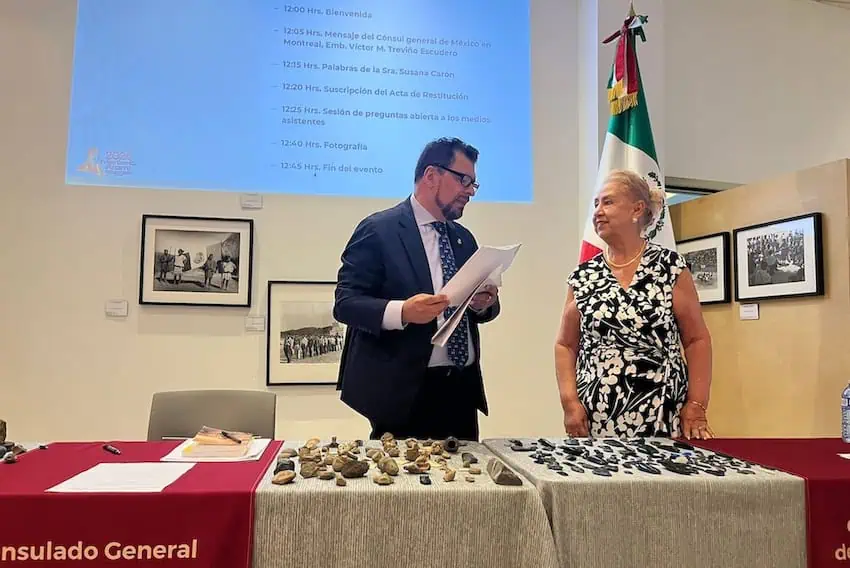
Mexico has repatriated 257 archaeological artifacts that were turned over by a Mexican citizen residing in Montreal, Canada, according to a statement by the National Institute of Anthropology and History (INAH).
These pieces were voluntarily returned by Susana Zarco Carón, who has lived in Canada since 1968. A restitution ceremony was held at the Consulate General in Montreal on Monday, where Consul General Montreal Víctor Treviño Escudero thanked Mrs. Zarco for helping reintegrate the heritage pieces with Mexico.
#ENTÉRATE: Canadá restituye 257 piezas arqueológicas a México
🔹Fueron devueltas a las autoridades consulares de nuestro país en Montreal por una ciudadana de origen mexicano.
La información completa en nuestro #BoletínINAH:https://t.co/10JeiSSJsL
📸 Cortesía: @SRE_mx pic.twitter.com/yD0Qk3tutv
— INAH (@INAHmx) July 9, 2024

After thoroughly analyzing the pieces, the INAH confirmed the Mexican origin of the artifacts. According to the INAH’s statement, 256 pieces are movable archaeological monuments from various Mesoamerican civilizations belonging to the Classic period (200-900 AD) and the Postclassic period (1200-1521 AD). The one remaining piece is of “historical nature.”
It is unknown how Mrs. Zarco acquired these pieces.
The artifacts will add to the more than 13,500 items recovered by Mexico as part of the #MiPatrimonioNoSeVende initiative (My Heritage is Not for Sale). This new initiative is part of the current administration’s mission to reclaim, safeguard and promote cultural heritage that has been unlawfully taken from Mexico. The majority of these reclaimed artifacts have been discovered in the United States, followed by Spain and Italy.
“This campaign helps to reduce collecting through looting while encouraging the appreciation of our heritage,” the INAH has said.
So far this year, Mexico has retrieved 30 artifacts from Los Angeles, 22 from Philadelphia and 35 from Seattle. The latest recovery included artifacts originally from the Cintalapa region in the southern state of Chiapas, Mexico.
Besides Canada and the United States, Mexico has recovered cultural heritage from The Netherlands, Switzerland, France and Italy, among other countries.
Mexico and Canada have maintained diplomatic relations since 1944. This year, the two countries are celebrating the 80th anniversary of such a milestone with a range of events, including a photographic exhibition inaugurated by Canadian Foreign Minister Mélanie Joly during her visit to Mexico City in late June.
Mexico News Daily