Generous rainfall during the second half of July has significantly reduced the percentage of Mexico’s territory affected by drought, continuing a steady recovery from the aridity that threatened to become a crisis.
On Monday, the National Water Commission (Conagua) published its drought monitor update through July 31, showing that nearly 47% of the country was free of drought conditions and 40.1% of Mexico’s territory was affected by moderate to exceptional drought.
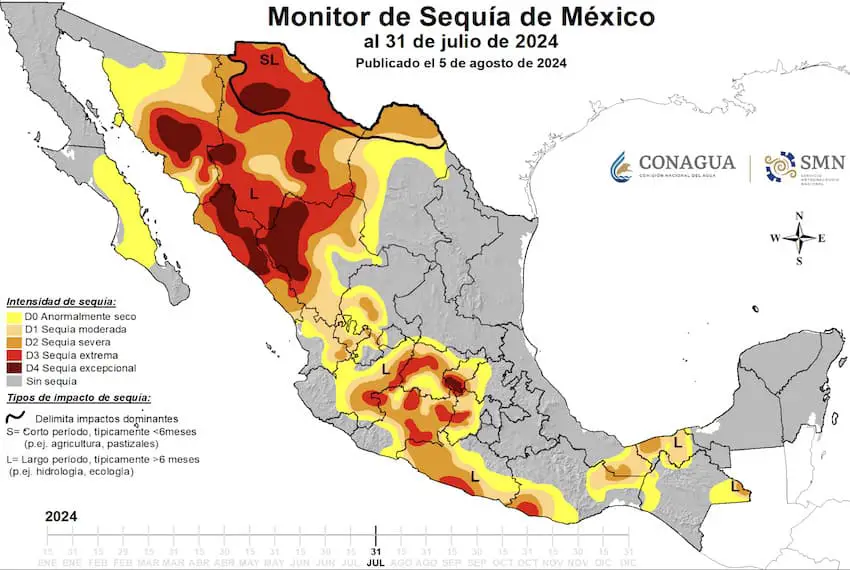
This is 11.9 points less than reported two weeks ago and nearly 36 points less than two months ago, when 76% of the country was afflicted by some degree of drought conditions.
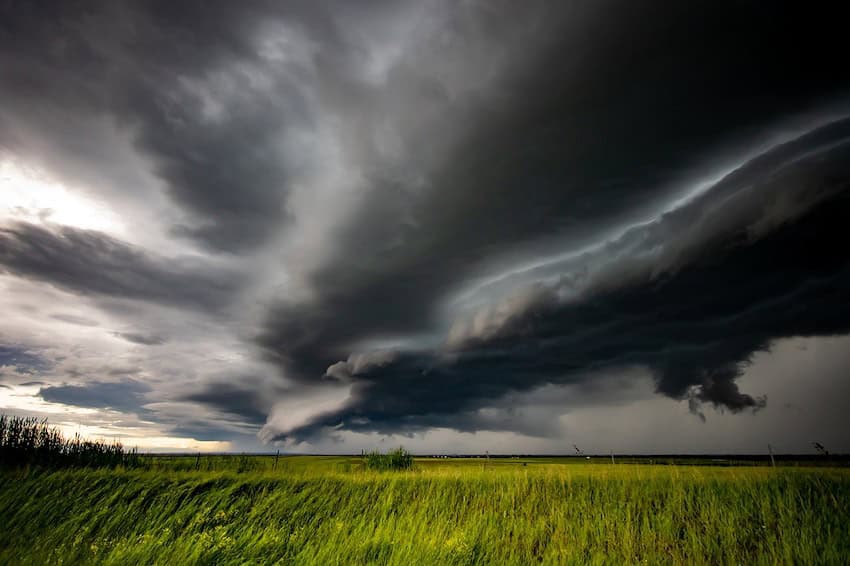
The Conagua report attributed the improved conditions to “positive anomalies in precipitation” during the second half of July. The heavy rainfall was attributed to a shifting tropical depression off the Pacific coast of Mexico and the arrival of four tropical waves that combined with a low-pressure system to produce cyclones.
Both the Pacific and Gulf coasts experienced considerable humidity due to a low-pressure system that interacted with an abnormal weather front. The Mexican monsoon — a pattern of pronounced increase in thunderstorms and rainfall often centered over the Sierra Madre Occidental — also contributed to the rainfall.
These phenomena reduced the drought conditions across large swaths of Mexico, principally in the northeast, the central plateau, the west-central region and the south.
Conagua declared Tamaulipas and San Luis Potosí in the northeast to be drought-free while Guanajuato, Hidalgo and México state in the central plateau were downgraded from exceptional drought to moderate drought conditions.

Mexico’s northwest and west-central regions will continue to get relief, fed by two tropical storms in the Pacific. Tuesday’s Conagua forecast foresees heavy rainfall (50-75 mm) in Chihuahua, Sonora, Sinaloa, Guerrero, Jalisco, Michoacán and Nayarit as tropical storm Fabio skirts Baja California.
Se prevén #Lluvias puntuales muy fuertes en #Chihuahua, #Guerrero, #Jalisco, #Michoacán #Nayarit, #Sonora y #Sinaloa.
Más información en:https://t.co/GnGGgij0PF pic.twitter.com/i6lKnhJzY0
— Conagua (@conagua_mx) August 6, 2024
Mexico City, Durango, México state, Chiapas Colima, Morelos, Oaxaca Puebla and Veracruz will receive 25 to 50 mm of rain.
In a separate report last week, Conagua announced that the country’s 210 principal reservoirs had risen from 42% to 46% capacity as of July 29. Those 210 reservoirs, which now hold 58.1 billion cubic meters of water, represent 92% of Mexico’s water storage capacity.
The rains have also helped the Cutzamala hydraulic system recover. Conagua reported that the three principal reservoirs of the system — which supplies 25% of Mexico City’s water — saw capacity rise from 26.9% at the beginning of July to 32.4% as of July 30. This represents an increase of 43.12 million cubic meters of water.
With reports from ADN 40 and El Financiero