
President Claudia Sheinbaum announced that construction on the Mexico City-Querétaro train line will begin in 2025, following her pledge to build more than 3,000 kilometers of passenger railways during her six-year term.
Speaking from an event in Querétaro to inaugurate preliminary studies for the railway, Sheinbaum said that construction will begin in April 2025 and will be completed in three years. It will require an investment of 75 billion pesos (US $3.8 billion).
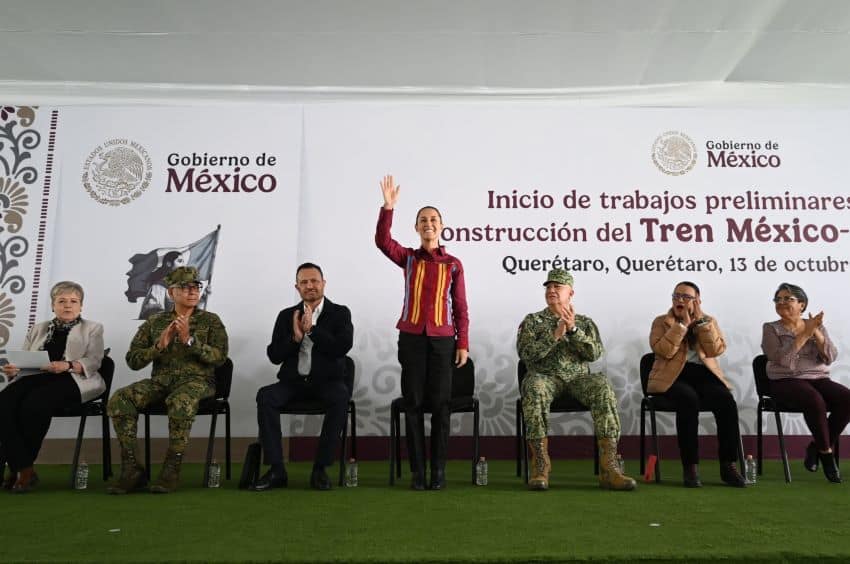
At the Oct. 13 event, Querétaro Governor Mauricio Kuri González celebrated the news, anticipating that this mobility alternative would improve the quality of life of citizens and visitors to the state.
As with the Mexico City–Pachuca passenger train, and other federal infrastructure projects, the Defense Ministry (Sedena) will be responsible for the train’s construction.
Located about 206 kilometers north of Mexico City, Querétaro is a city of 1.6 million and the capital of the state bearing the same name. The passenger train will connect both cities within an estimated one hour and forty minutes — a 40% reduction in travel time compared to what it currently takes by car. The train will have a capacity of 450 passengers and an estimated speed of 160 km per hour.
The train’s main stations will be Buenavista, Mexico City, San Juan del Río, Querétaro, and Querétaro city, with intermediate stops in towns throughout México state and Hidalgo. In Querétaro, the train will connect with the Qrobús, a public bus line servicing the metropolitan Querétaro area. Meanwhile, in Mexico City, the train will connect with Line B of the Metro, Line 1, 3 and 4 of the Metrobús, and with ecobici bicycle ports.

According to Sheinbaum, the train will feature two parallel passenger lines built adjacent to existing freight lines.

As part of Sheinbaum’s goal to extend passenger train routes to the north of the country, the forthcoming Querétaro station will eventually offer passengers access to three new destinations by train: Nuevo Laredo, Tamaulipas; Guadalajara, Jalisco; and Nogales, Sonora.
“This train will improve the country’s connectivity, consolidating President López Obrador’s vision of recovering passenger trains,” said Jesús Antonio Esteva Medina, head of the Infrastructure, Communications and Transport Ministry (SCIT).
The federal government expects the project to benefit more than 30,000 people and generate approximately 490,000 jobs, including 165,000 direct and 325,000 indirect jobs.
Mexico News Daily