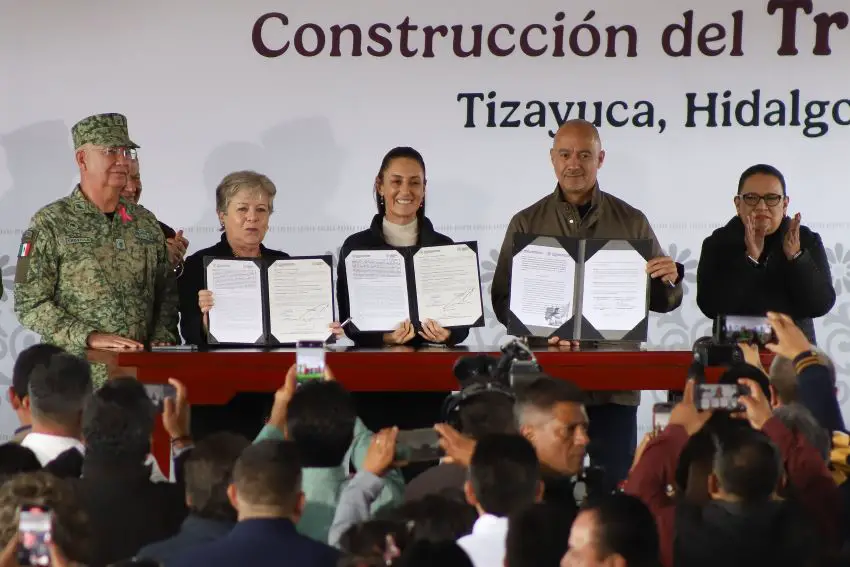
Mexico’s President Claudia Sheinbaum was in Hidalgo this weekend to ceremonially inaugurate construction on the planned Mexico City-Pachuca passenger train.
Located about 106 kilometers north of Mexico City, Pachuca is a city in central Mexico and the state capital of Hidalgo. The passenger rail service would connect three states and include a stop at the Felipe Ángeles International Airport (AIFA) in México state.
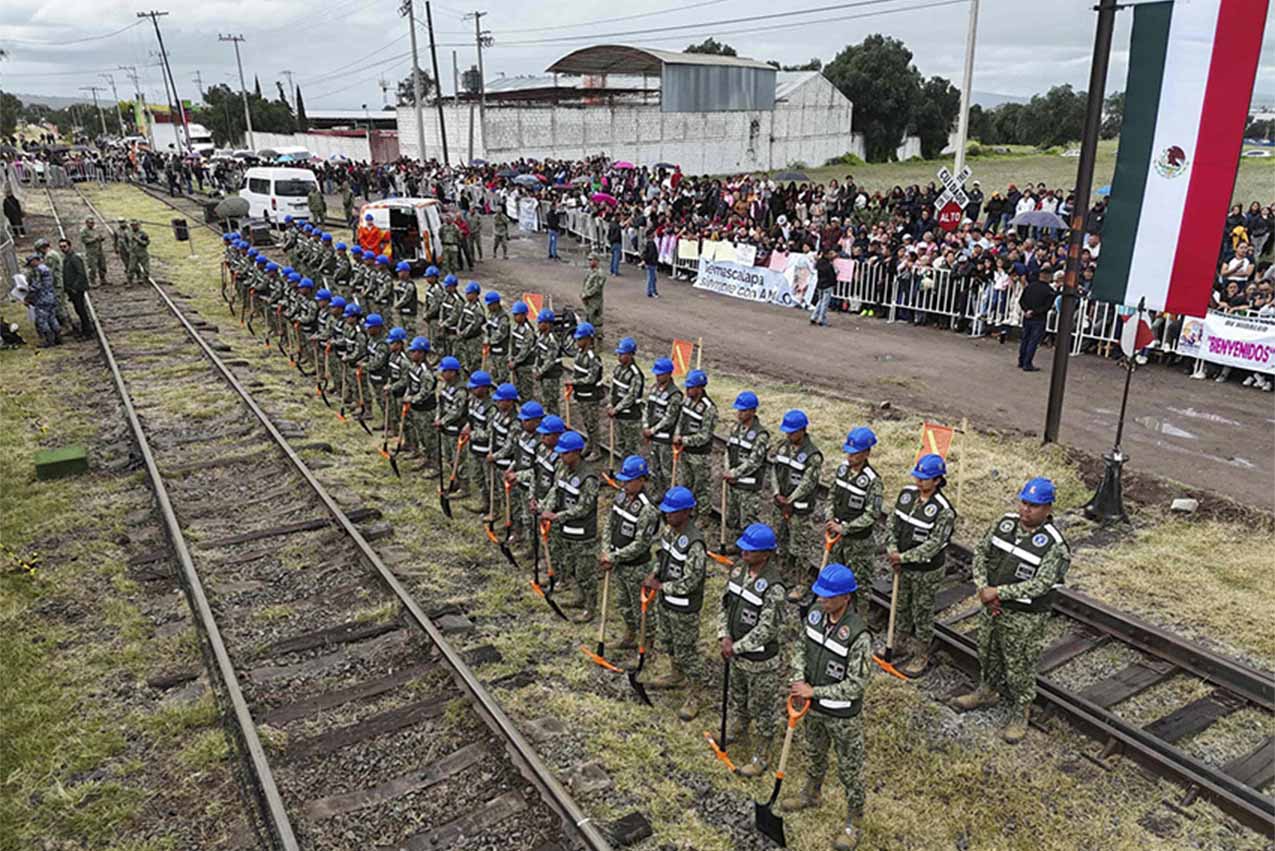
The train will depart from Buenavista, north of Mexico City, and will stop at AIFA, Huitzila, Téllez and Pachuca. It will be electric with double electrified tracks along all 106 kilometers of the route.
The AIFA-Pachuca route, like Buenavista-AIFA, will require new tracks to be laid.
With an estimated speed of 120 kilometers per hour and a capacity of 718 passengers per train, the journey between AIFA and Pachuca will take only 20 minutes, half the time it currently takes by car.
Environment Minister Alicia Bárcena said that the project will include green walkways. Air, soil and water quality near the route will also be monitored as part of efforts to make the train an ecologically sustainable travel option, she said.
The commuter railway line seeks to improve access to AIFA while facilitating connectivity for commuters between Mexico City and Pachuca. It is expected to benefit the inhabitants of Zumpango, Tecámac, Nextlalpan, Temascalapa — all municipalities in México state — and Tizayuca, Zapotlán, Zempoala, Villa de Tezontepec, Jaltocán and Pachuca, all located in Hidalgo.

Preliminary studies by the Infrastructure, Communications and Transportation Ministry (SICT) show the commuter train will require an initial investment of 50 billion pesos (US $2.5 billion). As with the Maya Train, the Defense Ministry (Sedena) will be responsible for the project.
Sheinbaum said during the inauguration that she will soon be in the state of Querétaro to inaugurate construction on other commuter train routes. The goal, she said, is to create passenger train routes that extend to the border city of Nuevo Laredo, Tamaulipas.
During her presidential campaign, Sheinbaum unveiled plans to build three new train routes based on the model of the Maya Train. In addition to the Mexico City–Pachuca line, plans include a train to connect Mexico City with Nuevo Laredo and Mexico City with Guadalajara.
Her plans also include the expansion of the Maya Train and the Interoceanic to Guatemala.
Sheinbaum’s plan builds on former president Andrés Manuel López Obrador’s commitment to revive the use of passenger trains across the country. In the past, the Mexican government eliminated passenger train service, but now it is seeking to revitalize it as a viable option to improve mobility.
With reports from El Universal Hidalgo, Infobae and La Jornada.