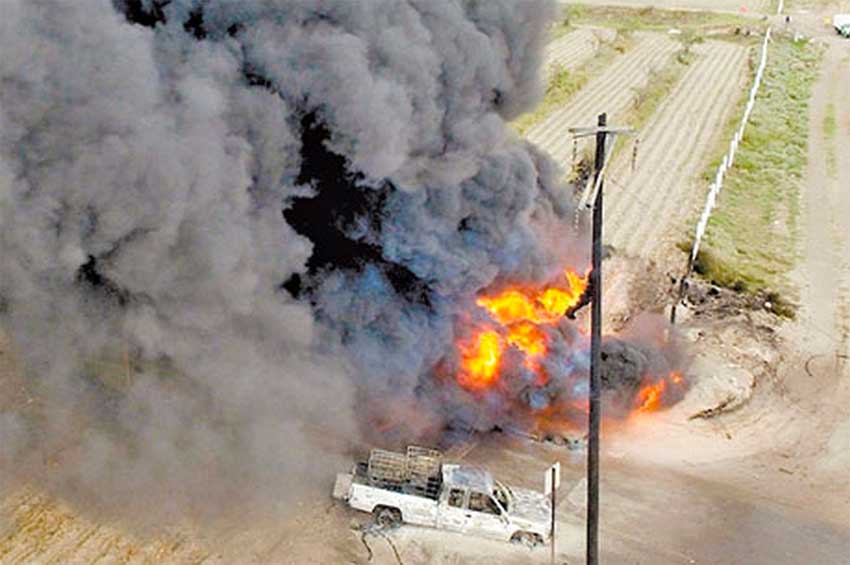
The government of Puebla has recovered 8 million liters of stolen fuel since January 2017, the state governor said yesterday.
The Safe Puebla security coordination group — a joint state and federal task force — has also seized 3,818 vehicles used to transport the stolen product in the same period, Governor José Antonio Gali reported yesterday.
In addition, security forces have arrested 881 people in connection with fuel theft, seized 32 properties and secured more than 2,300 illegal taps on state-owned petroleum pipelines in Puebla, Gali said.
Yet despite the statistics suggesting that authorities are getting on top of the fuel theft problem, other data paints a different picture.
Puebla recorded more illegal taps on its fuel pipelines than any other state in the first four months of 2018, while its homicide rate also increased in the same period compared to 2017 figures.
Feuds between rival gangs of fuel thieves known as huachicoleros have been blamed for increasing levels of violence in Puebla and other states, most notably Guanajuato, which has become one of the country’s most violent.
Fuel theft also takes a heavy toll on the federal government’s coffers. Pemex CEO Carlos Treviño said in April that the illicit practice costs the state oil company 30 billion pesos (US $1.6 billion) a year in lost revenue.

Gali recognized the damage the crime inflicts on the nation and stressed that he and his government would continue to act with a “firm hand” against the crime, adding that “nobody is above the law.”
A statement issued by the Puebla government following Gali’s remarks noted that the Minatitlán-Mexico City pipeline passes through the state, transporting regular and premium fuel as well as diesel between the Pemex refinery in the Veracruz city and the capital.
The different types of fuel that flow through the pipeline, coupled with the fact that it is one of Mexico’s most important, make it particularly profitable for thieves, the government said.
Source: El Universal (sp)