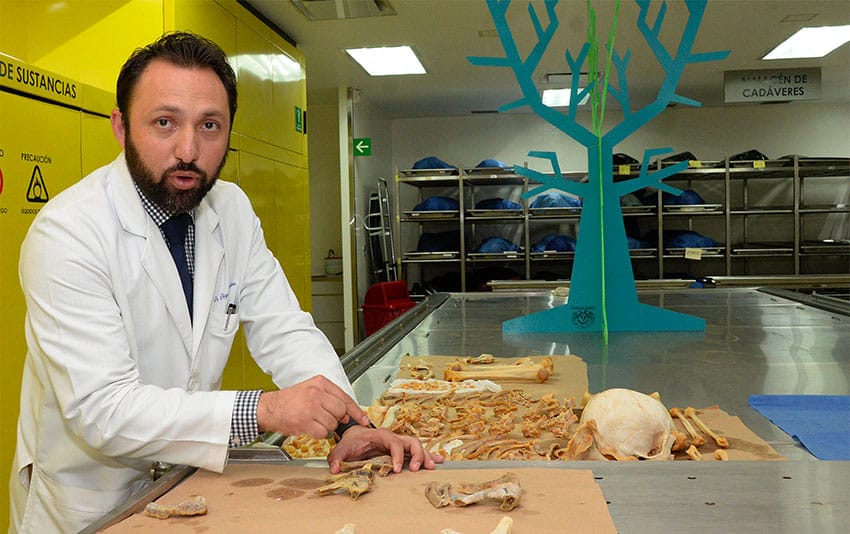
Scientists at the National Autonomous University (UNAM) have developed a chemical formula to preserve cadavers without the use of refrigeration.
The formula is safer than using refrigeration and maintains the flexibility of the bodies, which allows them to be used for research and teaching.
According to Diego Pineda, the head of the biological innovation department at the UNAM’s medical school, researchers experimented for a year and a half before discovering the formula, which has several advantages over formaldehyde, commonly used for most chemical preservation of cadavers.
To be preserved in the latter, bodies need to be treated for three months, but the new formula developed at UNAM can preserve a body in 15 days, after which the body will not need further treatment or refrigeration to remain preserved. The formula contains less than 3% of formaldehyde mixed with other substances.
Formaldehyde and other alcohols that are used to preserve cadavers also dehydrate bodies, make them rigid and distort their natural colors, which limits their usability for research and teaching.
“With better cadavers, we will develop better skills, and reduce medical errors,” said Pineda. “And that will have a positive impact, because medical errors are the third-most-common cause of preventable death in the world.”
The new preservation process, along with an expansion of the medical school’s body donation program, has allowed the school to offer more postgraduate courses. Currently, more than 2,000 people have signed up to donate their bodies to the school. On average, one body can be used to teach eight courses.

The preservation formula is currently in the process of receiving Mexican and international patents.
Source: El Universal (sp)