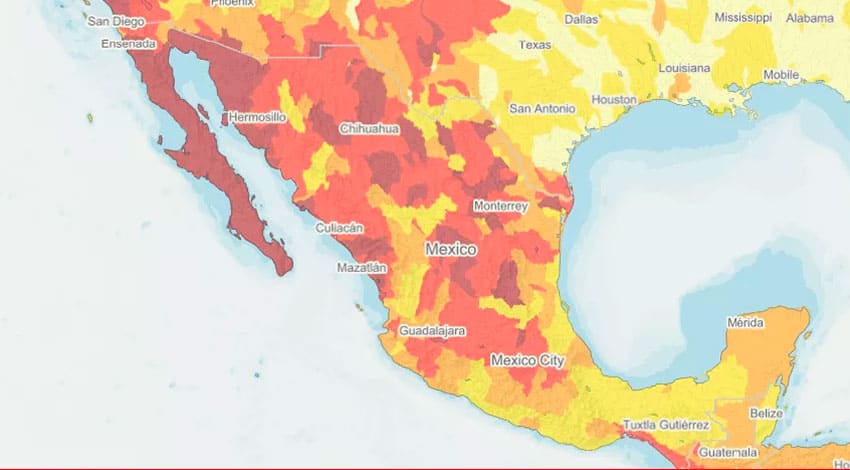
About a third of the world’s population of over 7 billion live in countries at high risk of running out of water in the near future, and Mexico ranks high on the list, according to a study by the World Resources Institute.
The institute categorized countries into five different levels according to their relative risk of consuming all of their water resources, ranging from “Low Baseline Water Stress” to “Extremely High Baseline Water Stress.”
Mexico falls into the high-stress category, the second-highest on the list, meaning that the nation consumes between 40% and 80% of the water supply available in a year. Overall, Mexico ranks 24th out of the 164 nations included in the study.
However, a more detailed look at the maps included in the study shows that some regions of Mexico are under significantly more baseline water stress than others. Fifteen states, all in northern and central Mexico, fall within the “Extremely High Baseline Water Stress” category, meaning that they consume between 80% and 100% of available water every year.
Among the states most vulnerable to water crises Baja California Sur is in the lead, followed closely by Guanajuato, Mexico City, Aguascalientes, México state, Querétaro, Hidalgo, Chihuahua, Zacatecas, Sonora, Sinaloa, Nuevo León, Morelos, Jalisco and Tamaulipas.
Several Mexican states, mostly located in the Gulf region, are at medium to high risk of suffering drought, including Tabasco, Veracruz, Tamaulipas, Tlaxcala, Yucatán, Colima and Puebla.
Mexico is one of 44 countries, representing one-third of the world’s population, deemed most at risk of hitting “Day Zero,” the point at which there is not enough water to meet the needs of its citizens.

“Water stress poses serious threats to human lives, livelihoods and business stability. It’s poised to worsen unless countries act: population growth, socioeconomic development and urbanization are increasing water demands, while climate change can make precipitation and demand more variable.”
However, the institute stressed that decisive action could have a significant and swift impact on countries’ available water resources.
It said that to step back from impending disaster, countries should implement several strategies, including increasing agricultural efficiency, investing in gray and green infrastructure and treating, reusing and recycling water.
“The data is clear: there are undeniably worrying trends in water. But by taking action now and investing in better management, we can solve water issues for the good of people, economies and the planet.”
Source: El Financiero (sp)