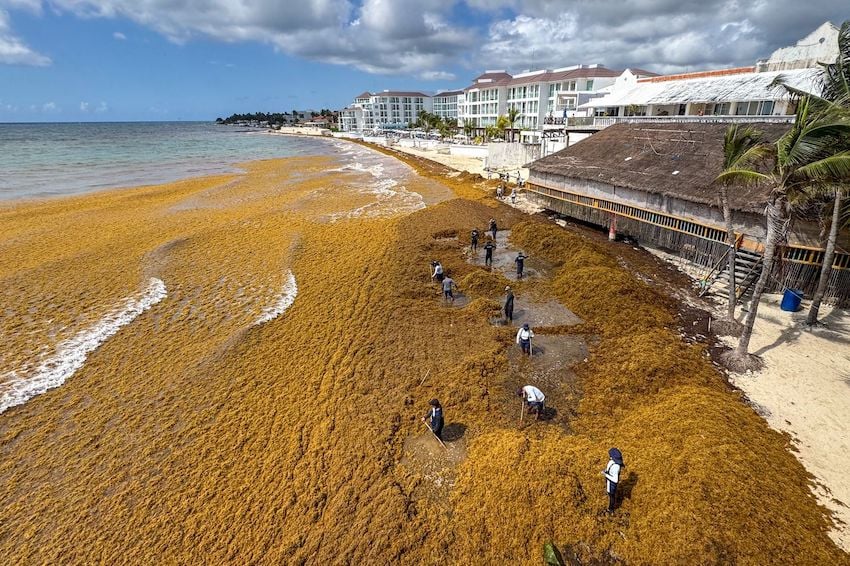
March is here, and with it the typical start to sargassum season, when the noxious seaweed begins washing up on Mexico’s Caribbean coastline, darkening the sea, fouling the sand and chasing away the tourists.
This year could be worse than ever.
For one thing, the season started earlier than usual, with the slimy invader first washing up on Isla Mujeres in the second week of January. According to industry publication Reportur, 244 tonnes of sargassum were collected from Tulum in February, up from 59 in 2025. It has since accumulated in many other beaches along the Quintana Roo coastline, particularly near Playa del Carmen.
“This year is going to be terrible,” said Rosa Rodríguez, a researcher at the National Autonomous University of Mexico’s Institute of Limnology and Marine Sciences in Puerto Morelos.
According to Rodríguez, a record 9.5 million tonnes of sargassum was spotted out in the Atlantic Ocean during January and another 13.6 million tonnes in February, far exceeding the previous records of 7.8 and 4.3 million tonnes in 2025. Because sargassum is a floating seaweed carried by ocean currents and winds, experts expect about 10% of that accumulation to reach Mexican shores, which is more than enough to surpass last year’s quantities.
While it does not pose any direct health risk to humans, its decomposition can generate unpleasant odors and affect water quality.
Initial forecasts suggest that the most affected beaches along Mexico’s Caribbean coast will be Cancún, Playa del Carmen, Tulum, Cozumel and Mahahual. A large patch of sargassum appeared along the coast of Akumal, in the municipality of Tulum, last Thursday.

The overall increase in the volume of sargassum is attributed to climate change, the warming of the seas and ocean acidification.
Authorities activate preventive protocols
Ahead of the official start of sargassum season, officials have been making moves to prevent the seaweed from reaching the shore. In Isla Mujeres and Puerto Morelos, barriers have been placed in the sea to trap the sargassum.
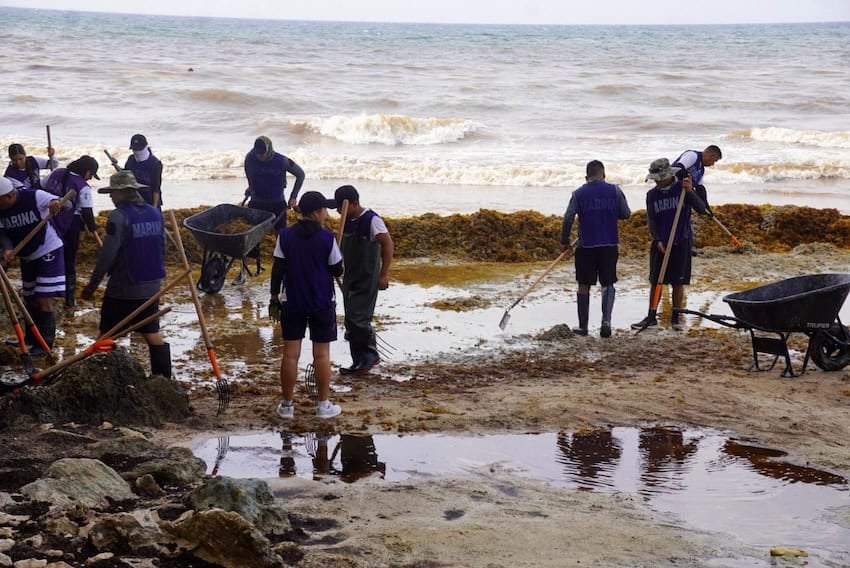
Meanwhile, Playa del Carmen has launched its Sargassum Challenge 2026, which includes the use of a 5-km double barrier to contain the seaweed, as well as the deployment of cleanup personnel at 15 locations.
Navy warns of record sargassum season ahead of Easter holiday
The Mexican Navy will use ships and an amphibious vehicle to capture and transport the seaweed.
Tourism Minister Josefina Rodríguez assured visitors that measures will be taken to contain any sargassum that washes up ahead of the busy Easter season, from March 29 to April 5.
Meanwhile, tourists can track the conditions of the beaches through the sargazo.info website. A blue or green indicator signifies that there is little to no sargassum on the beach, while a yellow, orange or red indicator suggests the presence of seaweed.
With reports from Quintana Roo Hoy, El Universal, Infobae and Reportur