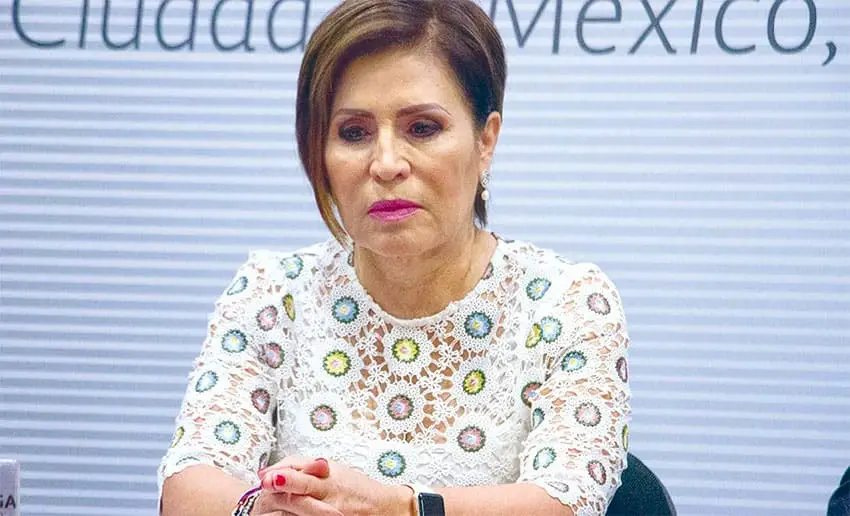
The legal team of former cabinet secretary Rosario Robles has accused the judge who ordered their client to stand trial on corruption charges and remanded her in preventative custody of making rulings based on “political and personal reasons.”
Judge Felipe de Jesús Delgadillo Padierna ruled on Tuesday that Robles must stand trial on charges of improper exercise of public service through omission.
The federal Attorney General’s Office alleges that Robles allowed over 5 billion pesos (US $258 million) to be misappropriated from the federal budget while she was leading two secretariats.
During court hearings, Delgadillo made pejorative, sexist and offensive comments, Robles’ lawyers said in a statement. They also said the judge’s rulings were “clearly out of legal context.”
“We will soon present a complaint before the Federal Judiciary Council since his conduct is contrary to our constitution, international treaties and the Organic Judicial Power Law,” the lawyers said.
“Our client and her team of lawyers feel offended by the partiality with which the judge acted,” they said, adding that the crime of which Robles is accused doesn’t warrant preventative prison.
“. . . The control Judge Felipe de Jesús Delgadillo Padierna flagrantly violated the concepts and principles related to precautionary measures,” the lawyers said.

Legal experts who spoke to the newspaper El Financiero agreed with their assessment.
Ricardo Sánchez Reyes Retana, a lawyer who is currently acting for former Veracruz governor Javier Duarte, said the law provides judges with the option of imposing 14 different precautionary measures apart from preventative custody in cases where the accused is considered a flight risk.
They include confiscation of a person’s passport and the imposition of an ankle bracelet monitoring device, he said.
Sánchez also said that Robles’ decision to return from overseas to attend court was clear evidence that she has no intention to attempt to evade justice.
Therefore, the judge’s decision to impose preventative prison was “excessive,” he said.
Former president Felipe Calderón said it appeared that the decision to imprison Robles was motivated by revenge.
“. . . It’s clear to me that there are significant irregularities that have to be punished but . . . I think that the way in which she was put in prison . . . has an arbitrary part to it and it doesn’t have to be this way, it seems [to be] personal revenge against her,” he said.
“I don’t excuse her, I don’t exonerate her, I believe that there were very serious things in the Master Fraud but everything has to be done in accordance with the rule of law” Calderón said.
Former Supreme Court judge José Ramón Cossío said in a radio interview that the imprisonment of Robles “sends a bad very sign for the justice model that we’re trying to build,” adding “it’s not a good precedent.”
However, he said the former secretary does have legal recourse, explaining that she can appeal the decision and seek an injunction against the imposition of preventative prison.
Robles’ legal team expressed confidence that the decision to jail Robles before her trial would be overturned and said that the process to win her release is already underway.
The lawyers concluded their statement by saying that they are convinced of their client’s innocence and will prove it in court.
Source: El Financiero (sp), Milenio (sp)