
On July 1, 2025, the government of Baja California Sur, through its Secretariat of Finance and Administration, launched what it termed an “Embrace It” tourist fee of 470 pesos (since raised to 488 pesos, or about US $28), mandatory for everyone over the age of 12 who arrives in the state by land or air from outside Mexico, and stays for more than 24 hours. The fee is paid digitally at an online site, with tourists then given a QR code that can be shown to any officials who ask for proof of payment.
Despite the good causes that underlie the implementation of this fee — namely, to strengthen environmental conservation and improve tourism infrastructure in the state — it has not been well-received by tourists.
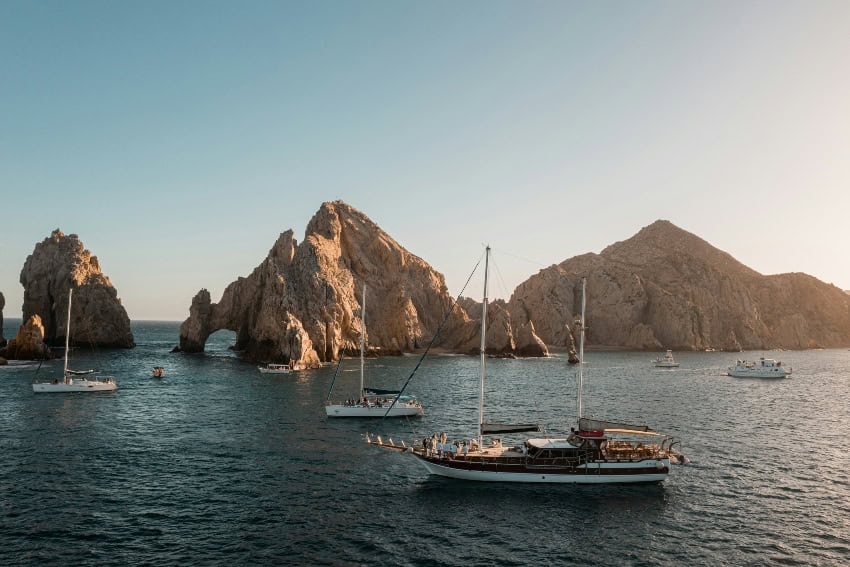
In fact, a great many of them are successfully ignoring the fee due to inconsistent enforcement. During the six months the fee was in force last year, 256 million pesos were collected, which translates to payments from 544,680 tourists.
However, considering over four million people flew into Los Cabos internationally (primarily from the U.S., but also from Canada, Europe and Central America), that suggests a significant percentage of the two million or so who flew in during the latter half of the year, after the fee had been initiated, simply didn’t pay.
Perhaps because the requirement was not properly communicated to them, or perhaps because they’re fed up with what is just another in an increasingly long line of taxes on visitors to Los Cabos.
The many taxes paid by Los Cabos tourists
Yes, the fee is being implemented by Baja California Sur, but it’s essentially a tax on visitors to Los Cabos, since the overwhelming majority of international tourists (83.2% in 2025) to the state are going only to that destination.
Once there, tourists can expect to be taxed on virtually every aspect of their stay.

This begins when buying an airline ticket, since a surcharge of about US $42 is added to the ticket price to account for the tourist visa needed to visit Mexico. The most significant taxes, however, begin to pile up once they check into a Los Cabos hotel. There’s the 4% lodging tax, which is used to fund the Los Cabos Tourism Board and infrastructure improvements. Then there’s the Environmental Sanitation Tax (only about US $4 per night) and the Impuesto al Valor Agregado (IVA), the 16% sales tax applied to room rates, food and beverage, and other hotel amenities.
But don’t confuse it with the service charge, which is between 15-18% and can be added in addition to the IVA on some purchases. In sum, it’s not uncommon for taxes on hotel stays in Los Cabos to total as high as 30%.
High hotel and Airbnb rates, plus cruise ship taxes
Did we mention Los Cabos also has the highest hotel rates in the country? The average hotel rate along the Ruta Escénica, the coastal corridor between Cabo San Lucas and San José del Cabo that’s home to the highest percentage of luxury resorts, was US $596 per night as of October 2025. That means on a single night’s stay, taxes could run upwards of $175. For those staying for a week or more, that’s upwards of 1,000 dollars in taxes on top of the standard room rate.
Airbnb rentals are not exempt either, with taxes increasing by 600% in 2025.
About the only way to avoid all these taxes used to be to visit by cruise ship, but as of last July, a tax had also been initiated for all cruise passengers to Mexico. Now, it’s only US $5 per person. However, in July 2026, it goes up to $10, then to $15 in 2027, and to $21 in 2028.
Why some in Los Cabos are pushing back on taxes
It’s not just tourists who are upset about all these charges. It’s also tourist-related employees and organizations in Los Cabos that understand the implications. Namely, that once tourists get fed up with all of these taxes, they may decide to spend their vacation somewhere else.
“This is something to be careful about,” Agustín Olachea Nogueda, president of the Association of Hotel and Tourism Companies in La Paz, said recently, echoing the sentiments of many in Los Cabos. “If we become a very expensive destination, tourists start looking at other places where it’s cheaper to travel.”

“The concern is not about paying taxes,” a Los Cabos hotel manager clarified to Vallarta Daily when the Embrace It fee was implemented last year. “It’s about how many taxes are stacked on top of each other without clear explanations or tangible returns. Tourists shouldn’t feel like ATMs.”
The stacking appears to be intensifying, with the cruise ship tax, Embrace It fee and Environmental Sanitation Tax all added within the last three years. Nor do these new taxes necessarily have all the bugs worked out before implementation. When Embrace It took effect in 2025, both the Los Cabos Tourism Board and the Los Cabos Hotel Association issued nearly identical statements to the effect that “No regulatory framework or operational system has been formalized.”
Problematic aspects of the ‘Embrace It’ tax
The Embrace It tax has the potential to be particularly problematic based on the history of the similar VISITAX in Quintana Roo. Both taxes, for instance, rely on the same Canadian tech company, Travelkore, for payment processing.
Implemented in 2021, four years before the launch in Los Cabos, VISITAX has experienced numerous issues that may foreshadow ones with Embrace It. These range from problems getting the online system to approve payment, even from valid credit cards, to scam websites claiming they’re legally authorized to accept payments, thus ripping off unwary tourists. As mentioned earlier, however, the real problem — at least from the taxer’s point-of-view — is a lack of efficient enforcement. What was supposed to be a mandatory tax has seemingly become only a voluntary one, with the likelihood of payment based on age.
As Yahoo Finance has reported, older tourists in the 45-59 and 60 and over age ranges are by far the most likely to pay the Embrace It tax, while younger tourists in the 18-29 age bracket are by far the most likely to skip paying.
Based on all the other taxes they have to pay, can you blame them?
Chris Sands is the former Cabo San Lucas local expert for the USA Today travel website 10 Best and writer of Fodor’s Los Cabos travel guidebook. He’s also a contributor to numerous websites and publications, including Tasting Table, Marriott Bonvoy Traveler, Forbes Travel Guide, Porthole Cruise, Cabo Living and Mexico News Daily.