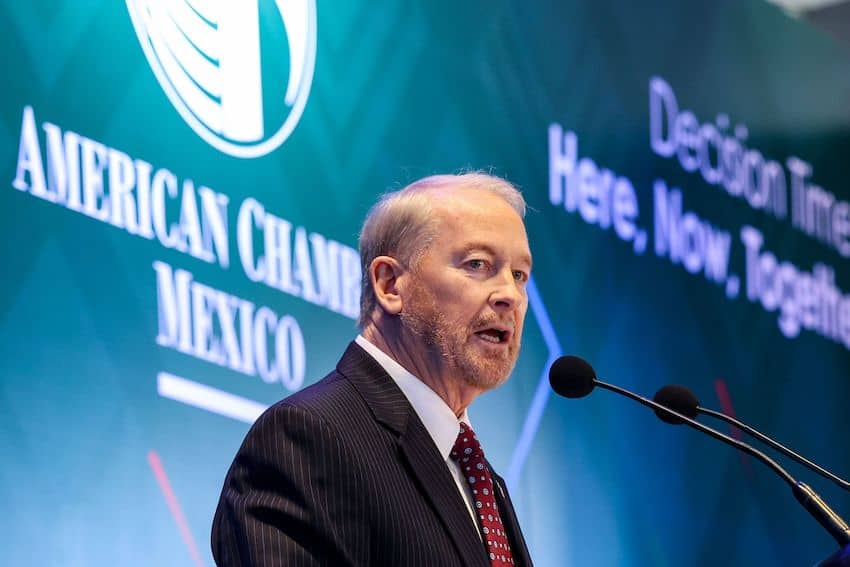
U.S. Ambassador to Mexico Ronald Johnson asserted Wednesday that the upcoming review of the USMCA doesn’t represent a “risk” to the trilateral North American free trade pact, but rather an “opportunity to deepen integration” in the region.
His remarks came during an address in Mexico City at the 109th General Assembly of Partners meeting of the American Chamber of Commerce of Mexico (AmCham). Johnson is the honorary president of AmCham.
Here is an overview of the ambassador’s remarks, as reported by major Mexican newspapers.
USMCA can be ‘the envy’ of the world
Johnson said that “we” — i.e., the U.S. government — “don’t see the 2026” review of the United States-Mexico-Canada Agreement (USMCA) “as a risk, but rather as an opportunity to deepen integration and strengthen [North American] supply chains in an increasingly complex world.”
The ambassador also said that the United States, Mexico and Canada have an opportunity to establish North America as the world’s most competitive economic region and a bloc that is the “envy” of the world.
His comments came as Mexican and U.S. officials commenced formal trade talks ahead of the review of the USMCA, which replaced NAFTA in 2020.
Mexico announces kick-off of formal USMCA negotiations — without Canada

Mexican Economy Minister Marcelo Ebrard wrote on social media on Wednesday that he and other Mexican officials held talks with U.S. Trade Representative Jamieson Greer “and his team to commence discussions with respect to the review of the USMCA.”
“The [Mexican and U.S.] technical teams will be working throughout the day today and tomorrow,” he added.
The talks are taking place in Washington, D.C. The formal trilateral USMCA review will take place later this year.
During his address, Johnson also said that the United States and Mexico will continue building a stronger, more dynamic and more competitive partnership.”
He noted that the U.S. and Mexico are each other’s largest trade partners, with two-way trade totaling close to US $1 trillion annually.
Despite that, U.S. President Donald Trump said in January that he doesn’t “care” about the USMCA, and claimed that the pact offers “no real advantage” to the United States.
“We could have [the agreement] or not, it wouldn’t matter to me,” he said.
Mexico-US relationship is like ‘a marriage’
Speaking to Mexican and U.S. businesspeople at the AmCham event at the Papalote Children’s Museum, Johnson described the U.S.-Mexico relationship as “a marriage.”
“You can love each other a lot, be partners, raise children and grow businesses [even] when you don’t agree on everything,” he said.
Johnson said that he had used the marriage analogy in a conversation with President Claudia Sheinbaum, and asserted that there is no possibility of a divorce between the two countries.
As he has asserted on social media, the ambassador said there is “historic cooperation” between the United States and Mexico under the leadership of Trump and Sheinbaum.
He also said that “when the United States and Mexico work together, we’re stronger.”
US and Mexico tout ‘historic’ security cooperation as DEA, Mexican officials meet in Washington
“We’re stronger economically, we’re stronger strategically and we’re stronger in the face of unfair competition from other parts of the world,” Johnson said.
He also said that “the true strength” of the U.S.-Mexico relationship “doesn’t lie just in economic figures, but in the depth of our human connections.”
‘North America, united, could be independent’
The ambassador claimed that North America could become self-sufficient at some point in the future, eliminating the need to import goods from other regions of the world.
“North America, united, could be independent,” Johnson said.
“Think about it. Mexico and the United States together could feed each other. We can provide each other the water we need. We could be independent and have everything we need for our people,” he said.
‘We have the most secure border in history’
Johnson highlighted that the U.S. and Mexican governments are “working together to stop fentanyl trafficking, seize illicit firearms, combat human trafficking and tackle illegal migration.”
“And that cooperation is delivering real results for our people and our communities,” the ambassador said.
Johnson asserted that the U.S. and Mexico currently have “the most secure border in history.”
“Illegal immigration is at record lows and there are zero releases of migrants [detained] at the border. This is important for President Trump and therefore it’s important for me,” he said.
Johnson said that fentanyl — which is made in Mexico with Chinese precursor chemicals before being smuggled into the U.S. — is still killing “too many” people in the United States, but noted that deaths related to the synthetic opioid are declining.
“We still have a lot of work to do, but [deaths] are declining and that’s very special,” he said.
‘A strong private sector needs certainty’
Johnson asserted that “a strong private sector needs certainty, fair conditions and a level playing field.”
“Guaranteeing those conditions both at home and in all of North America is a key priority for the United States,” he said.
Johnson’s predecessor as ambassador to Mexico, Ken Salazar, criticized Mexico’s judicial reform, saying in 2024 that the “direct election of judges is a major risk to the functioning of Mexico’s democracy” and that judicial elections — which were held last year — would “threaten the historic trade relationship we have built, which relies on investors’ confidence in Mexico’s legal framework.”
President Claudia Sheinbaum denied that the judicial reform would have a negative impact on investment in Mexico, which received a record amount of foreign direct investment in 2025.
World Cup ‘will demonstrate the strength of our cooperation’
Johnson said that the FIFA men’s World Cup — which will be co-hosted by the United States, Mexico and Canada in June and July — “will not only show the passion of our people for the game … but also demonstrate the strength of our cooperation.”
He also said that the five-week tournament will demonstrate “our capacity to coordinate with each other across borders in order to guarantee security and offer to the world an event that is successful, memorable and safe.”
With reports from El Economista, Reforma, El Universal and La Jornada