Mexico’s headline inflation slowed for the third consecutive fortnight, according to the national statistics agency INEGI, falling back within the central bank’s target range.
Inflation declined in the first half of July, marked by lower costs for various agricultural products, such as lemons and avocados, giving rise to expectations that the central bank (Banxico) will continue to cut interest rates.

Annualized inflation surprised to the downside in the first half of July, slowing from 4.13% to 3.55%, below the market consensus of 3.61%. Consumer prices rose 0.15% compared to the previous two weeks, also below expectations of a 0.27% increase.
President Claudia Sheinbaum celebrated the news, saying during her Thursday morning press conference that the slowdown in inflation “indicates that [Banxico] has room to keep cutting interest rates.”
Citing INEGI data, Sheinbaum said the rise in inflation in previous months was primarily due to the increase in the prices of beef, pork, and chicken, whose costs have begun to normalize.
Among the products with the highest price increases during the first two weeks of July were nopales, up 14.44%; air transport, up 11.25% and lettuce and cabbage, up 8.71%.
In the other column, grapes showed an 11.96% decrease in price; papayas fell 5.86% and lemons fell 5.73%.

Banxico, which targets an inflation rate of 3% plus or minus one percentage point, lowered its benchmark interest rate by 50 basis points in June — its fourth straight cut of that magnitude. This reduced the policy rate in Latin America’s second-largest economy to 8.0%, the lowest since August 2022.
Brokerage Monex said the data surprised the market as inflation reached its lowest level during the first fortnight of July in a decade. Still, core inflation continues to present challenges.
The closely watched core price index, which measures inflation excluding volatile items like food and energy prices, climbed 0.15% in early July, compared with 0.22% a month earlier.
Rumbo Económico MÉX: En la 1ra. quincena de julio, la inflación general fue de 0.15% q/q, situándose por debajo de la expectativa del mercado de 0.25%. A tasa anual, la inflación general se moderó a 3.55% desde 4.13% previo, alcanzando así su nivel más bajo desde la 2Q de enero. pic.twitter.com/VGTJiv2pE7
— Monex Análisis (@MonexAnalisis) July 24, 2025
The year-to-year core component came in at 4.25%, easing from 4.28% and below expectations (4.31%). Within the core index, goods “registered upward pressure,” according to a Scotiabank report, “rising from 3.97% to 4.01%, while services decelerated from 4.63% to 4.49%.”
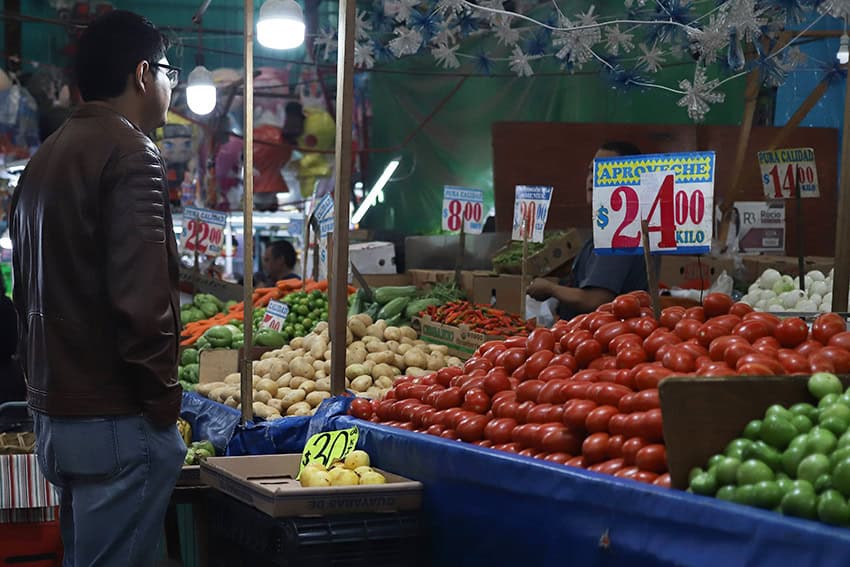
At the same time, the non-core rate declined from 3.43% to 1.24%, fueled by a sharp decline in fruit and vegetable prices (down 12.24%). This abrupt drop offset a 10.70% increase in livestock products.
In its statement from the June 27 meeting, Banxico said it expects to slow the pace of interest rate cuts. Monex analysts concurred, writing in a report that “Given the stubbornness of core inflation, we expect Banxico to reduce the scale of its cuts.”
Monex and Scotiabank project that the central bank will vote for a 25 basis point rate cut at its Aug. 7 meeting, lowering the benchmark interest rate to 7.75%.
With reports from El Economista and Reuters