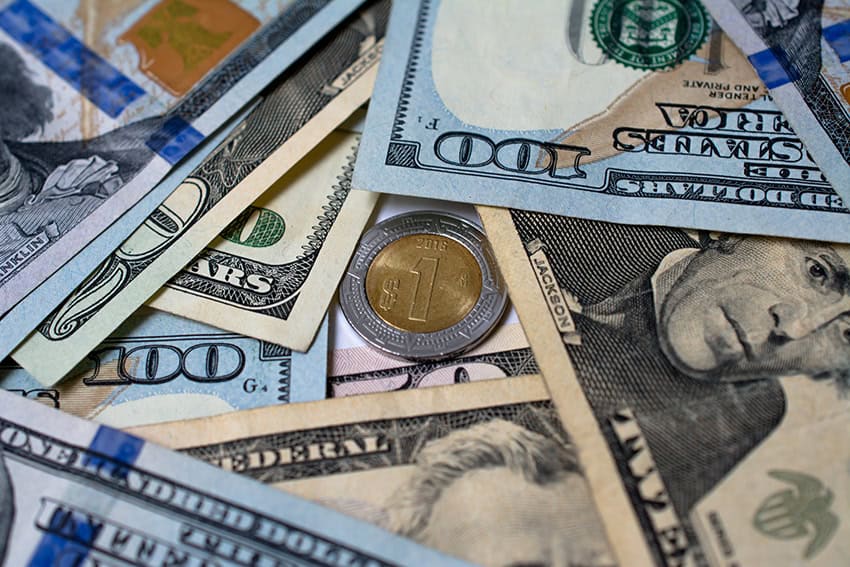
The peso appreciated to less than 17.5 units per US dollar on Wednesday, its strongest level since May 2024.
The closing rate of 17.483, represented an appreciation of 0.69%, or 12.13 centavos for the day. Through the first three weeks of the new year, the peso has gained 2.91% against the dollar.
#AlSonarLaCampana | El peso mexicano ganó terreno frente al dólar. El #TipoDeCambio se situó en 17.48 pesos por billete verde, su nivel más bajo desde mayo 2024.
📺: @RaquelLPM pic.twitter.com/eo6Sa58ZM7— El Financiero (@ElFinanciero_Mx) January 21, 2026
The exchange rate actually approached 17.40 pesos per greenback during the day, only to lose some ground after U.S. President Donald Trump said that attacks against Mexican cartels would “begin soon.”
Banamex reported that the dollar was selling for 17.91 pesos on Wednesday afternoon, while the purchase price was 16.93 units.

The peso movement was supported by a decrease in geopolitical tensions following comments by Trump in Davos, as well as by the narrative of less economic pressure in the U.S., which is seen as a positive for Mexico.
“Even so, the market remains sensitive to any news from the United States that could quickly shift sentiment,” Diego Albuja, market analyst at ATFX LATAM, told El Economista newspaper.
Wednesday’s strong performance led Banamex to revise its exchange rate projections. They now anticipate that the peso will trade below 19 units within the next two years.
“The superpeso could be making a comeback, supported by greater risk appetite and high interest rates,” Banamex economists said in a note. “We now estimate it at 18.36 pesos per dollar in December of this year and at 18.73 by 2027.”
The appreciation of the peso is not entirely good news, however.
Those who receive remittances — an estimated 1 in 10 adults in Mexico rely on money from abroad — receive fewer pesos when they exchange the money.
At the same time, companies in the export sector, an economic driver in recent years, generate less income in local currency.
“Currency appreciation can cause domestic production to lose competitiveness in the international market because local products are now worth more in foreign currency,” Monex economists told the newspaper La Jornada.
As such, exports tend to decrease, contributing to the trade deficit.
The peso gained significantly against the U.S. dollar in 2025 due to higher interest rates in Mexico and the decision by some U.S. companies to move manufacturing closer to home (and to Mexico).
A relatively weaker dollar has also helped the peso demonstrate strength in 2026. Analysts anticipate that continued nearshoring with the U.S. and Canada, along with overall foreign direct investment into Mexico, will continue driving strong demand for pesos.
Looking further into the future, the market consensus is that the exchange rate “will remain in the range of 18 to 20 pesos per dollar with a slight tendency towards depreciation, given a still weak economy and attention to monetary policy decisions both at home and in the U.S.”
A recent Reuters survey found that those polled believe the peso will keep trading close to the center of a range between 16-22 per U.S. dollar that has held firm for more than a decade.
With reports from El Economista, La Jornada and El Financiero