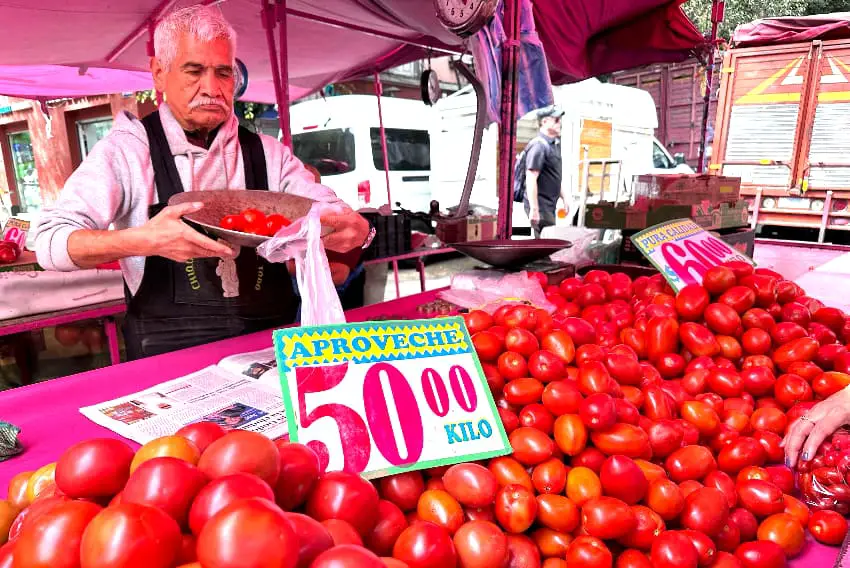
Mexico’s annual headline inflation rate rose for a fifth consecutive two-week period in the first half of January to reach 4.90%, well above the central bank’s 3% target.
An annual increase of over 20% in the cost of fruit and vegetables was the biggest driver of the increase.
Reported by the national statistics agency INEGI on Wednesday, the annual headline rate is slightly higher than the 4.78% consensus forecast of analysts surveyed by Citibanamex, and 0.24 percentage points above the 4.66% rate for the entire month of December.
The 4.90% rate is the highest headline rate recorded in Mexico since a 4.93% reading in the second half of June.
In better news, annual core inflation fell to 4.78% in the first half of January from 4.98% in the second half of December and 5.09% across the final month of 2023.
The core rate, which excludes some volatile food and energy prices factored into the headline rate, has now declined during 23 consecutive half-month periods, or almost an entire year.
INEGI data showed that fruit and vegetable prices were 20.69% higher in the first half of January compared to the same period in 2023, while processed food, beverages and tobacco were 5.63% more expensive.

Tomato prices rose over 25% from the second half of December, while onion prices jumped more than 7%.
The cost of services rose 5.19% on an annual basis, non-food goods were 3.05% more expensive and energy prices, including those for gasoline and electricity, increased 1.41%.
The Bloomberg news agency reported that the increases in tomato and onion prices are “thought to reflect the warming waters in the tropical Pacific as part of the climate phenomenon known as El Niño,” which can affect crop yields.

Despite the increase in headline inflation, many analysts believe that the Bank of Mexico (Banxico) will make an initial cut to its record high 11.25% benchmark interest rate in the first quarter of the year.
“El Niño affects tomato prices, but not Banxico’s willingness to cut,” said Gabriel Casillas, head of Latin America Economics at Barclays.
“Disinflation is coming from the core component, so even though the headline number might be higher, the composition from the central bank standpoint is way better,” he said.
Pamela Díaz Loubet, Mexico economist at BNP Paribas, expects the central bank to cut rates in March.
“Overall, it’s a positive reading, with surprises concentrated in very specific components, and core inflation showing a behavior similar to its pre-pandemic history,” she said, commenting on the latest inflation data.
Carlos Capistrán, chief economist for Mexico and Canada at Bank of America, said there was a risk that Banxico would “delay the first cut to later in the year,” but he agreed that an initial reduction to the 11.25% rate is likely in March.
A majority of respondents to the Citibanamex survey are forecasting a 25-basis-point cut in March.
Andrés Abadia, chief Latin America economist at Pantheon Macroeconomics, predicted that inflation will fall gradually this year, “particularly in the second half” of 2024. However, he acknowledged that “poor climatic conditions” pose a risk, given that they could affect prices for fresh food.
Over half of Mexico’s territory is currently affected by various degrees of drought.
Abadia also said he is closely monitoring “the effect of the minimum wage,” which increased 20% to just under 250 pesos (about US $14.50) per day in most of the country on Jan. 1.
With reports from El Financiero, El Economista and Bloomberg