Mexico and Canada are aiming to deepen their economic integration via a joint action plan that will be unveiled in the second half of the year.
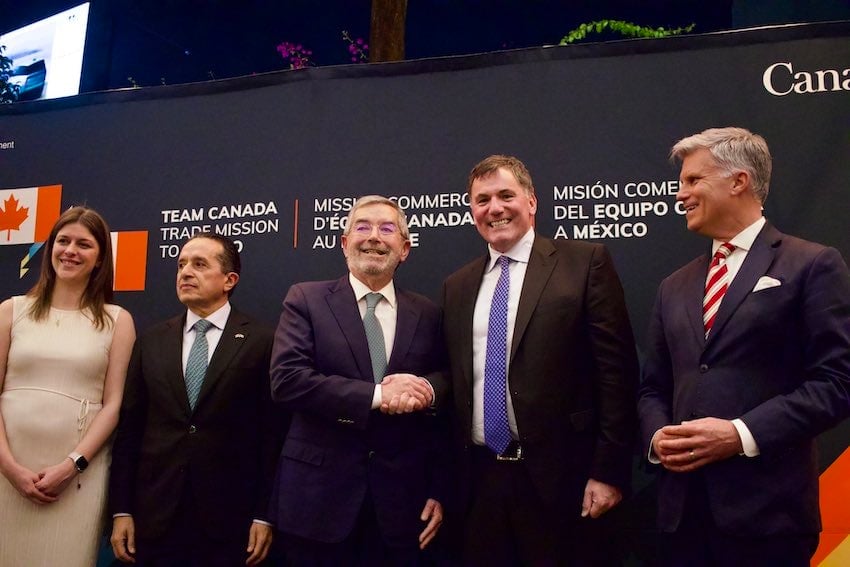
Economy Minister Marcelo Ebrard announced the initiative on Monday after meeting in Mexico City with Dominic LeBlanc, Canada’s minister for Canada-U.S. trade, intergovernmental affairs and One Canadian Economy.

Ebrard told reporters that Mexico and Canada are preparing an “action plan” in order to “expand investment, increase commerce, reduce regulatory difficulties or obstacles, and facilitate the investment and the commerce between our countries.”
He said that the plan will be presented in the second half of 2026, and indicated that it will focus on joint initiatives related to minerals, investment in ports, infrastructure and supply chain security.
Cooperation on security issues also looks set to be a feature of the joint action plan. Ebrard dismissed a suggestion that the abduction in Sinaloa of 10 employees of a Canadian mining company would affect Mexico’s relationship with Canada. However, LeBlanc stressed that Canada, in order to increase investment in Mexico, will need to see the Mexican government “working on priorities” such as security.
The announcement of the bilateral action plan comes ahead of the formal review of the USMCA free trade pact, which includes Mexico, Canada and the United States. The U.S. government has imposed tariffs on a range of Mexican and Canadian goods since President Donald Trump returned to the White House in January 2025, a move that has angered the United States’ neighbors and served to bring them closer together.
Ebrard on Monday acknowledged that times are “uncertain,” but asserted that uncertainty “always” creates “opportunity.”

“We have a great opportunity in front of us, which is to increase our relationship,” he told Canadian officials and hundreds of business representatives who made the trip to Mexico to explore investment opportunities.
“… We need to increase the presence of Mexican exports and investments … in countries like Canada. This is a necessity,” Ebrard said.
“… We are not in a comfort zone as we were in the past,” he said.
Ebrard highlighted that the trade and investment relationship between Mexico and Canada has grown twelvefold over the past 30 years, and prompted citizens of both countries to “imagine what can be accomplished in the next years, starting now, if we have the will, … the commitment to increase our relationship.”
“… It makes sense, it’s about our safety in the future, it’s about opportunities for investment and to learn from each other. You can imagine [the] pharmaceutical industry, you can imagine [the] aeronautical industry, [the] space industry, advanced manufacturing in our countries, refined minerals, critical minerals, many fields which have been explored in the past, but [which] can be explored in other ways in the next years,” he said.
“Robotics, drones, artificial intelligence, vaccines, new technologies and medicine, everything can be done,” said Ebrard, who described Canada as a “very reliable partner for Mexico.”
“… We have the tremendous opportunity to start to work in this direction. … So we are very, very happy. I think it’s very good news for Canada and for Mexico,” he said.
For his part, LeBlanc said he felt “privileged” to be able to work with Ebrard “at what is a critical moment for our countries and the North American relationship.”
“So I just wanted to say in front of our Canadian and Mexican friends how much I value and how much Canada values your engagement, Secretary Ebrard, and we thank you very, very much,” he said.
LeBlanc noted that he was accompanied in Mexico by “over 240 organizations and more than 370 business leaders from across Canada, representing all 10 provinces and one territory.”
Más de 400 empresas participan en el encuentro entre empresas canadienses y mexicanas que inició esta mañana . Crecer y diversificar nuestro comercio es la meta . pic.twitter.com/G6BauvyIxw
— Marcelo Ebrard C. (@m_ebrard) February 16, 2026
“The incredible level of interest generated by this trade mission is a testament to Canada’s commitment to a renewed and sustained partnership with Mexico,” he said.
LeBlanc’s visit to Mexico came five months after Canadian Prime Minister Mark Carney met with President Claudia Sheinbaum in Mexico City. At the time, Carney said that Canada and Mexico were “beginning a new era of elevated cooperation,” while Sheinbaum declared that the bilateral partnership would “bring a new era of further strengthening economic ties.”
Bilateral private sector dialogue ‘largest’ and ‘most important’ in years, says Ebrard
Ebrard noted that hundreds of Canadian business sector representatives traveled to Mexico to engage with Mexican companies in Mexico City, Guadalajara and Monterrey.
“[This] is the largest and most important dialogue between [the] private sectors [of] both countries in recent years,” he said.
In Mexico City on Monday, Mexico’s Business Coordinating Council (CCE) and the Business Council of Canada signed a memorandum of understanding, which, according to the CCE, “strengthens a permanent dialogue mechanism and business cooperation between both countries.”
Canadian business representatives and LeBlanc also met with Mexico’s Foreign Minister Juan Ramón de la Fuente and other federal officials.
Ebrard noted that Mexican officials and business representatives will make a reciprocal visit to Canada at an unspecified date.
In Mexico, the Canadian business delegation — which will remain in the country until Friday — will “focus on areas including advanced manufacturing; agriculture, processed foods, and agricultural technology; clean technologies and clean energy; creative industries; and information and communications technologies,” according to the Canadian government.
In a statement issued last Friday, the Canadian government said that “in the face of a shifting global economic landscape, Canada is moving to diversify and strengthen its international trade relationships to ensure that Canadian workers and businesses can thrive.”
LeBlanc told CNN on Monday that Canada’s trade mission to Mexico was the largest the country has organized “in decades, and probably ever.”
He said that Canadian companies and business organizations are “interested in seeing how we can expand our two-way trade with Mexico.”
“… I was told this afternoon that more than 2,000 business-to-business meetings have been set up,” LeBlanc said.
When CNN journalist Gabriela Frías put it to him that “pressure from the Trump administration” has forced Canada and Mexico to seek greater engagement with each other, the Canadian minister responded:
“I wouldn’t pretend to speak for the government of Mexico, but for the government of Canada that’s absolutely true. And Mexico for us is a very reliable partner. There are deep people-to-people cultural ties, business leaders in Canada that talk to me about their relationships with Mexican companies — it’s very positive. But there’s an opportunity for us in the face of some of the headwind created by the [U.S.] tariffs.”
Mexico’s exports to Canada surged in 2025
Data from the national statistics agency INEGI shows that Mexico’s exports to Canada were worth US $22.16 billion last year.
The figure represents a 17.3% annual increase, but is nevertheless dwarfed by the value of Mexico’s exports to the United States.
INEGI data, cited in a report by the newspaper El Economista, shows that Mexico’s imports from Canada were worth $12.55 billion in 2025, a 3.9% decrease compared to the previous year.
In an opinion article published in The Globe and Mail on Monday, Catherine Fortin LeFaivre, senior vice president for international policy and global relationships at the Canadian Chamber of Commerce, wrote that “although we often hear of Mexico as Canada’s third-largest trading partner, it only accounts for 1.1 per cent of our exports, or 3.6 per cent of our two-way trade.”
She wrote that “investing more” in the relationship with Mexico “isn’t just good diplomacy for Canada,” but also “smart strategy.”
“… Mexico offers an obvious and underused opportunity,” Fortin LeFaivre wrote.
“With a population of 133 million, a growing middle class, similar time zones, and a clear openness to deeper collaboration with Canada, it checks many of the boxes,” she wrote.
“… Strengthening ties with Mexico isn’t only about diversification. It’s also about leverage,” Fortin LeFaivre said, adding that “a deeper, more resilient partnership” with Mexico could be beneficial during this year’s USMCA negotiations with the United States.
With reports from El Economista, El Financiero and La Jornada