Mexico is working with the United States and Canada to develop a plan aimed at replacing manufacturing inputs from Asia and other parts of the world with regional content, a high-ranking Mexican official said Wednesday.
Speaking in Mexico City at the American Society of Mexico’s 5th Mexico–United States Binational Convention, Deputy Economy Minister for Foreign Trade Luis Rosendo Gutiérrez said that the goal is to increase regional value added in manufactured products, including electronic goods.
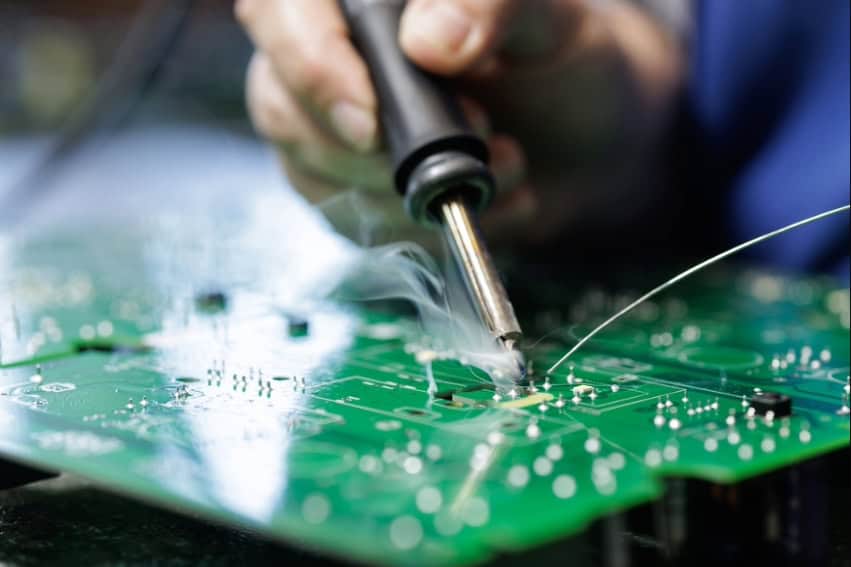
Mexico’s export revenue has increased significantly in 2026, in large part due to a sharp increase in the shipment to the United States of AI servers and other computer and electronic equipment. However, much of the content in such products is sourced from Asia, particularly Taiwan.
Gutiérrez said that Mexican value added in electronics sector exports to the United States is around 7% to 8% on average. That figure is well below the 44% of Mexican value added across all “Made in Mexico” exported products, per 2024 data.
According to a report by the news agency EFE, Gutiérrez said that the goal is to increase the Mexican — or at least regional — value added in electronic goods to “20, 30 or 40%, hand in hand with the United States and Canada.”
Gutiérrez said that Mexico, the United States and Canada are seeking to identify what additional inputs — for the electronics industry and other sectors — can viably be produced in North America.
“We’re working with the United States to develop a plan for a gradual transition,” he said.

According to EFE, Gutiérrez framed the initiative as part of Plan México, and said that the goal of reducing the reliance on imports from outside North America was being discussed in ongoing trade talks between Mexico and the United States.
Among the goals of Plan México, an ambitious economic development and industrial policy strategy unveiled by the federal government in early 2025, is to increase the use of domestically made content in products made by the Mexican automotive, aerospace, electronics, semiconductor, pharmaceuticals and chemicals industries.
As part of efforts to protect Mexican industry and ensure its ongoing viability, on Jan. 1 Mexico imposed new and higher tariffs on a wide range of goods from countries with which it doesn’t have free trade agreements. The tariffs apply to goods from China and Taiwan, among other countries, and have led to a reduction in imports across almost 1,500 product categories.
However, there are suspicions that some imports from Vietnam — which more than doubled in the first six months of 2026 — are in fact Chinese goods.
Mexico in Numbers: How much value does Mexico add to its exports?
Gutiérrez: Fourth round of Mexico-US trade talks has been postponed
After the American Society of Mexico event on Wednesday, Gutiérrez told reporters that a fourth round of trade talks between Mexico and the United States won’t take place next week as planned. The talks could instead be held in October, he said.
Gutiérrez attributed the postponement to scheduling conflicts related to Chinese President Xi Jinping’s visit to the United States and the upcoming G20 Summit, which will be held in Miami in December.
“We agreed with the United States that in the coming weeks we’ll announce when the fourth round [of talks] will be,” he said.
“… We’re working practically every day with the Office of the United States Trade Representative [and] with the Commerce Secretary [Howard Lutnick],” Gutiérrez added.
He said that Mexico is conducting the talks with the U.S. with a “cool head,” as advocated by President Claudia Sheinbaum.
“Our priority is reducing Section 232 tariffs on steel, aluminum and automobiles,” Gutiérrez said.
The United States imposed duties on Mexican steel, aluminum and vehicles last year. Nevertheless, a large majority of Mexico’s exports continue to enter the United States tariff-free under the USMCA free trade pact.
The ongoing trade-focused dialogue between Mexico and the United States is taking place after the Trump administration announced on July 1 that it had declined to renew the USMCA in its “current form.”
U.S. Trade Representative Jamieson Greer said at the time that the United States would “continue to engage with Mexico and Canada to address the Agreement’s shortcomings and our trade deficits with these countries.”
Despite the U.S. government’s decision not to renew the USMCA for an additional 16 years, the trade pact remains in effect.
Reuters reported that the current Mexico-U.S. “negotiations are seeking an interim bilateral bargain under which Mexico could win relief from some U.S. tariffs while addressing U.S. demands on areas including automotive content and Chinese investment.”
“… The negotiation agenda has expanded from 54 issues to nearly 90, which Gutiérrez described as the natural evolution of complex topics such as digital platform regulation,” the news agency reported.
With reports from EFE, Reuters and La Jornada