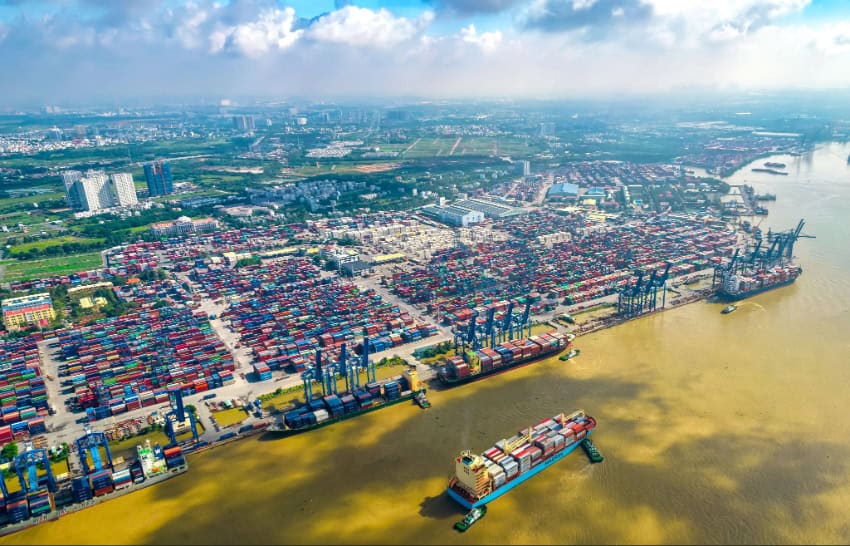
The value of Mexico’s imports from Vietnam more than doubled in the first six months of 2026, raising suspicions that Chinese goods are being passed off as Vietnamese goods to avoid steep tariffs when entering the country.
According to Bank of Mexico data, Mexico imported products worth US $18.4 billion from Vietnam between January and June, an increase of 103% compared to the same period of 2025.
The value of imports from Vietnam in the first six months of the year was equivalent to 82% of Mexico’s total outlay on Vietnam-sourced products in 2025. Imports from the Southeast Asian country totaled a record high of $22.37 billion last year.
Bank of Mexico data shows that Mexico’s imports from Vietnam have increased significantly since 2010. Mexico’s outlay on products from Vietnam last year was almost 26 times higher than in 2010, when goods worth $836 million came into the country from the Southeast Asian nation.
Mexico’s main imports from Vietnam are currently tech products such as electronic circuits, telephones, computers and machinery parts, according to the news outlet Expansión.
The sharp increase in imports from Vietnam in the first six months of 2026 came after Mexico, on Jan. 1, imposed new and higher tariffs on goods from China and other countries with which it doesn’t have free trade agreements.
Vietnamese goods can enter Mexico tariff-free as both Vietnam and Mexico — along with 10 other countries including the United Kingdom, Japan, Canada and Australia — are signatories to the Comprehensive and Progressive Agreement for Trans-Pacific Partnership, or CPTPP for short.

Vietnamese or Chinese?
Expansión noted that if a Chinese product only goes to Vietnam to be relabeled as Vietnamese or to undergo “a minor process before arriving in Mexico,” it shouldn’t qualify for tariff-free status under CPTPP.
“The risk arises when customs controls don’t differentiate between legitimate [Vietnamese] manufacturing and insufficient transformation” of a Chinese product in Vietnam, Expansión reported.
The United States — which has imposed very high tariffs on imports from China during a long-running trade war with the East Asian nation — has identified Vietnam as a transshipment hub for Chinese goods. In “The Great Transshipment Scam,” a report published by the White House this month, Vietnam is listed among countries on “Tier 2” of a “shadow transshipment network.”
Countries are listed on “Tier 2” if they show “significant transshipment volumes combined with deeper integration into China-linked supply chains, input sourcing, manufacturing platforms, logistics systems, or regional rerouting channels.”
The same report identifies Mexico as a “Tier 1” country in the so-called “shadow transshipment network,” with “large absolute volumes of China-linked goods; diversified industrial bases and major U.S.-bound export platforms where transshipment risk is embedded within broad legitimate trade flows.”
The U.S. government’s argument is essentially that Mexico facilitates the tariff-free entry of Chinese goods to the United States. Given that Mexico imposed new and higher tariffs on imports from China this year — a move aimed at protecting Mexican industry but also widely seen as an attempt to placate the U.S. — Chinese exporters now have added incentive to route Mexico-bound goods through third countries that have free trade agreements with Mexico, such as Vietnam.
This practice — if it is indeed occurring — would undermine Mexico’s efforts to protect its domestic industries. Mexican industry, Expansión reported, is concerned about Chinese companies with export-oriented operations in Vietnam, even though many manufacturing companies that operate in Mexico use Chinese inputs due to their low cost, or because no alternatives are made locally or within the region.
In its report, the White House said that “every year, the United States loses tens of billions of dollars to the illegal transshipment of goods from higher-tariff countries through more than 40 lower-tariff jurisdictions before those goods enter the American market.”
Congress approves new tariffs on goods from China and non-FTA countries
“Historically, much of this activity has involved Chinese-origin goods,” the report added.
U.S. President Donald Trump has long accused Mexico of being a transshipment hub for Chinese goods that eventually enter the United States. Mexico has denied that claim.
Although Trump has imposed tariffs on various Mexican goods, including vehicles, steel and aluminum, the majority of Mexico’s exports to the U.S. enter that country tariff-free under the USMCA free trade pact. Mexico — where a significant number of Chinese companies have opened plants in recent years — is thus an attractive “back door” to the United States.
Meanwhile, the Vietnamese Foreign Ministry said on Thursday that Vietnam would continue to address U.S. concerns about the transshipment of goods in a constructive manner, according to Reuters.
With reports from Expansión