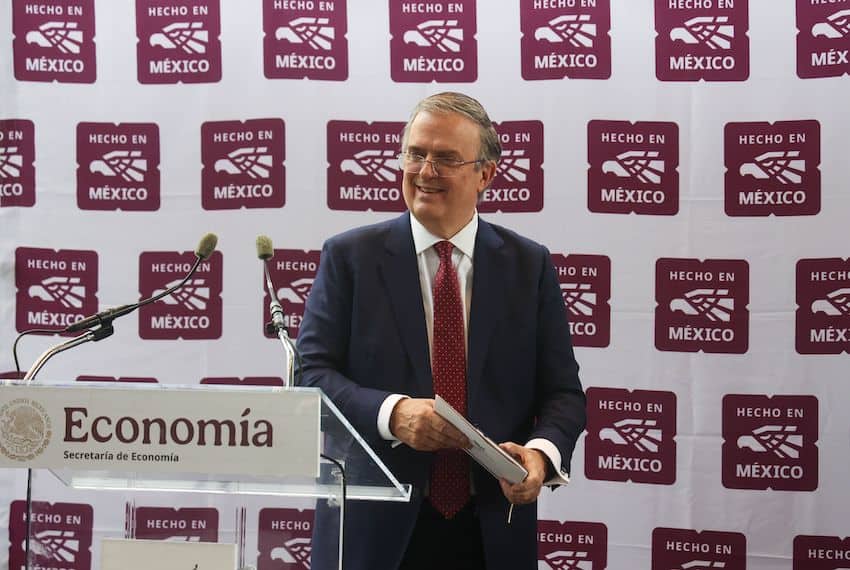
Mexico has formally notified the United States and Canada that it wishes to extend the USMCA free trade pact for an additional 16 years to 2042.
Separately, Canada notified Mexico and the United States on Tuesday that it also wants the trilateral pact to be renewed until 2042.
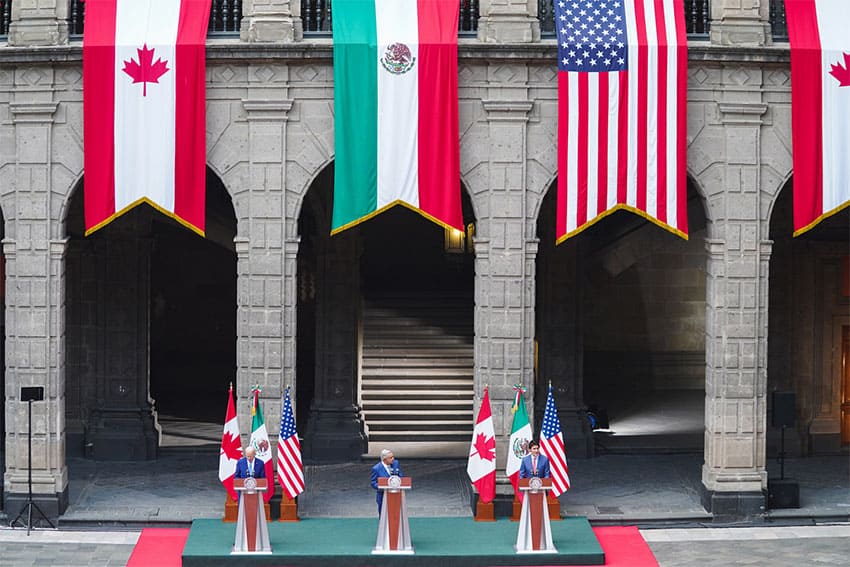
Mexico and Canada’s notifications to their North American trade partners came as USMCA review talks continue. A formal trilateral review process is set to take place later this year.
In a June 1 letter addressed to U.S. Trade Representative Jamieson Greer and Canadian Trade Minister Dominic LeBlanc, Mexico’s Economy Minister Marcelo Ebrard wrote that the Mexican government’s public consultations on the USMCA revealed a “positive perception” toward the three-way trade pact “as an instrument that fosters economic stability and provides legal certainty, and as an engine for the attraction of foreign direct investment.”
Ebrard also wrote that those consulted were in favor of maintaining the USMCA and continuing to strengthen “regional production chains” and “trilateral cooperation in various fields.”
In addition, “sectors consulted” expressed their opposition to the United States’ Section 232 tariffs on steel and aluminum and spoke about “the importance of strengthening the resilience of supply chains in the face of global and trade changes,” the economy minister told Greer and LeBlanc.
Ebrard also wrote that “almost six years after the USMCA took force, Mexico reaffirms its commitment to the shared prosperity of North America.”

“However, continuing this economic growth will only occur by providing economic certainty to investors who seek our market strength. Consequently, Mexico’s position is to extend the agreement for 16 additional years and to seek agreements that benefit … the three nations,” he wrote.
Ebrard confirmed on Tuesday that the letter had been sent to Greer and LeBlanc.
“Mexico’s intention and position is that the treaty should be extended,” he said at an event with Spanish Minister of Economy, Trade and Enterprise Carlos Cuerpo.
“Keep in mind that the treaty will remain in effect for many more years, but we would like it to be extended to 16 years,” Ebrard said.
Meanwhile, LeBlanc said in a letter to Ebrard and Greer that the USMCA is “highly beneficial to each of our countries and to the integrated North American economy.”
U.S. officials have been less enthusiastic than their Mexican and Canadian counterparts when speaking about the trade agreement that superseded NAFTA on July 1, 2020.
In January, U.S. President Donald Trump said the free trade pact — which governs around US $2 trillion in annual trade — provides “no real advantage” to the United States and is “irrelevant” to him.
“We could have it or not, it wouldn’t matter to me. I think they want it, I don’t really care about it,” Trump said.
Trump says he doesn’t care about USMCA; Sheinbaum says US businesses do
Even if Mexico, the United States and Canada don’t reach an agreement to extend the pact during the upcoming review process, the earliest it could be terminated would be 2036.
According to the Associated Press, LeBlanc has said “he believes the U.S. might want to have the trade agreement subject to annual reviews, and that the Trump administration might seek to cause uncertainty about the trade pact’s permanence.”
Mexico-US trade talks
Ebrard sent his letter to Greer and LeBlanc three days after Mexico and the United States concluded their first formal round of USMCA review talks.
“The technical teams from both countries, working in coordination, made steady progress on an agenda aimed at strengthening the region’s competitiveness. During this first round, priority issues for the regional economy were reviewed: rules of origin for the automotive sector, steel and aluminum, and the region’s economic security,” the Economy Ministry said in a statement.
“Mexico reiterated that the … [USMCA’s] strength lies in the integration of its value chains and in the rules that have made North America the world’s most competitive manufacturing platform,” the ministry said.
The Office of the United States Trade Representative (USTR) issued a similar statement at the conclusion of the bilateral talks in Mexico City.
“The United States concluded discussions with the goals of reducing the trade deficit with Mexico and strengthening American supply chains. During this first round, negotiators discussed priority issues related to automotive rules of origin, steel and aluminum, and economic security,” USTR said.
“The United States and Mexico recognize the importance of advancing cooperation to enhance regulatory compatibility to strengthen sectors, including medical devices, pharmaceuticals, cosmetic products, and others,” Greer’s office said.
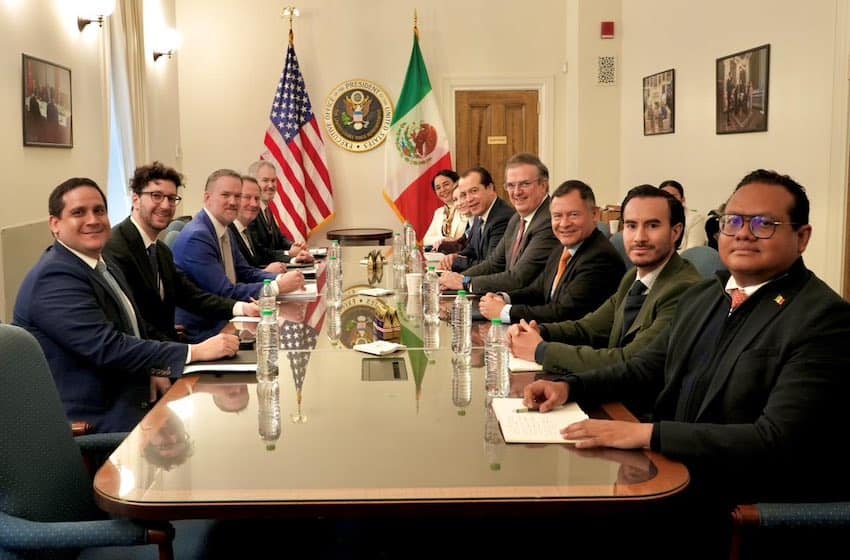
A second round of bilateral discussion is scheduled to take place in Washington, D.C., on June 16 and 17.
Among Mexico’s top goals is to win a reprieve from the tariffs that the United States imposed last year on Mexican steel, aluminum and vehicles. Mexico’s exports to the United States have increased despite the United States’ protectionism, but the U.S. tariffs have been an impediment to the Mexican automotive sector’s export growth.
Still, Mexico’s trade with the United States largely remains tariff-free as most exports comply with USMCA trade rules.
Economy Ministry: USMCA-compliant exports won’t be subject to the United States’ proposed ‘forced labor’ tariffs
The USTR announced on Tuesday that Trade Representative Greer was proposing to impose 10% or 12.5% tariffs on products from 60 countries, including Mexico, that were investigated and determined to have failed to “impose and effectively enforce a prohibition on the importation of goods produced with forced labor.”
That failure, the USTR said, “is unreasonable and burdens or restricts U.S. commerce, and are thus actionable under Section 301(b) of the Trade Act.”
Greer said that “the failure of our most important trading partners to address the importation of goods made with forced labor is unacceptable.”
“This creates a dynamic where American workers are forced to compete globally on an un-level playing field. We will no longer tolerate this disparity. Some trading partners have taken initial steps to prevent the importation of forced labor goods, including through USMCA and commitments in Agreements on Reciprocal Trade. However, each of our trading partners must do more to ensure that trade does not perversely encourage and entrench forced labor globally,” he said.
The Mexican Economy Ministry (SE) said in a statement on Tuesday that the USTR was proposing a 10% tariff on imports from Mexico and 13 other economies including the European Union, Canada, the United Kingdom and Argentina.
The SE said that it would present arguments against the proposed 10% tariff on Mexican products, and on Wednesday announced that the proposed duty — if enforced — would not apply to USMCA-compliant goods.
“Following consultations with the USTR today, the Ministry of Economy has confirmed that goods that comply with the rules of the United States-Mexico-Canada Agreement (USMCA) would be exempt from the potential application of the proposed tariff on 60 countries as part of an investigation conducted under Section 301,” the ministry said.
“… The proposal does not provide for immediate implementation, but rather initiates a 45-day consultation period,” the SE said.
“In consultations held today, it was clarified that Mexican trade that complies with USMCA rules of origin — approximately 85% of our export volume — is exempt from the measure. Nor would it affect goods covered by [Section] 232 orders (vehicles, steel, and aluminum),” the SE said.
“Regarding the remaining 15 percent of Mexican exports, the Ministry of Economy will hold formal discussions with the USTR over the next 45 days, including a formal round of talks as part of the [USMCA] review to be led on the Mexican side by Minister Marcelo Ebrard, during which information will be presented on Mexico’s commitment and actions against forced labor,” the ministry said.
With reports from La Jornada, Reforma, BBC and Reuters