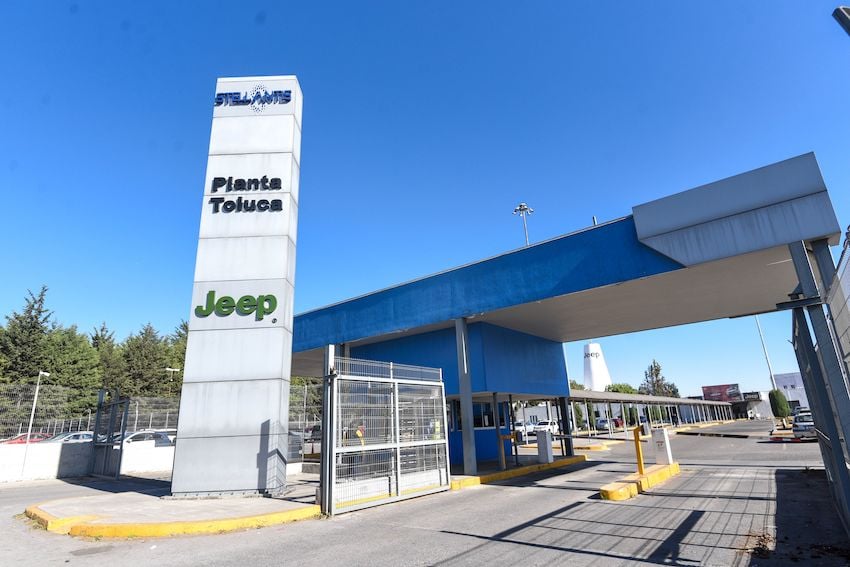
After cracking the top five of global automotive manufacturers in 2024, Mexico has lost its grip on that elite ranking, a victim, it is believed, of U.S. President Donald Trump’s imposition of tariffs on cars and heavy trucks.
The International Organization of Motor Vehicle Manufacturers (OICA) reported on Wednesday that the two countries that Mexico had surpassed in 2024 — South Korea and Germany — had scrambled back up to the fifth and sixth position, producing 4,102,200 and 4,148,836 cars in 2025, respectively.
Mexico took seventh place, producing 4,092,488 units, 2.6% fewer than in 2024.
China is the leading auto manufacturer in the world, producing 34,530,738 units (up by 10.4% over 2024), followed by the United States, with 10,243,844 (-2.6%); Japan, with 8,410,232 (+2.1%); and India, with 6,490,810 vehicles.
In April 2025, the United States implemented a 25% tariff on light vehicle imports, which was followed by a 25% tariff on auto parts in May. Then, in November, it introduced a 25% tariff on heavy truck imports and a 10% tariff on bus imports.
While the 25% tariff is only levied on the non-U.S. content in exported vehicles, the total tariff rate still stands at around 15%.
As it introduced higher tariffs on Mexico’s auto industry, the United States reached agreements with various countries to lower tariff rates to 15%, from around 30% to 40% previously. This has made other countries, such as Japan, South Korea, and the European Union, more competitive.

Mexico also attracted less gross fixed investment in its heavy vehicle sector last year.
Heavy truck assembly in Mexico decreased by 34.8%, to 138,954 units, representing almost 75,000 fewer vehicles, according to figures from Mexico’s National Institute of Statistics and Geography. Meanwhile, light vehicle manufacturing fell by 0.9%, to 3,953,494 units.
North America’s share of global automobile production decreased from 17.3% to 16.2% in 2025, while Asia-Oceania’s share rose from 59.3% to 61.4%, with China alone increasing its share from 33.7% to 35.8%.
With reports from El Economista