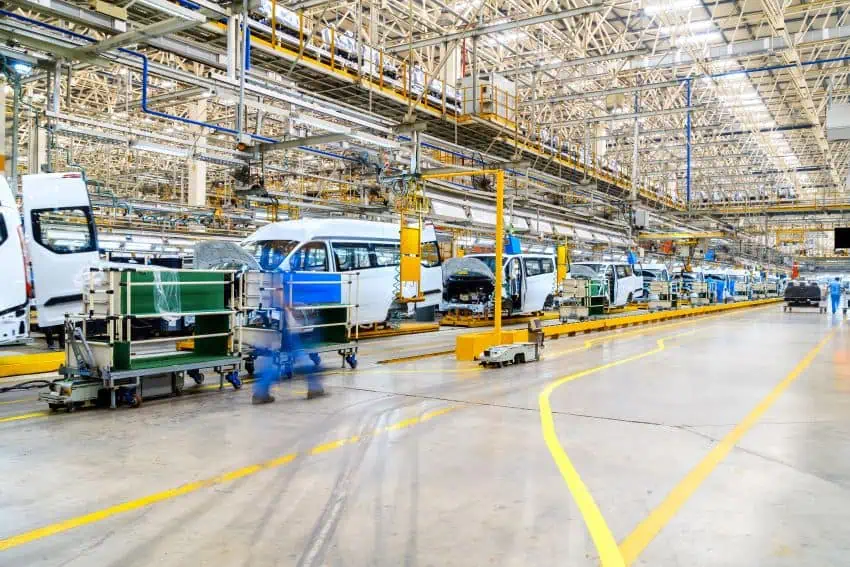
Despite heavy tariffs imposed on several Mexican products by the United States, the border state of Nuevo León continues to attract investment to its auto parts sector owing to a free trade agreement exception for the industry. However, some companies are now choosing to downplay their Mexican ventures and skip splashy investment announcements, according to state officials.
U.S. tariffs on a range of Mexican goods, including 25% levies on steel and aluminum, have made companies wary of investing in Mexican industry and nearshoring. However, Mexico’s auto parts sector is exempt from U.S. tariffs so long as companies comply with regional content requirements outlined in the USMCA free trade agreement.
The USMCA requires automakers to adhere to strict rules of origin. Companies can avoid paying tariffs when exporting in North America if they produce 75% of the value of cars, light trucks and essential auto parts with components from the USMCA region.
This exception has helped Nuevo León to maintain high levels of foreign direct investment (FDI) in the sector, albeit more discreetly. Several companies investing in the state have chosen not to make public investment announcements in recent months, to avoid unwanted attention.
“There are many companies that tell us, ‘I’m going to wait [to make the announcement],’” Emmanuel Loo, the deputy minister of investment and innovation at the state Economy Ministry, told the newspaper El Economista.
“They are new companies that have arrived in the state and are already building and hiring staff… They tell us, ‘I don’t want to say, because of the tariff issue… Hey, I’m investing in Nuevo León. Please don’t put me in the spotlight because they’ll make an example of me later.’”
Some companies have been more successful at adhering to USMCA measures than others. Kia Mexico, for example, uses around 98% regional content.

However, several German car brands that export from Mexico rely heavily on supplies from Europe. Previously, they paid a 2.5% tax for these imports, but many have now been hit with 25% U.S. tariffs, according to Loo.
Nuevo León has recorded higher levels of FDI so far this year than previous year, with US $2.7 billion in the first quarter of 2025, compared to US$2.5 billion in the whole of 2023 and $2.1 billion in 2024.
“We are almost at the same level as [the whole of] last year in FDI,” stated Loo.
“We know this will continue. Yesterday I visited three companies; workers will be contracted for 3,000 jobs. We are still experiencing the effect of nearshoring, but each time it is with greater added value, and creating high-impact jobs.”
The state government reported that since 2021, over 400 investments totaling more than $73 billion have been announced in Nuevo León, many of which are in varying stages of development and may not yet appear in federal records.
With reports from El Economista