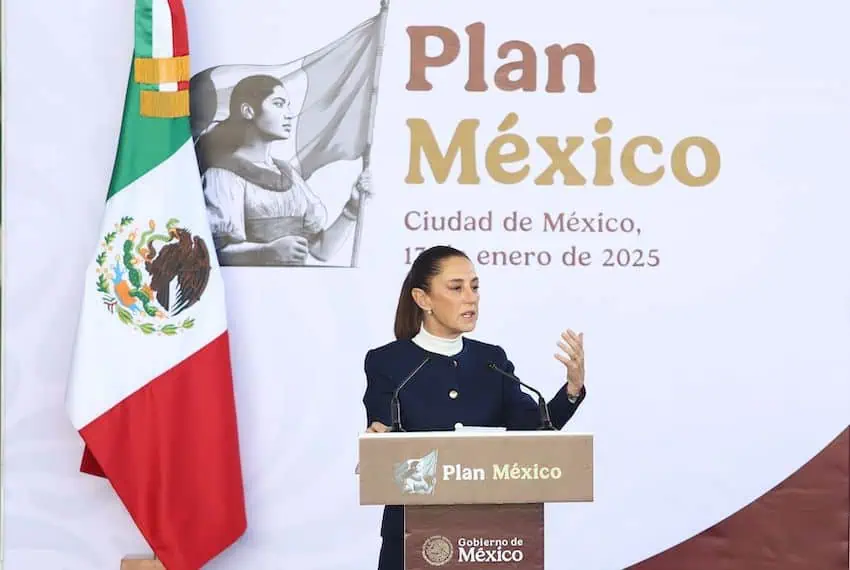
On Monday, what was announced last week at the meeting of Mexico’s Economic Development Advisory Council was presented by President Sheinbaum. Plan México represents the vision of industrial policy that this administration seeks to promote through investment incentives and collaboration between the government and the private sector.
The plan acknowledges key areas to focus on, but the challenges for its implementation are significant.
The plan proposes to strengthen micro, small- and medium-sized enterprises. In Mexico, small businesses have a short life span.
The National Institute of Statistics and Geography (Inegi) has observed that companies in Mexico die before they are able to start growing and strengthening them will require more than just good intentions. A small business, in which a group of individuals risk their capital, needs social and economic conditions that go beyond just subsidies or fiscal favors.
These companies are more susceptible to extortion. In this sense, the simplification of paperwork — also contemplated in Plan México — becomes key.
Each procedure, and each window to carry it out, opens a door to be extorted. If extortion from organized crime is added to the extortion involved in red tape, the yield required by small businesses becomes increasingly higher. This cost takes companies out of the market that could have grown, but the lack of rule of law forces them to close. Yes, let there be better regulation, but it has to be the right kind.
The plan also intends to build stronger links between educational institutions and the industrial sector. Undoubtedly, the conversation between the two — and I would add the public sector — is essential to understanding the current and future needs of companies. Without human capital, it will be impossible to add more value. The most competitive states in the country have the strongest links between the three sectors.

One of IMCO’s most emblematic studies — Compara Carreras (Compare Degrees) — shows that the ten most studied bachelor’s degrees in Mexico have stayed practically unchanged over the last ten years. The world is changing, the country is changing and education is not adapting. Will this administration be able to turn around the educational policy that it has pursued in recent years?
The idea of import substitution, however, is what we need to pay even more attention to. Of course, supply chains must be strengthened, companies of all sizes must be given the necessary certainty so that they can risk their capital under the best possible conditions, and the private sector must be allowed to evaluate the investments to be made. But we must not give in to the argument that everything must be produced locally. This would squander comparative advantages and would result in the misallocation of resources, labor and capital, in a way that would not be most useful to society.
The import substitution that prevailed during several decades of the last century led the country into a situation where there were hundreds of public companies because, over time, the lack of entrepreneurial expertise was rewarded. If the private bicycle company went bankrupt, the government intervened by injecting resources.
The government of President Claudia Sheinbaum, if it wants this plan to be successful, will have to be careful not to go to extremes. Provide infrastructure, energy and rule of law. But in addition — and perhaps this is the biggest challenge — it will need to work under a new judicial system that could make it very expensive to attract investment.
Domestic challenges are many, but on top of everything else, the start of Trump’s second term in office is just days away.
This article was translated, edited and republished with the permission of Valeria Moy, whose column regularly appears in the newspaper El Universal.