



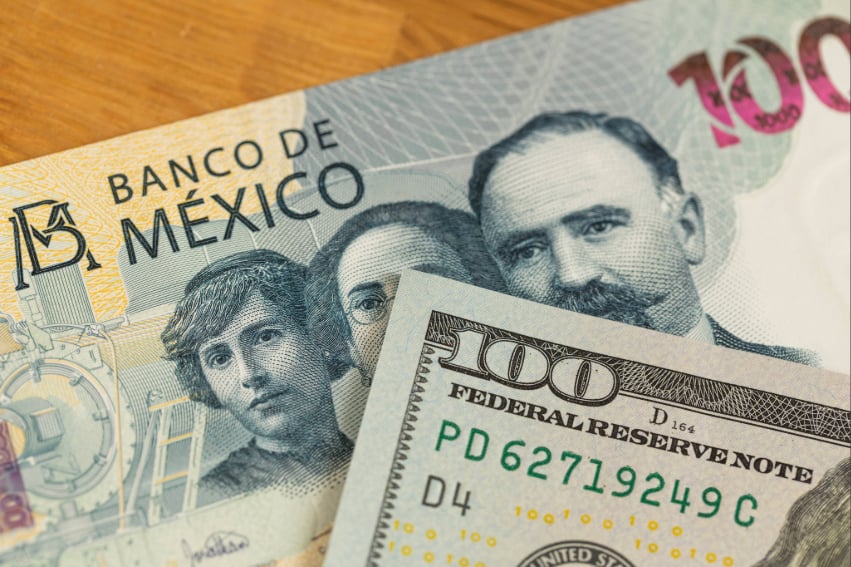
After seven consecutive days of decline, the Mexican peso appreciated early on Friday, though trading volume is typically much lower on Black Friday than on a standard business day.
The peso fell to its worst level since April 2015 on Thursday, closing at 19.72 to the U.S. dollar, while depreciating 7.01% during the seven-day losing streak. It has fallen nearly 14% over the past three months and was down 9.54% on the year.

The peso initially climbed 0.64% to 19.57 shortly after opening, but had weakened to 19.657 by 5 p.m.
Banco Base expects the peso to end its losing streak and trade between 19.49 and 19.69 per dollar in a session of reduced liquidity, due to the partial reopening of U.S. capital and bond markets after the Thanksgiving holiday.
Mexico’s currency had not experienced such a prolonged negative stretch since the period from Aug. 31-Sept. 8, 2023, although the depreciation then was less severe (5.07%).
Analysts attribute the losing streak to investors unwinding carry-trade positions and shifting into safe-haven assets.
The carry-trade is a strategy where an investor borrows money at a low interest rate (in this case, the U.S. dollar) and invests it in an asset offering a higher rate of return (the Mexican peso), thus profiting from the interest rate gap.

However, Mexico’s central bank (Banxico) has embraced a policy of monetary easing. And when it cut its benchmark interest rate by 25 basis points to 6.25% in early November just two months after the U.S. Federal Reserve raised its rate from 3.75% to 4%, the interest rate gap narrowed to 225 basis points, a historic low.
At the same time, markets are pricing in potential U.S. Federal Reserve hikes (it is widely expected to raise its rate again at its Dec. 8-9 meeting), expecting the yield cushion that made the peso attractive to narrow even further.
Meanwhile, persistent U.S. inflation, strong U.S. growth and broader risk-off sentiment have boosted demand for the U.S. dollar as a safe haven.
Some strategists expect elevated volatility heading into the Fed’s upcoming policy meeting and see potential for the peso exchange rate to surpass 20 to the dollar before stabilizing or drifting lower toward 18.50 in 2027.
However, headline inflation in Mexico neared 4.0% in the first half of November, which alongside tariff and trade uncertainty, complicates Banxico’s policy path, though it is not expected to lower its rate at its Dec. 17 meeting.
With reports from Reforma, El Financiero and La Jornada