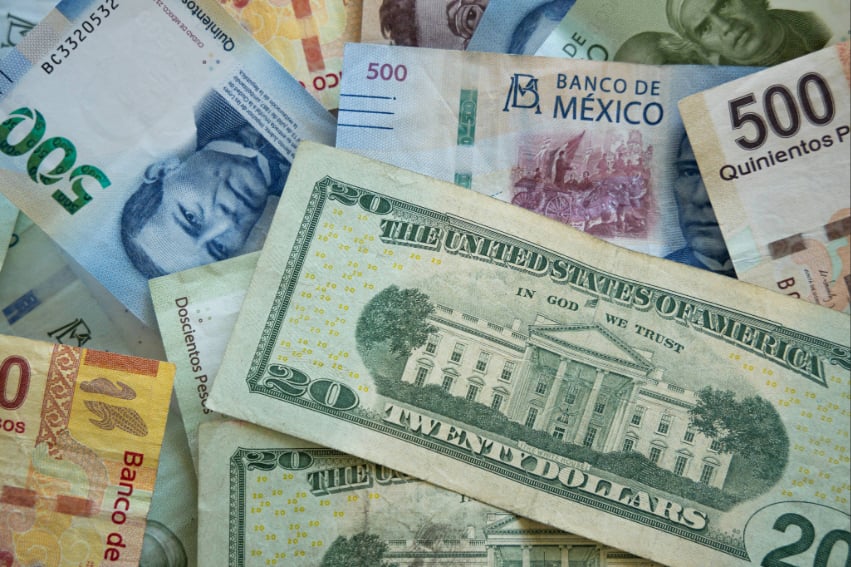
The peso depreciated on Friday morning and was on track for its worst weekly performance since March, as traders continued to react to the U.S. Federal Reserve’s decision to raise interest rates.
The tightening of U.S. monetary policy has eroded the appeal of assets denominated in local currency, a trend that became evident as soon as the Fed announced its decision on Wednesday morning.

The peso had weakened to 17.32 to the dollar Friday morning, and hovered at 17.229 to the dollar by 2:00 p.m., down nearly 6 centavos from Thursday’s close of 17.1706. Market analysts projected a trading range of between 17.08 to 17.28 pesos per dollar for Friday’s session.
The Fed’s decision on Wednesday to raise its benchmark rate by 25 basis points, bringing it to a range of 3.75% to 4%, interrupted an eight-month pause that saw the U.S. rate remain between 3.50% and 3.75% since December.
The peso lost 0.58%, or 10 centavos, against the dollar that same afternoon.
Gabriela Siller, director of Financial Analysis at Banco BASE, said the fall of the peso is directly linked to the Fed decision, as well as the possibility of another rate cut in the United States this year.
“This is relevant because of carry trade operations, where the interest rate differential between Mexico and the U.S. is important,” she said.

The carry trade is an investment strategy in which investors borrow money in a currency with a low interest rate to invest in another currency or asset with a higher rate.
“With the rate cut, traders get a lower return, because the rate differential is the net return after paying off the loan,” Siller explained.
The Fed’s decision reduced the interest rate differential between Mexico and the U.S. to 250 basis points, a historic low not seen since December 2015. Mexico’s benchmark rate sits at 6.5% and the Bank of Mexico is expected to hold the rate steady at its meeting next week.
If the Fed announces another rate hike before the end of the year, as anticipated, this differential will be at 225 points, representing even lower returns for investors.
As such, the peso’s value would be impacted by the relative unattractiveness of peso-denominated investments.
These expectations are also related to the recent inflation trend in Mexico.
As of August, inflation stood at 3.26%, remaining within the central bank’s target range, a situation that contrasts with the United States, where inflationary pressures remain more persistent, suggesting the Fed will continue with a more aggressive posture.
With reports from El Economista, Forex.com and El Financiero