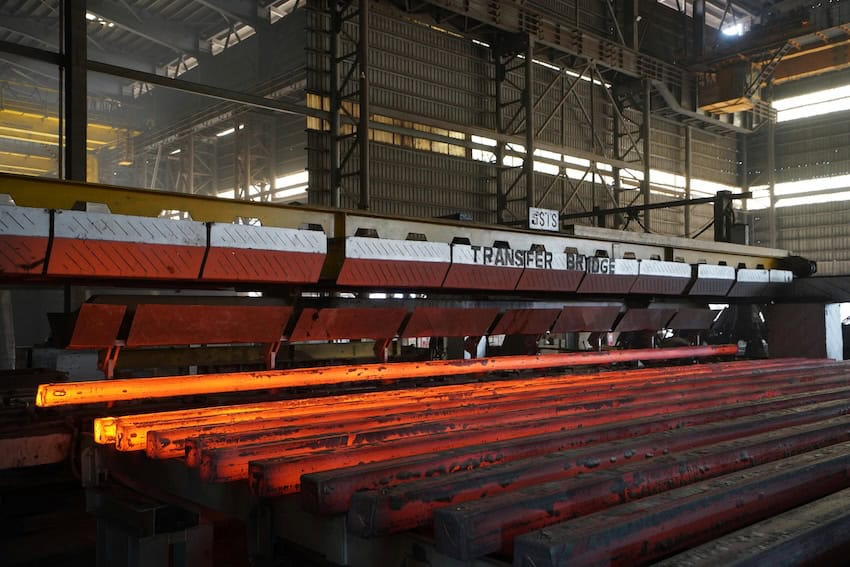
In an international market pressured by oversupply and competition from Chinese steel, the steelmaker Ternium is nearing completion of one of its largest industrial projects in Mexico — a US $7.51 billion expansion of its complex in Pesquería, Nuevo León.
Maximo Vedoya, president of the Latin American Steel Association (Alacero) and CEO of Ternium, said the completed project will add 2.6 million tonnes of steelmaking capacity starting in 2027.
Steel company Ternium to invest additional US $4B in Nuevo León
At last week’s inauguration of the Alacero Summit 2026 in Mexico City, Vedoya said Ternium aims to enhance its ability to serve demand from the automotive, construction and energy sectors in Mexico while contending with stiff Chinese competition.
Vedoya said one solution is to increase the regional steel content in Asian cars.
“If Chinese cars continue to arrive without any regional content, it will be difficult to increase … investment in the industry and the value chain,” he added.

Vedoya said the Latin American steel industry is battling against the inroads Chinese companies have made, allocating US $22 billion in the last five years and, in an effort to defend local manufacturing, Alacero members intend to invest $13 billion more through 2030.
This includes investment in small and medium-sized enterprises to improve their added value and integration into supply chains.
At the same time, Mexico has taken steps to reduce Asian steel imports by imposing tariffs and control measures on the entry of steel from countries with which it does not have free trade agreements.
Speaking at the summit, Luis Rosendo Gutiérrez, Mexico’s undersecretary of foreign trade, said metal imports have decreased thanks to the required traceability of steel products. Tracing helped to reduce 80% of the steel imports from Vietnam, he said, putting a stop to 13 billion pesos (nearly US $700 million) in falsified imports that can now be supplied by the domestic industry.
Participé en el @RedAlacero Summit 2026 junto a Máximo Vedoya, @Ternium; y @AMalagonB, presidente de @CONCAMIN.
La industria del acero es estratégica para México y para la integración productiva de Norteamérica. Trabajamos para fortalecer la cadena de valor, promover un comercio justo, garantizar que NO exista “transhipment” o triangulacion de importaciones de Asia-Exportaciones de México, y atraer más inversión y empleo con el Plan México. 🇲🇽 @CANACERO
@m_ebrard @Claudiashein @SE_mx— Luis Rosendo Gutiérrez (@LuisRosendo_) November 12, 2026
So while imports from China and other Asian countries fell by 30% since last year, Gutiérrez expressed hopefulness that U.S. tariffs on Mexican steel will soon be reduced from 50% to zero.
Vedoya said that although U.S. tariffs on steel products affect all Latin American countries, they have a greater impact on Mexican exports, claiming that the sector faces unfair trade in finished products and throughout the value chain.
Meanwhile, Vedoya said regional investment will focus on technological innovation, decarbonization and technical training for local talent.
With reports from El Economista, Informador, Expansión and Milenio