India and Mexico signed the Terms of Reference (ToR) for negotiations on a Preferential Trade Agreement (PTA) on Monday, as the two nations seek to expand bilateral trade and investment.
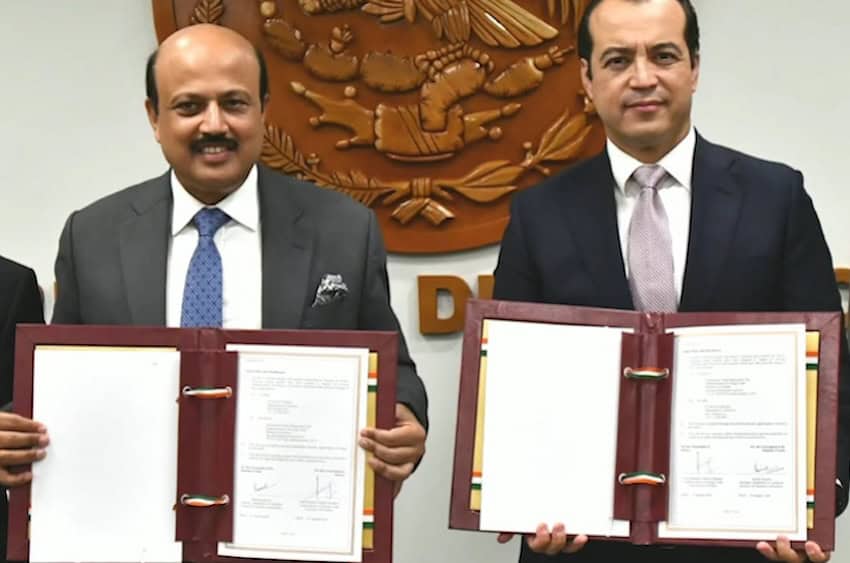
Mexico’s Deputy Minister of Foreign Trade Luis Rosendo Gutiérrez Romano and India’s Commerce Secretary Rajesh Agrawal signed the ToR, which sets out a roadmap for negotiations, during Agrawal’s official visit to Mexico.

The move advances an understanding reached by President Claudia Sheinbaum and Indian Prime Minister Narendra Modi on the sidelines of the G7 Summit in Canada in June 2025 to strengthen the bilateral partnership.
“India and Mexico are ready to turn untapped potential into tangible prosperity through balanced, ambitious and mutually beneficial negotiations,” the Indian Embassy wrote on the X social media site on Monday.
The proposed agreement includes key areas, such as market access for goods, rules of origin, customs procedures, trade facilitation, dispute settlement, sanitary and phytosanitary measures, technical barriers to trade and trade remedies.
Both countries are aiming to develop a “mutually beneficial and balanced PTA,” India’s Department of Commerce stated, emphasizing that Mexico is an important market for Indian exporters and investors.
Merchandise trade between India and Mexico totaled US$8.74 billion in 2024, with $5.73 billion in Indian exports and $3.01 billion in Mexican exports, resulting in a $2.72 billion trade differential, according to data from the Directorate General of Commercial Intelligence and Statistics.

The development of a PTA will help expand bilateral trade, create business opportunities, boost investment flows and strengthen supply chains. Potential areas of cooperation include automobiles, chemicals, electronics, pharmaceuticals, agri-food, energy, critical minerals, medical devices and advanced manufacturing.
In a February meeting between Mexico’s Economy Minister Marcelo Ebrard and India’s Ambassador to Mexico Pankaj Sharma, the two officials also highlighted the need to foster greater cooperation in priority sectors such as science, technology and digitalization.
During the recent visit, Gutiérrez Romano and Agrawal discussed a potential Mexican business mission to India in the first quarter of 2027 to help identify commercial opportunities and further strengthen ties.
In 2024, India’s primary exports to Mexico included light vehicles, with a value of US $880 million, motorcycles ($390 million), base metals ($760 million), auto parts ($740 million), mechanical machinery ($460 million) and textiles and clothing ($410 million).
Meanwhile, Mexico’s main exports to India included crude petroleum oil ($1.7 billion), smartphones ($270 million), and gold ($170 million).
With reports from CNCV TV18