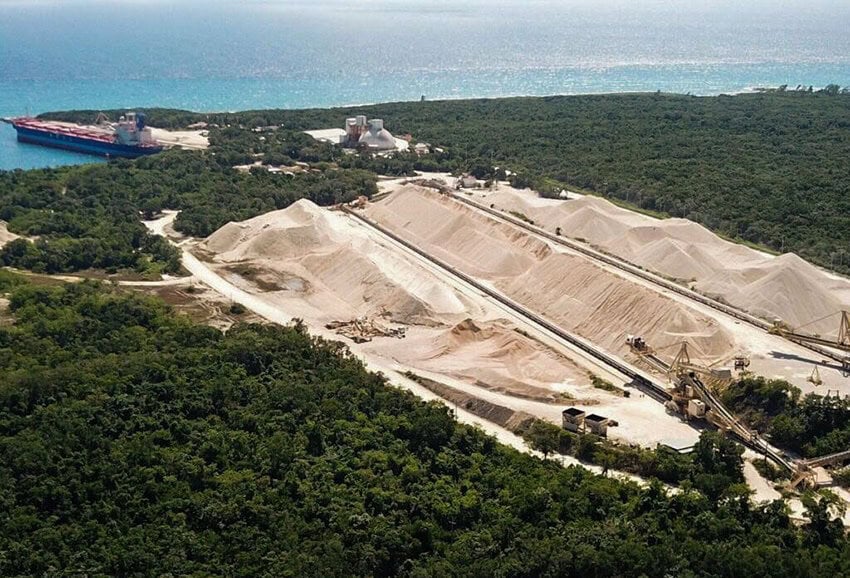
Mexico could offer new sites of operation to U.S. mining company Vulcan Materials in a bid to settle a long-running dispute, President Claudia Sheinbaum said this week as Mexico faces a fresh wave of pressure from the United States over what the company calls the “expropriation” of its land in Mexico.
The U.S. House of Representatives this week approved legislation to protect U.S. business assets abroad. The bill — now pending a Senate vote — was proposed by Texas Congressman August Pfluger, who has acknowledged that the initiative was inspired by the Vulcan Materials case in Mexico.
Dubbed the Act to Protect American Companies Abroad, the bill could lead to sanctions for the Mexican government after it closed the company’s port and limestone quarry in Quintana Roo in 2023, and declared the land a Protected Natural Area (ANP) two years later.
President Sheinbaum recently said that her administration is seeking new land where Vulcan Materials can continue its operations.
The Environment Ministry confirmed Sheinbaum’s claim and clarified that Vulcan Materials’ assets in Mexico, including its maritime terminal, “remain the property of the company.”
“The Mexican government maintains an open and good-faith dialogue with the company to find solutions that provide legal certainty and guarantee environmental protection,” the Ministry said.

It said the mining restrictions are due to the declaration of the “Felipe Carrillo Puerto” Protected Natural Area, in accordance with the Mexican legal framework.
The Alabama-based company has a different position. In 2024, Vulcan Materials said that the Mexican government’s decree constituted a de facto expropriation of its properties on Mexico’s Caribbean coast and that the measure violated the United States-Mexico-Canada Agreement (USMCA).
The Mexican government has also argued that the company’s operations caused an “ecological disaster” in the area it was authorized to mine.
At her Tuesday morning press conference, Sheinbaum said her proposal to find new sites for Vulcan Materials would allow the company to continue operating in Mexico, ending a years-long conflict.
“Mining could no longer take place in the Protected Natural Area. There are some mines located elsewhere that the Environment Ministry would have to analyze to determine if their operation is feasible, or if there is some other mechanism to avoid the controversy and reach an agreement,” she said.