Mexico’s annual headline inflation rate declined for an eighth consecutive month in September, but remains above the central bank’s target.
Annual inflation was 4.45% in September, the national statistics agency INEGI reported Monday.
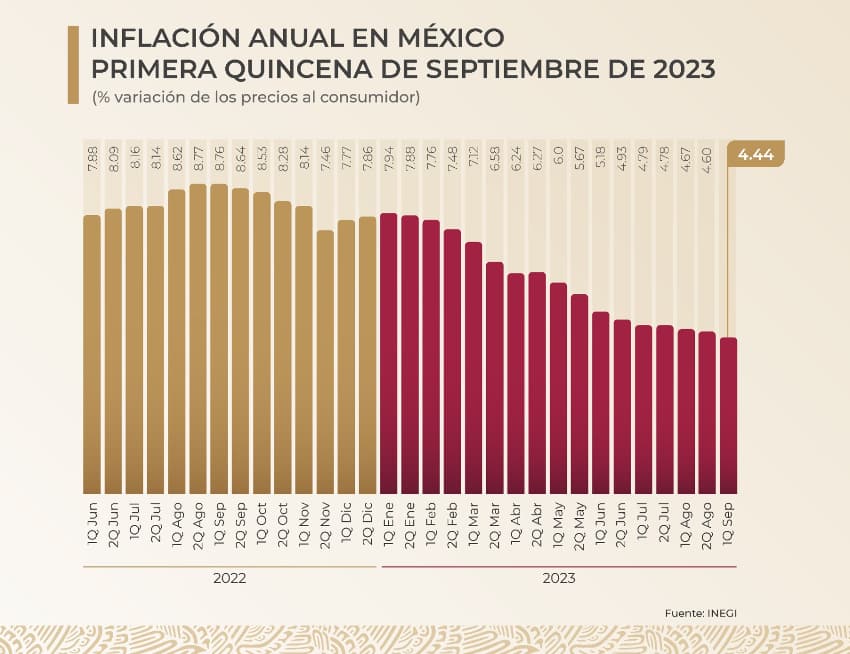
That rate – the lowest since February 2021 – is 0.19 percentage points lower than the 4.64% rate recorded in August. Month-over-month inflation was 0.44%, INEGI said.
The annual core inflation rate, which excludes volatile food and energy prices, was 5.76% in September, down from 6.08% in August.
Andres Abadia, chief Latin America economist at Pantheon Macroeconomics, said that the decline in inflation was “thanks to the lagged effect of tighter financial conditions, the impressive MXN rebound in recent months” – although the peso has lost value in October – “and lower raw-material prices.”
INEGI noted that in September last year, annual headline inflation was 8.7%. While inflation has declined every month since February, the headline rate remains above the Bank of Mexico’s target of 3% with tolerance for one point in either direction.

The central bank late last month decided to keep its benchmark interest rate at a record high 11.25% due to persistent inflation and a “very complex” outlook. The bank has said on repeated occasions that “it will be necessary to maintain the reference rate at its current level for an extended period” in order to bring inflation down to its 3% target.

Jason Tuvey, deputy chief emerging markets economist at Capital Economics, said that the latest INEGI data “reinforces” the view that “an easing cycle will not begin until early next year.”
Once rates start to fall, they “will come down slower than the consensus anticipates,” he predicted.
What fueled annual inflation in September?
INEGI data shows that goods in general were 6.2% more expensive last month than in September 2022. Within that category, processed food, beverages and tobacco prices were up 7.57%, while those for non-food goods rose 4.59%.
Fruit and vegetables were 6.75% more expensive in annual terms, while meat prices ticked up 0.33%.
Services were 5.23% more expensive, housing cost 3.58% more and private school fees increased 6.59%.
Energy prices, including those for gasoline and electricity, fell 1.71% compared to September 2022.
Pricey limes, cheap chayotes
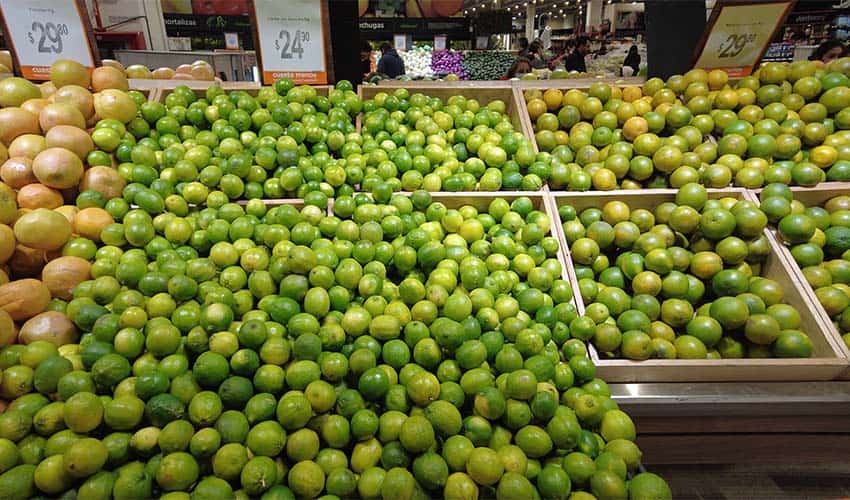
INEGI reported month-over-month increases for a range of individual products and services.
- Prices for limes rose 33.79% in September compared to August.
- Carrots +25.17%
- Tomatoes +10.28%
- Primary school fees +6.07%
- Sugar +5.71%
- Eggs +5.43%
- LP gas +2.81%
Price decreases
- Prices for chayotes, also known as mirlitons and chokos, declined 27.48% in September compared to August.
- Professional services –14.61%
- Green tomatoes –12.6%
- Oranges –10.86%
- Avocados –8.59%
- Serrano peppers –6.87%
- Bananas –6.32%
With reports from El Financiero, El Economista and Reuters